Zhang Juanjuan, Litvinova Maria, Liang Yuxia, Zheng Wen, Shi Huilin, Vespignani Alessandro, Viboud Cecile, Ajelli Marco, Yu Hongjie
School of Public Health, Fudan University, Key Laboratory of Public Health Safety, Ministry of Education, Shanghai, China.
Department of Epidemiology and Biostatistics, Indiana University School of Public Health, Bloomington, IN, USA.
Sci Adv. 2021 May 7;7(19). doi: 10.1126/sciadv.abe2584. Print 2021 May.
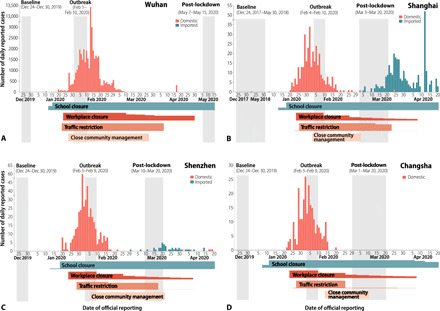
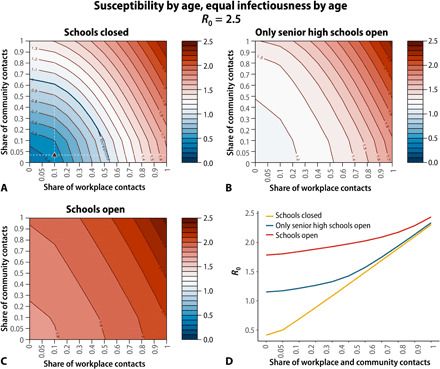
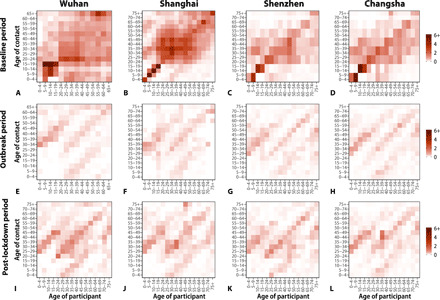
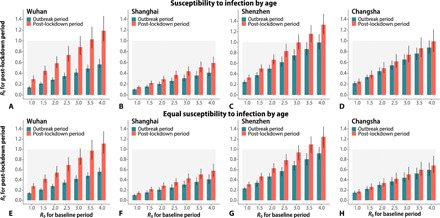
Nonpharmaceutical interventions to control SARS-CoV-2 spread have been implemented with different intensity, timing, and impact on transmission. As a result, post-lockdown COVID-19 dynamics are heterogeneous and difficult to interpret. We describe a set of contact surveys performed in four Chinese cities (Wuhan, Shanghai, Shenzhen, and Changsha) during the pre-pandemic, lockdown and post-lockdown periods to quantify changes in contact patterns. In the post-lockdown period, the mean number of contacts increased by 5 to 17% as compared to the lockdown period. However, it remains three to seven times lower than its pre-pandemic level sufficient to control SARS-CoV-2 transmission. We find that the impact of school interventions depends nonlinearly on the intensity of other activities. When most community activities are halted, school closure leads to a 77% decrease in the reproduction number; in contrast, when social mixing outside of schools is at pre-pandemic level, school closure leads to a 5% reduction in transmission.
为控制严重急性呼吸综合征冠状病毒2(SARS-CoV-2)传播而实施的非药物干预措施,在强度、时间和对传播的影响方面各不相同。因此,解封后新型冠状病毒肺炎(COVID-19)的动态情况各异,难以解读。我们描述了一组在疫情前、封锁期间和解封后,于中国四个城市(武汉、上海、深圳和长沙)开展的接触调查,以量化接触模式的变化。在解封后时期,与封锁期间相比,平均接触人数增加了5%至17%。然而,该数字仍比疫情前水平低三至七倍,足以控制SARS-CoV-2传播。我们发现,学校干预措施的影响非线性地取决于其他活动的强度。当大多数社区活动停止时,学校关闭会使再生数下降77%;相比之下,当校外社交活动恢复到疫情前水平时,学校关闭会使传播减少5%。