Antimicrobial Resistance Research Center, National Institute of Infectious Diseases, Tokyo, Japan.
Vietnam Research Station, Center for Infectious Disease Research in Asia and Africa, Institute of Tropical Medicine, Nagasaki University, Nagasaki, Japan.
mSphere. 2021 Aug 25;6(4):e0059221. doi: 10.1128/mSphere.00592-21. Epub 2021 Aug 4.
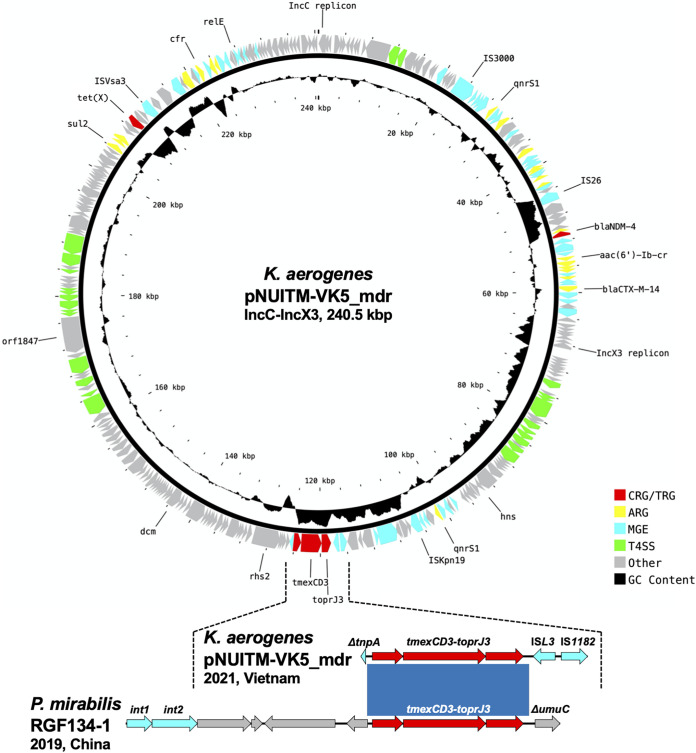
Tigecycline is a last-resort antimicrobial against carbapenemase-producing (CPE). However, mobile tigecycline resistance genes, (X) and , have emerged in China and have spread possibly worldwide. Tet(X) family proteins function as tigecycline-inactivating enzymes, and TMexCD-TOprJ complexes function as efflux pumps for tigecycline. Here, to the best of our knowledge we report a CPE isolate harboring both emerging tigecycline resistance factors for the first time. A carbapenem- and tigecycline-resistant Klebsiella aerogenes strain, NUITM-VK5, was isolated from an urban drainage in Vietnam in 2021, and a plasmid, pNUITM-VK5_mdr, cocarrying (X) and along with the carbapenemase gene was identified in NUITM-VK5. pNUITM-VK5_mdr was transferred to Escherichia coli by conjugation and simultaneously conferred high-level resistance against multiple antimicrobials, including carbapenems and tigecycline. An efflux pump inhibitor reduced TMexCD3-TOprJ3-mediated tigecycline resistance, suggesting that both tigecycline resistance factors independently and additively contribute to the high-level resistance. The plasmid had the IncX3 and IncC replicons and was estimated to be a hybrid of plasmids with different backbones. Unlike IncX3 plasmids, IncC plasmids are stably maintained in an extremely broad range of bacterial hosts in humans, animals, and the environment. Thus, the future global spread of multidrug resistance plasmids such as pNUITM-VK5_mdr poses a public health crisis. Tigecycline is important as a last-resort antimicrobial and effective against antimicrobial-resistant bacteria, such as carbapenem-producing (CPE), whose infections are difficult to treat with antimicrobials. Since 2019, mobile tigecycline resistance genes, (X) and , and their variants have been reported mainly from China, and it has become important to understand their epidemiological situation and detailed genetic mechanisms. In this study, we identified a bacterial isolate coharboring (X) and on the same plasmid. A Klebsiella aerogenes isolate in Vietnam carried both these tigecycline resistance genes on a transferable plasmid leading to high-level resistance to multiple clinically important antimicrobials, including carbapenem and tigecycline, and could actually transfer the plasmid to other bacteria. The spread of such a multidrug resistance plasmid among bacterial pathogens should be of great concern because there are few antimicrobials to combat bacteria that have acquired the plasmid.
替加环素是一种针对产碳青霉烯酶(CPE)的最后手段的抗菌药物。然而,在中国已经出现了移动的替加环素耐药基因(X)和 ,并且可能已经在全球范围内传播。 Tet(X)家族蛋白作为替加环素失活酶,TMexCD-TOprJ 复合物作为替加环素的外排泵。在这里,据我们所知,我们首次报告了一种同时携带这两种新出现的替加环素耐药因子的 CPE 分离株。2021 年,从越南城市排水系统中分离出一株耐碳青霉烯类和替加环素的肺炎克雷伯菌 NUITM-VK5,该菌携带可移动的 (X)和 以及碳青霉烯酶基因 。pNUITM-VK5_mdr 可通过接合转移至大肠杆菌,并同时对包括碳青霉烯类和替加环素在内的多种抗菌药物表现出高水平耐药性。一种外排泵抑制剂降低了 TMexCD3-TOprJ3 介导的替加环素耐药性,表明这两种替加环素耐药因子独立且累加地导致高水平耐药性。该质粒具有 IncX3 和 IncC 复制子,估计是具有不同骨架的质粒的混合物。与 IncX3 质粒不同,IncC 质粒在人类、动物和环境中极其广泛的细菌宿主中稳定维持。因此,多药耐药质粒如 pNUITM-VK5_mdr 的全球传播将构成公共卫生危机。替加环素作为一种最后手段的抗菌药物非常重要,可有效对抗抗菌药物耐药菌,如产碳青霉烯酶的(CPE),这些细菌感染用抗菌药物治疗很困难。自 2019 年以来,主要在中国发现了移动的替加环素耐药基因(X)和 及其变体,了解其流行病学情况和详细的遗传机制变得非常重要。在这项研究中,我们鉴定了一个同时携带(X)和 的细菌分离株。来自越南的肺炎克雷伯菌分离株在一个可转移的质粒上同时携带这两种替加环素耐药基因,导致对多种重要的临床抗菌药物(包括碳青霉烯类和替加环素)产生高水平耐药性,实际上可以将质粒转移到其他细菌中。由于对抗已经获得质粒的细菌的抗菌药物很少,因此应该非常关注这种多药耐药质粒在细菌病原体中的传播。