Henriques Rafael Neto, Correia Marta M, Marrale Maurizio, Huber Elizabeth, Kruper John, Koudoro Serge, Yeatman Jason D, Garyfallidis Eleftherios, Rokem Ariel
Champalimaud Research, Champalimaud Centre for the Unknown, Lisbon, Portugal.
Cognition and Brain Sciences Unit, University of Cambridge, Cambridge, United Kingdom.
Front Hum Neurosci. 2021 Jul 19;15:675433. doi: 10.3389/fnhum.2021.675433. eCollection 2021.
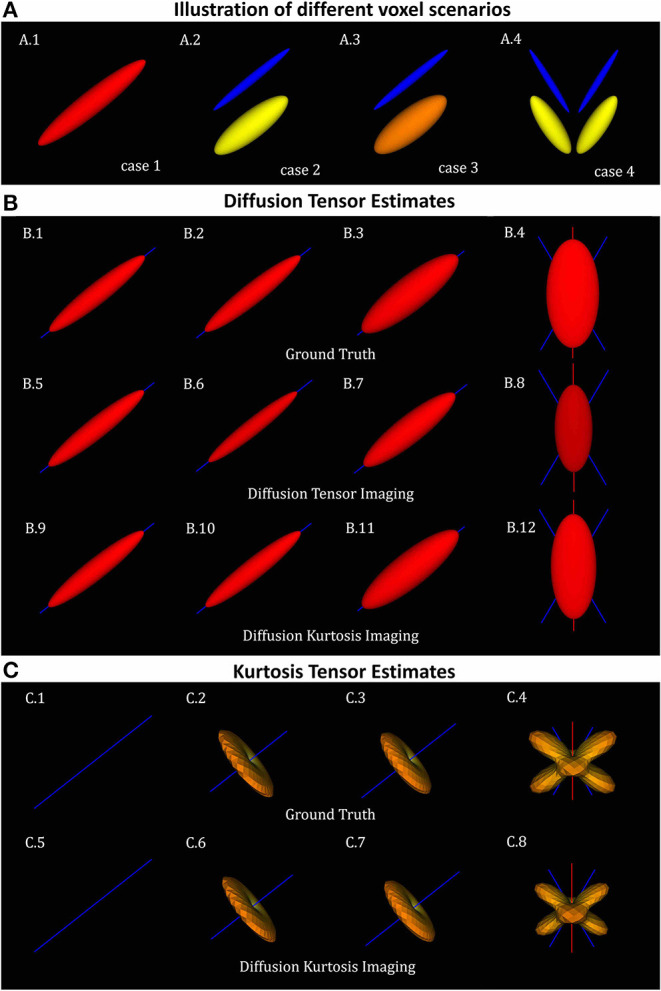
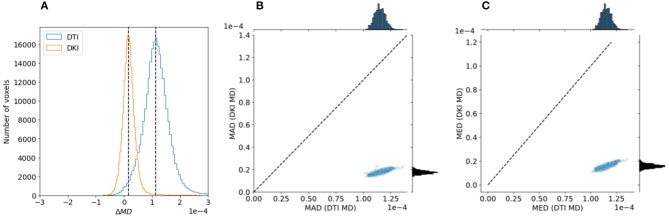
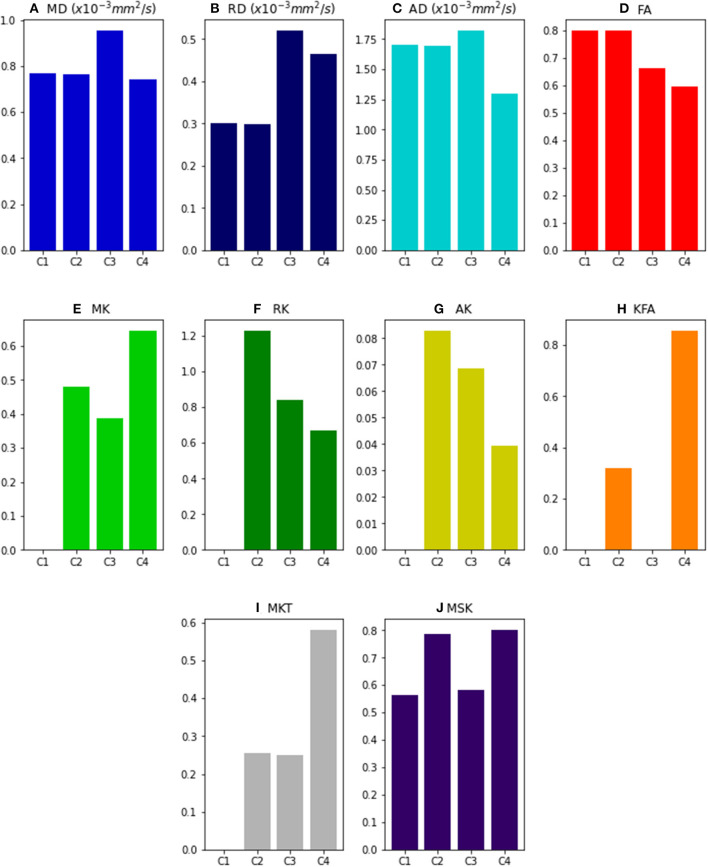
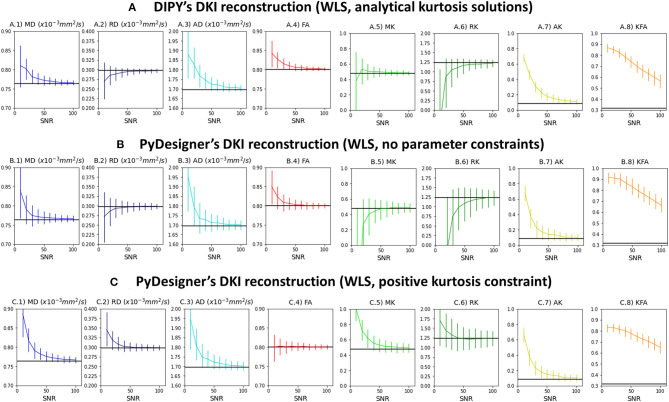
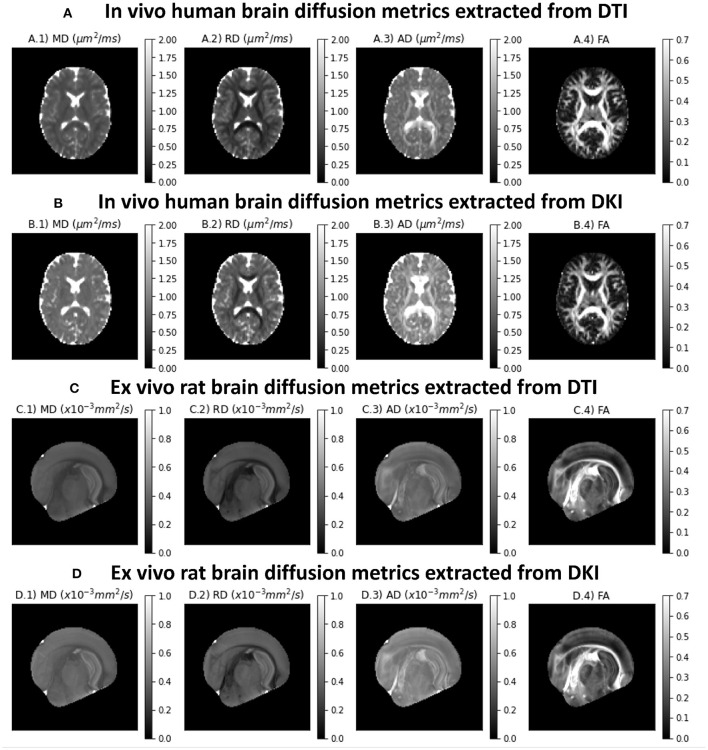
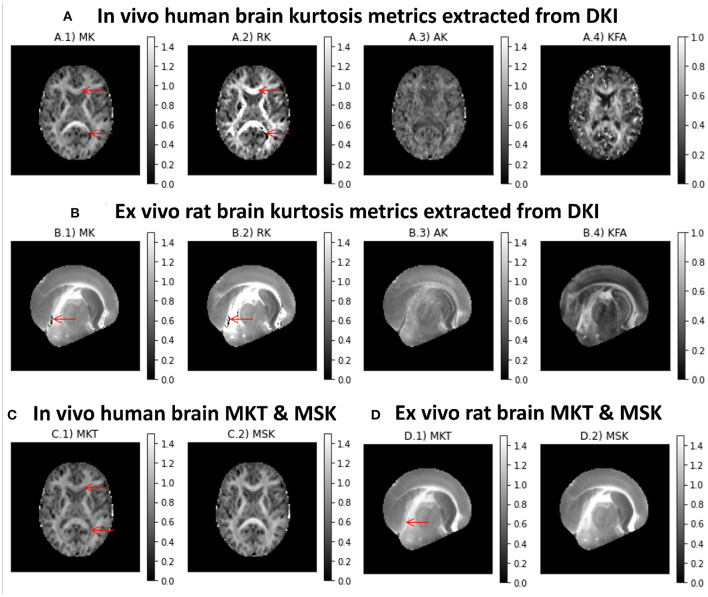
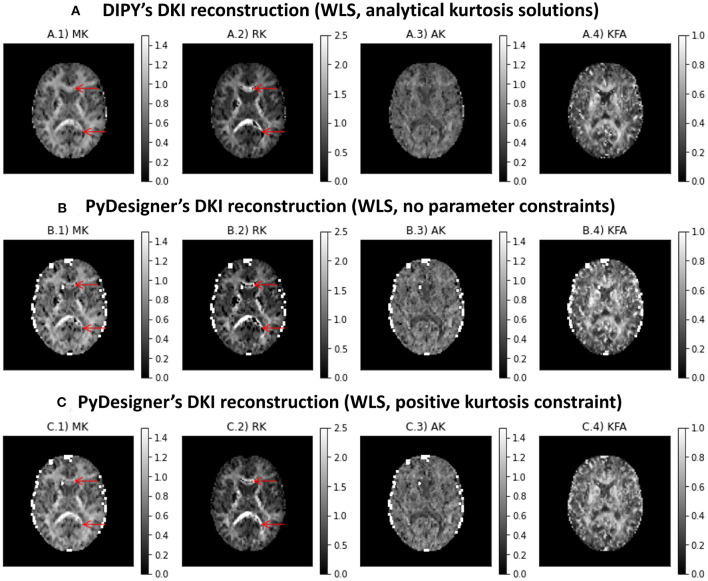
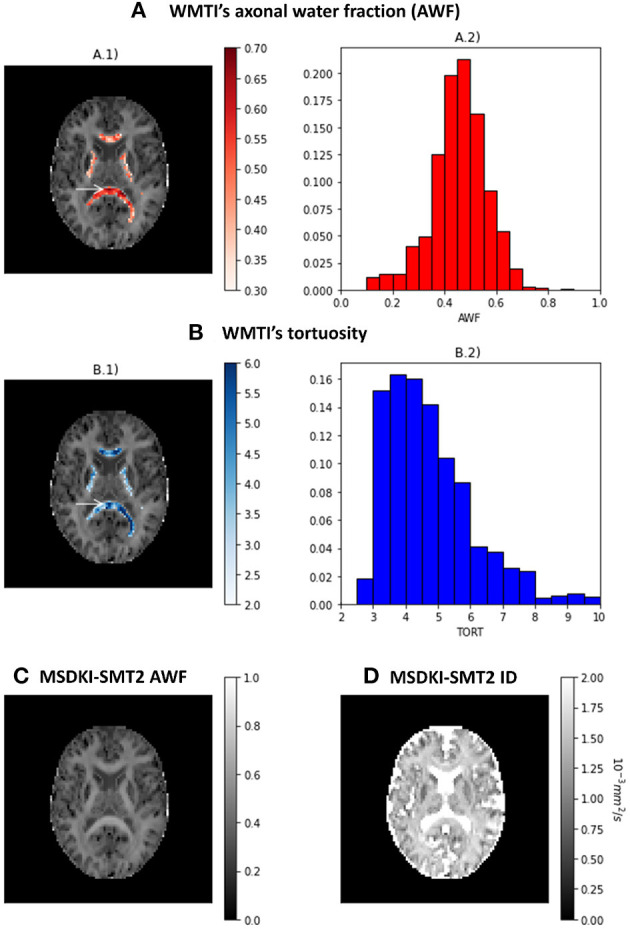
Diffusion-weighted magnetic resonance imaging (dMRI) measurements and models provide information about brain connectivity and are sensitive to the physical properties of tissue microstructure. Diffusional Kurtosis Imaging (DKI) quantifies the degree of non-Gaussian diffusion in biological tissue from dMRI. These estimates are of interest because they were shown to be more sensitive to microstructural alterations in health and diseases than measures based on the total anisotropy of diffusion which are highly confounded by tissue dispersion and fiber crossings. In this work, we implemented DKI in the Diffusion in Python (DIPY) project-a large collaborative open-source project which aims to provide well-tested, well-documented and comprehensive implementation of different dMRI techniques. We demonstrate the functionality of our methods in numerical simulations with known ground truth parameters and in openly available datasets. A particular strength of our DKI implementations is that it pursues several extensions of the model that connect it explicitly with microstructural models and the reconstruction of 3D white matter fiber bundles (tractography). For instance, our implementations include DKI-based microstructural models that allow the estimation of biophysical parameters, such as axonal water fraction. Moreover, we illustrate how DKI provides more general characterization of non-Gaussian diffusion compatible with complex white matter fiber architectures and gray matter, and we include a novel mean kurtosis index that is invariant to the confounding effects due to tissue dispersion. In summary, DKI in DIPY provides a well-tested, well-documented and comprehensive reference implementation for DKI. It provides a platform for wider use of DKI in research on brain disorders and in cognitive neuroscience.
扩散加权磁共振成像(dMRI)测量和模型可提供有关脑连接性的信息,并且对组织微观结构的物理特性敏感。扩散峰度成像(DKI)可根据dMRI量化生物组织中非高斯扩散的程度。这些估计值很受关注,因为已证明它们对健康和疾病中的微观结构改变比基于扩散全各向异性的测量更敏感,而后者会因组织离散和纤维交叉而受到高度混淆。在这项工作中,我们在Python中的扩散(DIPY)项目中实现了DKI,这是一个大型协作开源项目,旨在对不同的dMRI技术提供经过充分测试、文档完善且全面的实现。我们在具有已知真实参数的数值模拟和公开可用的数据集中展示了我们方法的功能。我们DKI实现的一个特别优势在于它对模型进行了多种扩展,将其与微观结构模型以及三维白质纤维束重建(纤维束成像)明确联系起来。例如,我们的实现包括基于DKI的微观结构模型,可用于估计生物物理参数,如轴突水含量。此外,我们说明了DKI如何提供与复杂白质纤维结构和灰质兼容的非高斯扩散的更一般特征,并且我们引入了一种新的平均峰度指数,该指数不受组织离散造成的混淆效应影响。总之,DIPY中的DKI为DKI提供了一个经过充分测试、文档完善且全面的参考实现。它为DKI在脑部疾病研究和认知神经科学中的更广泛应用提供了一个平台。