Department of Cardiovascular & Metabolic Sciences, Lerner Research Institute, 9500 Euclid Ave, Cleveland, OH 44195, USA.
Department of Cardiology, Charité Centrum 11, Charité-Universitätsmedizin, Hindenburgdamm 30, 12203, Berlin, Germany.
Cardiovasc Res. 2022 Jul 27;118(10):2367-2384. doi: 10.1093/cvr/cvab263.
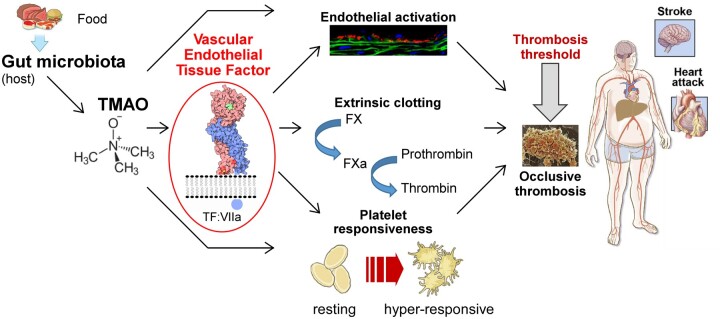
Gut microbiota and their generated metabolites impact the host vascular phenotype. The metaorganismal metabolite trimethylamine N-oxide (TMAO) is both associated with adverse clinical thromboembolic events, and enhances platelet responsiveness in subjects. The impact of TMAO on vascular Tissue Factor (TF) in vivo is unknown. Here, we explore whether TMAO-enhanced thrombosis potential extends beyond TMAO effects on platelets, and is linked to TF. We also further explore the links between gut microbiota and vascular endothelial TF expression in vivo.
In initial exploratory clinical studies, we observed that among sequential stable subjects (n = 2989) on anti-platelet therapy undergoing elective diagnostic cardiovascular evaluation at a single-site referral centre, TMAO levels were associated with an increased incident (3 years) risk for major adverse cardiovascular events (MACE) (myocardial infarction, stroke, or death) [4th quartile (Q4) vs. Q1 adjusted hazard ratio (HR) 95% confidence interval (95% CI), 1.73 (1.25-2.38)]. Similar results were observed within subjects on aspirin mono-therapy during follow-up [adjusted HR (95% CI) 1.75 (1.25-2.44), n = 2793]. Leveraging access to a second higher risk cohort with previously reported TMAO data and monitoring of anti-platelet medication use, we also observed a strong association between TMAO and incident (1 year) MACE risk in the multi-site Swiss Acute Coronary Syndromes Cohort, focusing on the subset (n = 1469) on chronic dual anti-platelet therapy during follow-up [adjusted HR (95% CI) 1.70 (1.08-2.69)]. These collective clinical data suggest that the thrombosis-associated effects of TMAO may be mediated by cells/factors that are not inhibited by anti-platelet therapy. To test this, we first observed in human microvascular endothelial cells that TMAO dose-dependently induced expression of TF and vascular cell adhesion molecule (VCAM)1. In mouse studies, we observed that TMAO-enhanced aortic TF and VCAM1 mRNA and protein expression, which upon immunolocalization studies, was shown to co-localize with vascular endothelial cells. Finally, in arterial injury mouse models, TMAO-dependent enhancement of in vivo TF expression and thrombogenicity were abrogated by either a TF-inhibitory antibody or a mechanism-based microbial choline TMA-lyase inhibitor (fluoromethylcholine).
Endothelial TF contributes to TMAO-related arterial thrombosis potential, and can be specifically blocked by targeted non-lethal inhibition of gut microbial choline TMA-lyase.
肠道微生物及其产生的代谢物影响宿主的血管表型。代谢物三甲胺 N-氧化物(TMAO)与不良的临床血栓栓塞事件相关,并且增强了血小板对受试者的反应性。TMAO 对血管组织因子(TF)的影响尚不清楚。在这里,我们探讨 TMAO 增强的血栓形成潜力是否超出了 TMAO 对血小板的影响,并与 TF 有关。我们还进一步探讨了肠道微生物与体内血管内皮 TF 表达之间的联系。
在最初的探索性临床研究中,我们观察到,在单个转诊中心接受选择性诊断心血管评估的连续稳定受试者(n=2989)中,TMAO 水平与主要不良心血管事件(MACE)(心肌梗死、中风或死亡)的(3 年)风险增加有关(第 4 四分位数(Q4)与 Q1 调整后的风险比(HR)95%置信区间(95%CI),1.73(1.25-2.38))。在随访期间服用阿司匹林单药治疗的受试者中也观察到了类似的结果[调整后的 HR(95%CI),1.75(1.25-2.44),n=2793]。利用获得的第二组具有先前报道的 TMAO 数据的高风险队列和监测抗血小板药物的使用情况,我们还观察到在瑞士急性冠状动脉综合征队列中的多站点研究中,TMAO 与(1 年)MACE 风险之间存在强烈关联,该队列主要关注(n=1469)在随访期间接受慢性双联抗血小板治疗的亚组[调整后的 HR(95%CI),1.70(1.08-2.69))。这些综合临床数据表明,TMAO 与血栓形成相关的影响可能是由不受抗血小板治疗抑制的细胞/因素介导的。为了验证这一点,我们首先在人微血管内皮细胞中观察到 TMAO 剂量依赖性诱导 TF 和血管细胞黏附分子(VCAM)1 的表达。在小鼠研究中,我们观察到 TMAO 增强了主动脉 TF 和 VCAM1 的 mRNA 和蛋白表达,免疫定位研究表明,其与血管内皮细胞共定位。最后,在动脉损伤小鼠模型中,TF 抑制性抗体或基于机制的微生物胆碱 TMA 裂解酶抑制剂(氟甲胆碱)特异性阻断了 TMAO 依赖性增强的体内 TF 表达和血栓形成。
内皮 TF 有助于 TMAO 相关的动脉血栓形成潜力,并可通过靶向非致死性抑制肠道微生物胆碱 TMA 裂解酶来特异性阻断。