From the Department of Cardiology (A.H., D.S., F.Z., N.K., U.L.).
DZHK (German Center for Cardiovascular Research), Partner Site Berlin, Germany (A.H., N.K., M.E., U.L.).
Arterioscler Thromb Vasc Biol. 2018 Sep;38(9):2225-2235. doi: 10.1161/ATVBAHA.118.311023.
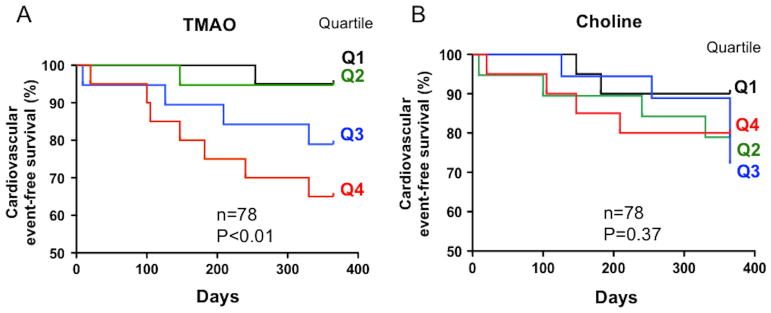
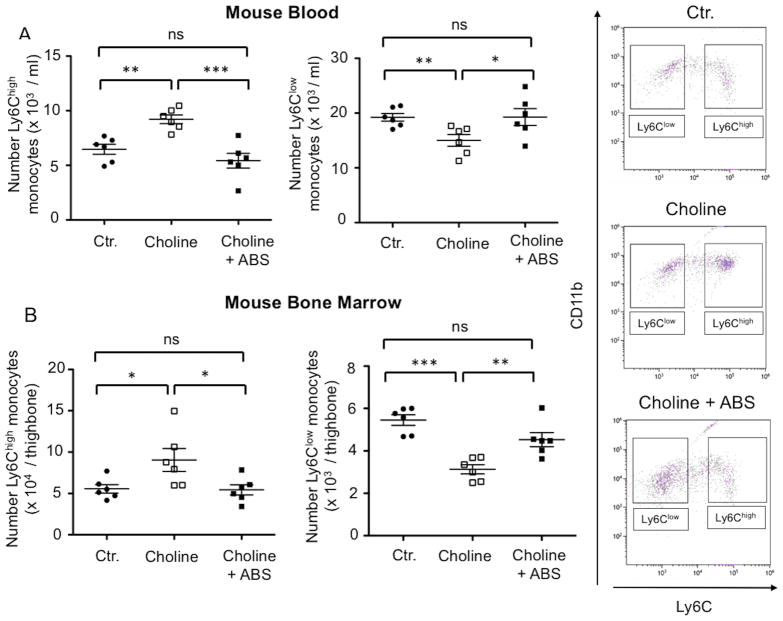
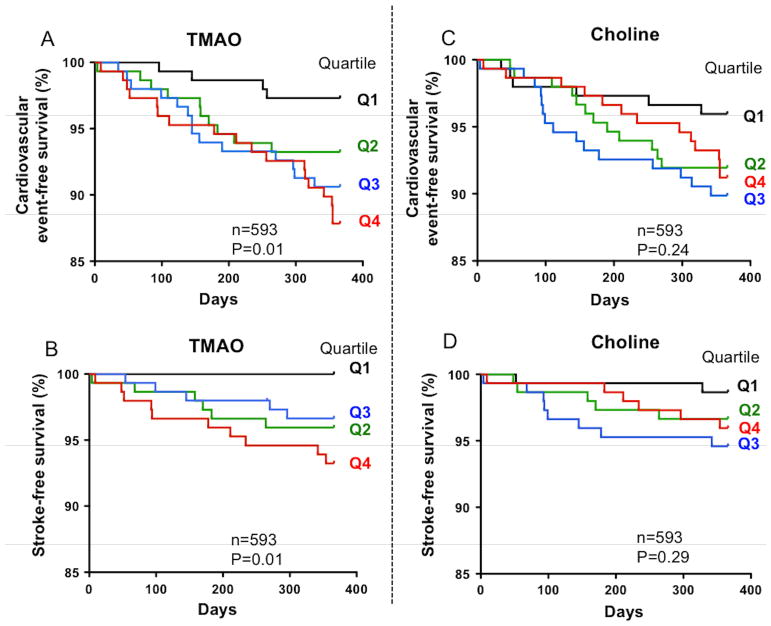
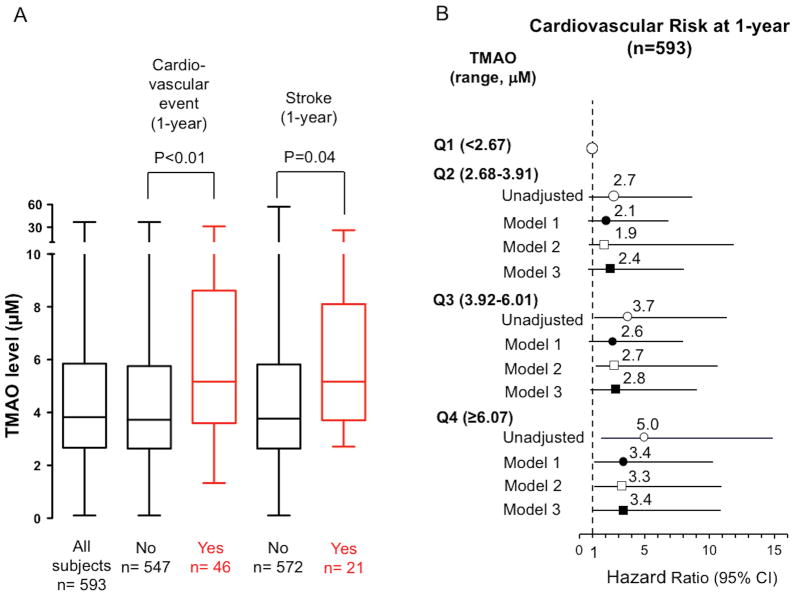
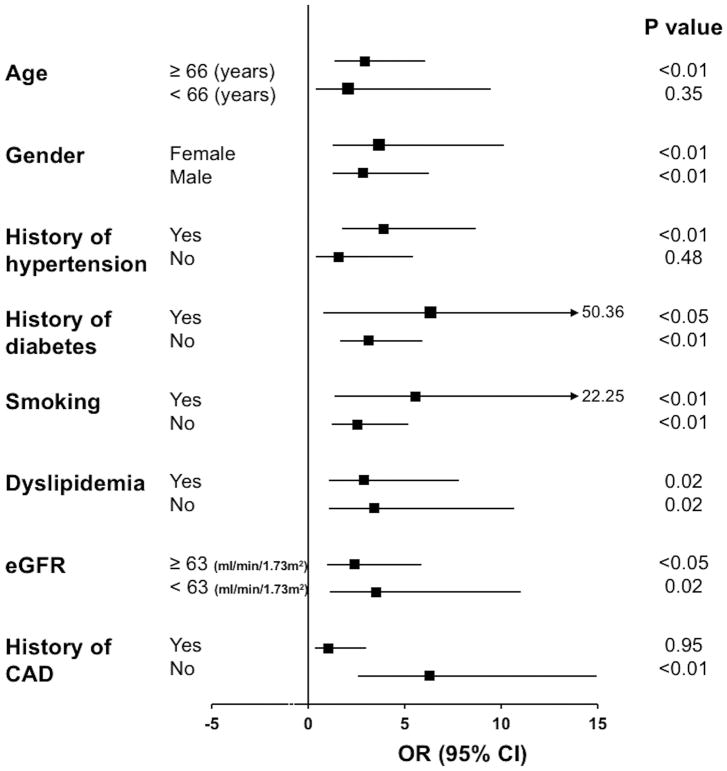
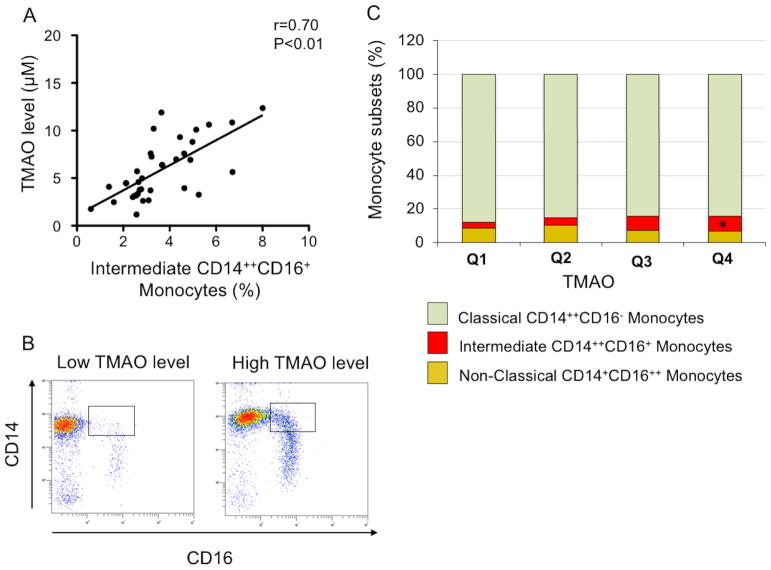
Objective- Gut microbiota-dependent metabolites, in particular trimethylamine N-oxide (TMAO), have recently been reported to promote atherosclerosis and thrombosis. Here, we examined for the first time the relation of TMAO and the risk of incident cardiovascular events in patients with recent first-ever ischemic stroke in 2 independent prospective cohorts. Moreover, the link between TMAO and proinflammatory monocytes as a potential contributing factor for cardiovascular risk in stroke patients was studied. Approach and Results- In a first study (n=78), higher TMAO plasma levels were linked with an increased risk of incident cardiovascular events including myocardial infarction, recurrent stroke, and cardiovascular death (fourth quartile versus first quartile; hazard ratio, 2.31; 95% CI, 1.25-4.23; P<0.01). In the second independent validation cohort (n=593), high TMAO levels again heralded marked increased risk of adverse cardiovascular events (fourth quartile versus first quartile; hazard ratio, 5.0; 95% CI, 1.7-14.8; P<0.01), and also after adjustments for cardiovascular risk factors including hypertension, diabetes mellitus, LDL (low-density lipoprotein) cholesterol, and estimated glomerular filtration rate (hazard ratio, 3.3; 95% CI, 1.2-10.9; P=0.04). A significant correlation was also found between TMAO levels and percentage of proinflammatory intermediate CD14CD16 monocytes ( r=0.70; P<0.01). Moreover, in mice fed a diet enriched with choline to increase TMAO synthesis, levels of proinflammatory murine Ly6C monocytes were higher than in the chow-fed control group (choline: 9.2±0.5×10 per mL versus control: 6.5±0.5×10 per mL; P<0.01). This increase was abolished in mice with depleted gut microbiota (choline+antibiotics: 5.4±0.7×10 per mL; P<0.001 versus choline). Conclusions- The present study demonstrates for the first time a graded relation between TMAO levels and the risk of subsequent cardiovascular events in patients with recent prior ischemic stroke. Our data support the notion that TMAO-related increase of proinflammatory monocytes may add to elevated cardiovascular risk of patients with increased TMAO levels.
目的-肠道微生物依赖的代谢物,特别是三甲胺 N-氧化物(TMAO),最近被报道可促进动脉粥样硬化和血栓形成。在这里,我们在 2 个独立的前瞻性队列中首次研究了 TMAO 与近期首次缺血性中风患者新发心血管事件风险之间的关系。此外,还研究了 TMAO 与促炎单核细胞之间的联系,作为中风患者心血管风险的潜在促成因素。
方法和结果-在第一项研究(n=78)中,较高的 TMAO 血浆水平与包括心肌梗死、复发性中风和心血管死亡在内的新发心血管事件风险增加相关(第四四分位与第一四分位;风险比,2.31;95%置信区间,1.25-4.23;P<0.01)。在第二个独立验证队列(n=593)中,高 TMAO 水平再次预示着不良心血管事件风险显著增加(第四四分位与第一四分位;风险比,5.0;95%置信区间,1.7-14.8;P<0.01),并且在调整了包括高血压、糖尿病、LDL(低密度脂蛋白)胆固醇和估计肾小球滤过率在内的心血管风险因素后也是如此(风险比,3.3;95%置信区间,1.2-10.9;P=0.04)。还发现 TMAO 水平与促炎中间 CD14CD16 单核细胞的百分比之间存在显著相关性(r=0.70;P<0.01)。此外,在给予富含胆碱以增加 TMAO 合成的饮食的小鼠中,促炎鼠 Ly6C 单核细胞的水平高于给予普通饮食的对照组(胆碱:9.2±0.5×10 个/mL 与对照组:6.5±0.5×10 个/mL;P<0.01)。在缺乏肠道微生物的小鼠中,这种增加被消除(胆碱+抗生素:5.4±0.7×10 个/mL;P<0.001 与胆碱)。
结论-本研究首次证明,TMAO 水平与近期缺血性中风后新发心血管事件风险之间存在分级关系。我们的数据支持这样一种观点,即与 TMAO 相关的促炎单核细胞增加可能会增加 TMAO 水平升高患者的心血管风险。