College of Health Solutions, Arizona State University, Phoenix, AZ, USA.
Department of Family, Consumer, and Nutritional Science, St. Catherine University, Minneapolis, MN, USA.
Adv Nutr. 2021 Dec 1;12(6):2076-2084. doi: 10.1093/advances/nmab093.
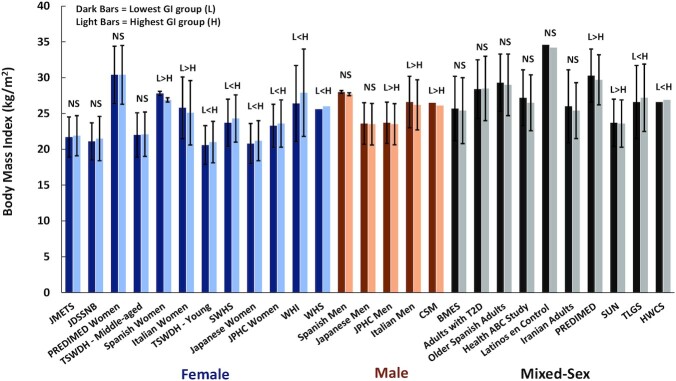
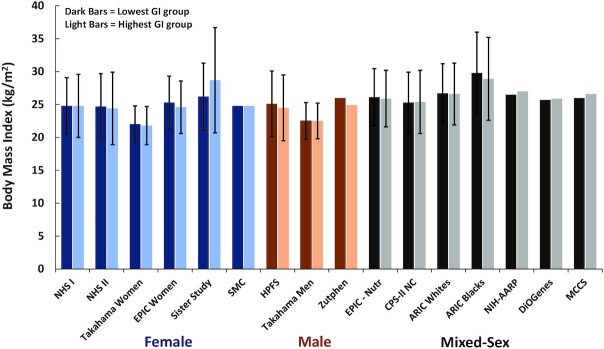
High-glycemic index (high-GI) foods (so-called fast carbs) have been hypothesized to promote fat storage and increase risk of obesity. To clarify whether dietary GI impacts body weight, we searched PubMed and the Cochrane Database of Systematic Reviews for observational studies reporting associations between BMI and dietary GI, and for meta-analyses of randomized controlled trials (RCTs) comparing low-GI and high-GI diets for weight loss. Data on 43 cohorts from 34 publications, totaling 1,940,968 adults, revealed no consistent differences in BMI when comparing the highest with the lowest dietary GI groups. In the 27 cohort studies that reported results of statistical comparisons, 70% showed that BMI was either not different between the highest and lowest dietary GI groups (12 of 27 cohorts) or that BMI was lower in the highest dietary GI group (7 of 27 cohorts). Results of 30 meta-analyses of RCTs from 8 publications demonstrated that low-GI diets were generally no better than high-GI diets for reducing body weight or body fat. One notable exception is that low-GI diets with a dietary GI at least 20 units lower than the comparison diet resulted in greater weight loss in adults with normal glucose tolerance but not in adults with impaired glucose tolerance. While carbohydrate quality, including GI, impacts many health outcomes, GI as a measure of carbohydrate quality appears to be relatively unimportant as a determinant of BMI or diet-induced weight loss. Based on results from observational cohort studies and meta-analyses of RCTs, we conclude that there is scant scientific evidence that low-GI diets are superior to high-GI diets for weight loss and obesity prevention.
高血糖指数(高 GI)食物(所谓的快速碳水化合物)被认为会促进脂肪储存并增加肥胖的风险。为了阐明饮食 GI 是否会影响体重,我们在 PubMed 和 Cochrane 系统评价数据库中搜索了报告 BMI 与饮食 GI 之间关联的观察性研究,以及比较低 GI 和高 GI 饮食对减肥效果的随机对照试验(RCT)的荟萃分析。来自 34 篇文献的 43 个队列研究的数据,共计 1940968 名成年人,在比较最高和最低饮食 GI 组时,BMI 没有一致的差异。在报告统计学比较结果的 27 项队列研究中,70%的研究表明,最高和最低饮食 GI 组之间的 BMI 没有差异(27 项队列中的 12 项),或者最高饮食 GI 组的 BMI 较低(27 项队列中的 7 项)。来自 8 篇文献的 30 项 RCT 荟萃分析的结果表明,低 GI 饮食通常不比高 GI 饮食更能减轻体重或体脂肪。一个值得注意的例外是,对于血糖正常的成年人,与对照饮食相比 GI 至少低 20 个单位的低 GI 饮食可导致更大的体重减轻,但对于血糖耐量受损的成年人则不然。虽然碳水化合物的质量,包括 GI,会影响许多健康结果,但作为碳水化合物质量的衡量标准,GI 似乎相对不重要,它不是 BMI 或饮食诱导的体重减轻的决定因素。基于观察性队列研究和 RCT 荟萃分析的结果,我们得出结论,几乎没有科学证据表明低 GI 饮食在减肥和预防肥胖方面优于高 GI 饮食。