CIIMAR/CIMAR, Interdisciplinary Centre of Marine and Environmental Research, Matosinhos, Portugal.
FCUP, Department of Biology, Faculty of Sciences, University of Porto, Porto, Portugal.
J Enzyme Inhib Med Chem. 2021 Dec;36(1):1829-1838. doi: 10.1080/14756366.2021.1960830.
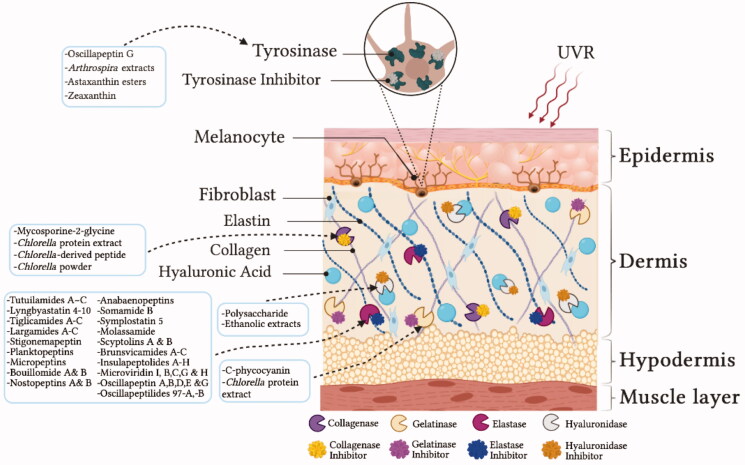
As the largest organ in human body, skin acts as a physicochemical barrier, offering protection against harmful environmental stressors, such as chemicals, pathogens, temperature and radiation. Nonetheless, skins prominence goes further, with a significant psychosocial role in an increasingly ageing population. Prompted by consumers' concern regarding skincare, cosmetic industry has been developing new formulas capable of lessening the most visible signs of ageing, including reduction in skin density and elasticity, wrinkling and hyperpigmentation. Allied to skincare is the rising importance set on natural products, sustainably obtained from less environmental impacting methods. Cyanobacteria and microalgae are adding importance in this field, given their ability to biosynthesize secondary metabolites with anti-ageing potential. In this review, we present an overview on the potential of cyanobacteria and microalgae compounds to overcome skin-ageing, essentially by exploring their effects on the metalloproteinases collagenase, elastase, gelatinase and hyaluronidase, and in other enzymes involved in the pigmentation process.
作为人体最大的器官,皮肤起着物理化学屏障的作用,保护人体免受化学物质、病原体、温度和辐射等有害环境因素的侵害。然而,皮肤的重要性不仅于此,在人口老龄化日益加剧的情况下,它还具有重要的社会心理作用。由于消费者对护肤的关注,化妆品行业一直在开发新的配方,以减轻衰老的最明显迹象,包括减少皮肤密度和弹性、皱纹和色素沉着。与护肤相关的是,人们越来越重视从环境影响较小的方法中获得的天然产品。由于蓝细菌和微藻具有生物合成具有抗衰老潜力的次生代谢物的能力,因此它们在这一领域的重要性日益增加。在这篇综述中,我们概述了蓝细菌和微藻化合物克服皮肤衰老的潜力,主要是通过探索它们对金属蛋白酶胶原酶、弹性蛋白酶、明胶酶和透明质酸酶以及参与色素沉着过程的其他酶的影响。