• 文献检索
  • 文档翻译
  • 深度研究
  • 学术资讯
  • Suppr Zotero 插件Zotero 插件
  • 邀请有礼
  • 套餐&价格
  • 历史记录
应用&插件
Suppr Zotero 插件Zotero 插件浏览器插件Mac 客户端Windows 客户端微信小程序
定价
高级版会员购买积分包购买API积分包
服务
文献检索文档翻译深度研究API 文档MCP 服务
关于我们
关于 Suppr公司介绍联系我们用户协议隐私条款
关注我们

Suppr 超能文献

核心技术专利:CN118964589B侵权必究
粤ICP备2023148730 号-1Suppr @ 2026

文献检索

告别复杂PubMed语法,用中文像聊天一样搜索,搜遍4000万医学文献。AI智能推荐,让科研检索更轻松。

立即免费搜索

文件翻译

保留排版,准确专业,支持PDF/Word/PPT等文件格式,支持 12+语言互译。

免费翻译文档

深度研究

AI帮你快速写综述,25分钟生成高质量综述,智能提取关键信息,辅助科研写作。

立即免费体验

非危重症住院COVID-19患者预后相关的营养参数:NUTRI-COVID19研究

Nutritional parameters associated with prognosis in non-critically ill hospitalized COVID-19 patients: The NUTRI-COVID19 study.

作者信息

Caccialanza Riccardo, Formisano Elena, Klersy Catherine, Ferretti Virginia, Ferrari Alessandra, Demontis Stefania, Mascheroni Annalisa, Masi Sara, Crotti Silvia, Lobascio Federica, Cerutti Nadia, Orlandoni Paolo, Dalla Costa Cloè, Redaelli Elena, Fabbri Alessandra, Malesci Alberto, Corrao Salvatore, Bordandini Lorella, Cereda Emanuele

机构信息

Clinical Nutrition and Dietetics Unit, Fondazione IRCCS Policlinico San Matteo, Pavia, Italy.

Clinical Nutrition and Dietetics Unit, Fondazione IRCCS Policlinico San Matteo, Pavia, Italy.

出版信息

Clin Nutr. 2022 Dec;41(12):2980-2987. doi: 10.1016/j.clnu.2021.06.020. Epub 2021 Jun 25.

DOI:10.1016/j.clnu.2021.06.020
PMID:34353669
原文链接:https://pmc.ncbi.nlm.nih.gov/articles/PMC8233046/
Abstract

BACKGROUND & AIMS: To investigate the association between the parameters used in nutritional screening assessment (body mass index [BMI], unintentional weight loss [WL] and reduced food intake) and clinical outcomes in non-critically ill, hospitalized coronavirus disease 2019 (COVID-19) patients.

METHODS

This was a prospective multicenter real-life study carried out during the first pandemic wave in 11 Italian Hospitals. In total, 1391 patients were included. The primary end-point was a composite of in-hospital mortality or admission to ICU, whichever came first. The key secondary end-point was in-hospital mortality.

RESULTS

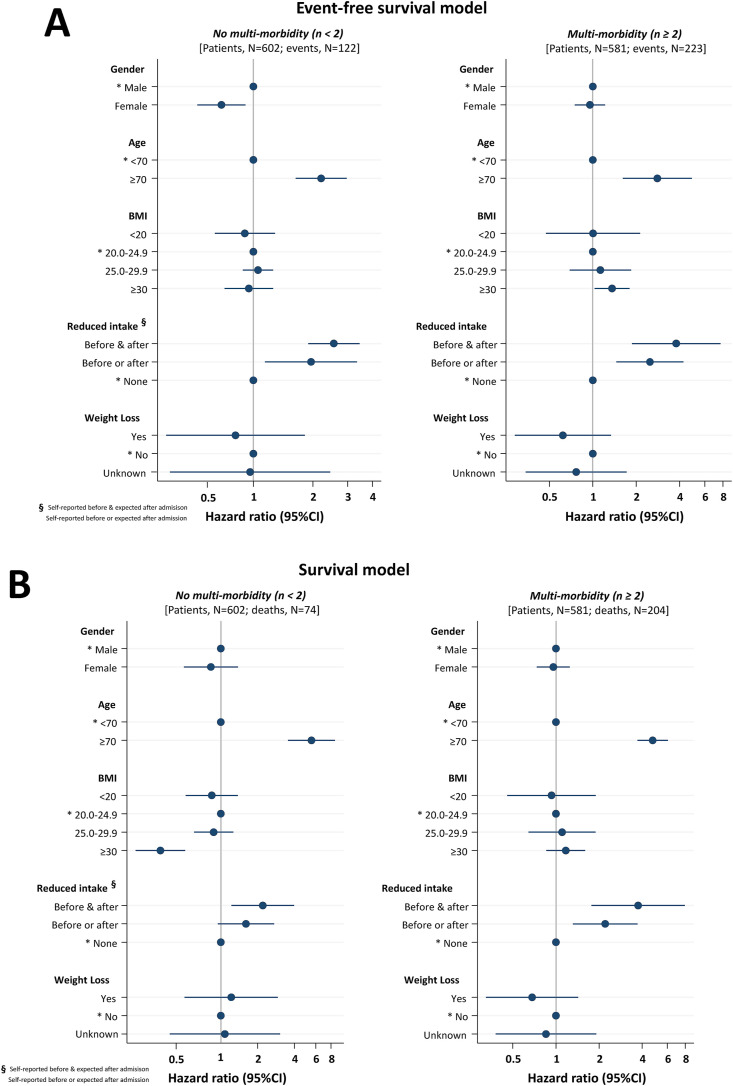
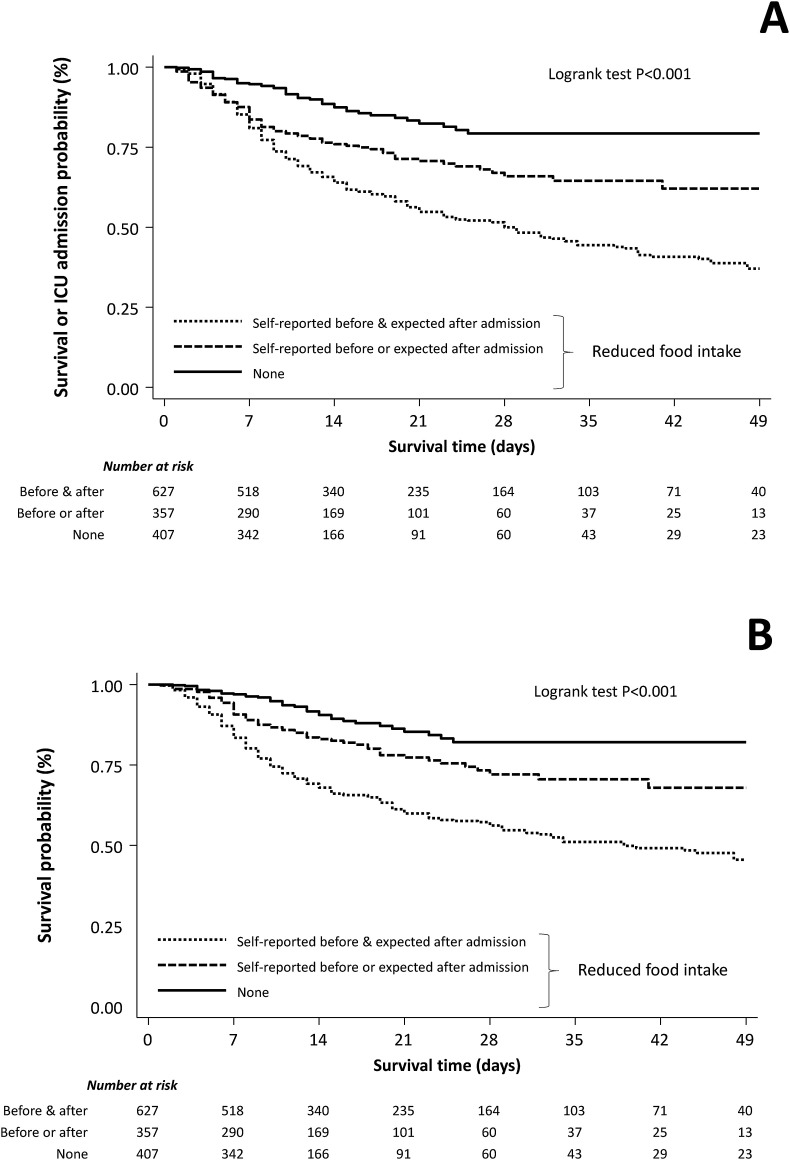
Multivariable models were based on 1183 patients with complete data. Reduced self-reported food intake before hospitalization and/or expected by physicians in the next days since admission was found to have a negative prognostic impact for both the primary and secondary end-point (P < .001 for both). No association with BMI and WL was observed. Other predictors of outcomes were age and presence of multiple comorbidities. A significant interaction between obesity and multi-morbidity (≥2) was detected. Obesity was found to be a risk factor for composite end-point (HR = 1.36 [95%CI, 1.03-1.80]; P = .031) and a protective factor against in-hospital mortality (HR = 0.32 [95%CI, 0.20-0.51]; P < .001) in patients with and without multiple comorbidities, respectively. Secondary analysis (patients, N = 829), further adjusted for high C-reactive protein (>21 mg/dL) and LDH (>430 mU/mL) levels yielded consistent findings.

CONCLUSIONS

Reduced self-reported food intake before hospitalization and/or expected by physicians in the next days since admission was associated with negative clinical outcomes in non-critically ill, hospitalized COVID-19 patients. This simple and easily obtainable parameter may be useful to identify patients at highest risk of poor prognosis, who may benefit from prompt nutritional support. The presence of comorbidities could be the key factor, which may determine the protective or harmful role of a high body mass index in COVID-19.

摘要

背景与目的

研究营养筛查评估中使用的参数(体重指数[BMI]、非故意体重减轻[WL]和食物摄入量减少)与非危重症住院的2019冠状病毒病(COVID-19)患者临床结局之间的关联。

方法

这是一项在意大利11家医院第一波疫情期间开展的前瞻性多中心真实世界研究。共纳入1391例患者。主要终点是院内死亡或入住重症监护病房(ICU),以先发生者为准。关键次要终点是院内死亡。

结果

多变量模型基于1183例有完整数据的患者。研究发现,入院前自我报告的食物摄入量减少和/或医生预计入院后几天内食物摄入量减少对主要和次要终点均有负面预后影响(两者P均<0.001)。未观察到与BMI和WL有关联。其他结局预测因素为年龄和多种合并症的存在。检测到肥胖与多种合并症(≥2种)之间存在显著交互作用。在有和没有多种合并症的患者中,肥胖分别被发现是复合终点的危险因素(HR = 1.36 [95%CI,1.03 - 1.80];P = 0.031)和院内死亡的保护因素(HR = 0.32 [95%CI,0.20 - 0.51];P < 0.001)。二次分析(患者,N = 829)进一步调整高C反应蛋白(>21 mg/dL)和乳酸脱氢酶(>430 mU/mL)水平后得出一致结果。

结论

入院前自我报告的食物摄入量减少和/或医生预计入院后几天内食物摄入量减少与非危重症住院COVID-19患者的不良临床结局相关。这个简单且易于获取的参数可能有助于识别预后不良风险最高的患者,这些患者可能从及时的营养支持中获益。合并症的存在可能是关键因素,它可能决定高体重指数在COVID-19中的保护或有害作用。
https://cdn.ncbi.nlm.nih.gov/pmc/blobs/ec1e/8233046/dbcdf40d04d0/gr2_lrg.jpg
https://cdn.ncbi.nlm.nih.gov/pmc/blobs/ec1e/8233046/6adeae03e89d/gr1_lrg.jpg
https://cdn.ncbi.nlm.nih.gov/pmc/blobs/ec1e/8233046/dbcdf40d04d0/gr2_lrg.jpg
https://cdn.ncbi.nlm.nih.gov/pmc/blobs/ec1e/8233046/6adeae03e89d/gr1_lrg.jpg
https://cdn.ncbi.nlm.nih.gov/pmc/blobs/ec1e/8233046/dbcdf40d04d0/gr2_lrg.jpg

相似文献

1
Nutritional parameters associated with prognosis in non-critically ill hospitalized COVID-19 patients: The NUTRI-COVID19 study.非危重症住院COVID-19患者预后相关的营养参数:NUTRI-COVID19研究
Clin Nutr. 2022 Dec;41(12):2980-2987. doi: 10.1016/j.clnu.2021.06.020. Epub 2021 Jun 25.
2
The modified NUTRIC score can be used for nutritional risk assessment as well as prognosis prediction in critically ill COVID-19 patients.改良的 NUTRIC 评分可用于危重症 COVID-19 患者的营养风险评估和预后预测。
Clin Nutr. 2021 Feb;40(2):534-541. doi: 10.1016/j.clnu.2020.05.051. Epub 2020 Jun 5.
3
Malnutrition, poor food intake, and adverse healthcare outcomes in non-critically ill obese acute care hospital patients.非危重症肥胖急性住院患者营养不良、食物摄入不良和不良医疗结局。
Clin Nutr. 2019 Apr;38(2):759-766. doi: 10.1016/j.clnu.2018.02.033. Epub 2018 Mar 10.
4
Feeding the critically ill obese patient: a systematic review protocol.为危重症肥胖患者提供营养支持:一项系统评价方案
JBI Database System Rev Implement Rep. 2015 Oct;13(10):95-109. doi: 10.11124/jbisrir-2015-2458.
5
Association of Different Malnutrition Parameters and Clinical Outcomes among COVID-19 Patients: An Observational Study.不同营养不良参数与 COVID-19 患者临床结局的相关性:一项观察性研究。
Nutrients. 2022 Aug 22;14(16):3449. doi: 10.3390/nu14163449.
6
Associations of obesity and malnutrition with cardiac remodeling and cardiovascular outcomes in Asian adults: A cohort study.肥胖和营养不良与亚洲成年人心脏重构和心血管结局的关系:一项队列研究。
PLoS Med. 2021 Jun 1;18(6):e1003661. doi: 10.1371/journal.pmed.1003661. eCollection 2021 Jun.
7
Body mass index and Mini Nutritional Assessment-Short Form as predictors of in-geriatric hospital mortality in older adults with COVID-19.体重指数和简易营养评估量表简表作为新型冠状病毒肺炎老年患者老年医院死亡率的预测指标
Clin Nutr. 2022 Dec;41(12):2973-2979. doi: 10.1016/j.clnu.2021.07.025. Epub 2021 Jul 29.
8
COVID-19 is associated with oropharyngeal dysphagia and malnutrition in hospitalized patients during the spring 2020 wave of the pandemic.COVID-19 与 2020 年春季大流行期间住院患者的口咽吞咽困难和营养不良有关。
Clin Nutr. 2022 Dec;41(12):2996-3006. doi: 10.1016/j.clnu.2021.06.010. Epub 2021 Jun 15.
9
Impact of COVID-19 on nutritional status during the first wave of the pandemic.COVID-19 对大流行第一波期间营养状况的影响。
Clin Nutr. 2022 Dec;41(12):3032-3037. doi: 10.1016/j.clnu.2021.05.001. Epub 2021 May 8.
10
Identifying reliable predictors of protein-energy malnutrition in hospitalized frail older adults: A prospective longitudinal study.确定住院虚弱老年人蛋白质-能量营养不良的可靠预测因素:一项前瞻性纵向研究。
Int J Nurs Stud. 2018 Jun;82:40-48. doi: 10.1016/j.ijnurstu.2018.03.007. Epub 2018 Mar 7.

引用本文的文献

1
People with long-term conditions are more adherent to protective behaviours against infectious disease.患有长期疾病的人更能坚持针对传染病的防护行为。
Public Health Pract (Oxf). 2024 Aug 22;8:100538. doi: 10.1016/j.puhip.2024.100538. eCollection 2024 Dec.
2
The relationship between comprehensive geriatric assessment on the pneumonia prognosis of older adults: a cross-sectional study.综合老年评估与老年人肺炎预后的关系:一项横断面研究。
BMC Pulm Med. 2024 Jun 10;24(1):276. doi: 10.1186/s12890-024-03089-4.
3
Obesity as a Risk Factor for Complications and Mortality in Individuals with SARS-CoV-2: A Systematic Review.

本文引用的文献

1
Early caloric deficit is associated with a higher risk of death in invasive ventilated COVID-19 patients.早期热量不足与侵入性通气 COVID-19 患者的死亡风险增加有关。
Clin Nutr. 2022 Dec;41(12):3096-3099. doi: 10.1016/j.clnu.2021.02.020. Epub 2021 Mar 2.
2
Obesity and its impact on COVID-19.肥胖及其对新冠病毒病的影响。
J Mol Med (Berl). 2021 Jul;99(7):899-915. doi: 10.1007/s00109-021-02072-4. Epub 2021 Apr 6.
3
The prevalence of malnutrition and analysis of related factors among adult patients with the Coronavirus Disease 2019 (COVID 19) in a tertiary government hospital: The MalnutriCoV study.
肥胖作为 SARS-CoV-2 感染者并发症和死亡的风险因素:系统综述。
Nutrients. 2024 Feb 16;16(4):543. doi: 10.3390/nu16040543.
4
Systematic Review and Meta-Analysis: Malnutrition and In-Hospital Death in Adults Hospitalized with COVID-19.系统评价和荟萃分析:COVID-19 住院成人的营养不良与住院死亡。
Nutrients. 2023 Mar 6;15(5):1298. doi: 10.3390/nu15051298.
5
A Comparative Study between the Three Waves of the Pandemic on the Prevalence of Oropharyngeal Dysphagia and Malnutrition among Hospitalized Patients with COVID-19.奥马哈系统在脑卒中吞咽障碍管理中的应用
Nutrients. 2022 Sep 16;14(18):3826. doi: 10.3390/nu14183826.
6
Neurological Consequences, Mental Health, Physical Care, and Appropriate Nutrition in Long-COVID-19.长新冠的神经后果、心理健康、身体护理和适当营养。
Cell Mol Neurobiol. 2023 Jul;43(5):1685-1695. doi: 10.1007/s10571-022-01281-w. Epub 2022 Sep 14.
7
COVID-19: Lessons on malnutrition, nutritional care and public health from the ESPEN-WHO Europe call for papers.COVID-19:ESPEN-WHO 欧洲论文征集活动对营养不良、营养护理和公共卫生的启示。
Clin Nutr. 2022 Dec;41(12):2858-2868. doi: 10.1016/j.clnu.2022.07.033. Epub 2022 Aug 11.
8
Vitamin D 25OH Deficiency and Mortality in Moderate to Severe COVID-19: A Multi-Center Prospective Observational Study.维生素D 25羟化缺乏与中重度新型冠状病毒肺炎患者死亡率的多中心前瞻性观察研究
Front Nutr. 2022 Jul 5;9:934258. doi: 10.3389/fnut.2022.934258. eCollection 2022.
9
Impact of malnutrition on clinical outcomes in patients diagnosed with COVID-19.营养不良对 COVID-19 患者临床结局的影响。
JPEN J Parenter Enteral Nutr. 2022 Nov;46(8):1797-1807. doi: 10.1002/jpen.2418. Epub 2022 Jun 21.
10
Nutrition risk assessed by Nutritional Risk Screening 2002 is associated with in-hospital mortality in older patients with COVID-19.营养风险筛查 2002 评估的营养风险与 COVID-19 老年患者的院内死亡率相关。
Nutr Clin Pract. 2022 Jun;37(3):605-614. doi: 10.1002/ncp.10860. Epub 2022 Apr 30.
一家三级政府医院中2019冠状病毒病(COVID-19)成年患者的营养不良患病率及相关因素分析:MalnutriCoV研究
Clin Nutr ESPEN. 2021 Apr;42:98-104. doi: 10.1016/j.clnesp.2021.02.009. Epub 2021 Feb 23.
4
CT-derived Chest Muscle Metrics for Outcome Prediction in Patients with COVID-19.基于 CT 的胸部肌肉指标预测 COVID-19 患者的预后。
Radiology. 2021 Aug;300(2):E328-E336. doi: 10.1148/radiol.2021204141. Epub 2021 Mar 16.
5
Risk of Malnutrition Is Common in Patients with Coronavirus Disease 2019 (COVID-19) in Wuhan, China: A Cross-sectional Study.中国武汉2019冠状病毒病(COVID-19)患者中营养不良风险普遍存在:一项横断面研究。
J Nutr. 2021 Jun 1;151(6):1591-1596. doi: 10.1093/jn/nxab009.
6
COVID-19 and cytokine storm syndrome: are there lessons from macrophage activation syndrome?新型冠状病毒肺炎与细胞因子风暴综合征:巨噬细胞活化综合征能带来哪些启示?
Transl Res. 2021 Jun;232:1-12. doi: 10.1016/j.trsl.2021.03.002. Epub 2021 Mar 5.
7
Malnutrition Prolongs the Hospitalization of Patients with COVID-19 Infection: A Clinical Epidemiological Analysis.营养不良延长 COVID-19 感染患者的住院时间:临床流行病学分析。
J Nutr Health Aging. 2021;25(3):369-373. doi: 10.1007/s12603-020-1541-y.
8
The nutritional status of the elderly patient infected with COVID-19: the forgotten risk factor?老年 COVID-19 感染患者的营养状况:被遗忘的危险因素?
Curr Med Res Opin. 2021 Apr;37(4):549-554. doi: 10.1080/03007995.2021.1882414. Epub 2021 Feb 16.
9
Nutritional Risk Screening and Body Composition in COVID-19 Patients Hospitalized in an Internal Medicine Ward.内科病房收治的 COVID-19 患者的营养风险筛查与身体组成情况
Int J Gen Med. 2020 Dec 23;13:1643-1651. doi: 10.2147/IJGM.S286484. eCollection 2020.
10
COVID-19 and Obesity: Epidemiology, Pathogenesis and Treatment.新型冠状病毒肺炎与肥胖症:流行病学、发病机制及治疗
Diabetes Metab Syndr Obes. 2020 Dec 14;13:4953-4959. doi: 10.2147/DMSO.S285197. eCollection 2020.