Translational Neuroscience Initiative, Sanford Burnham Prebys Medical Discovery Institute, La Jolla, CA 92037, USA.
Neurosciences Graduate Program, School of Medicine, University of California San Diego, La Jolla, CA 92093, USA.
Genes (Basel). 2021 Jul 14;12(7):1071. doi: 10.3390/genes12071071.
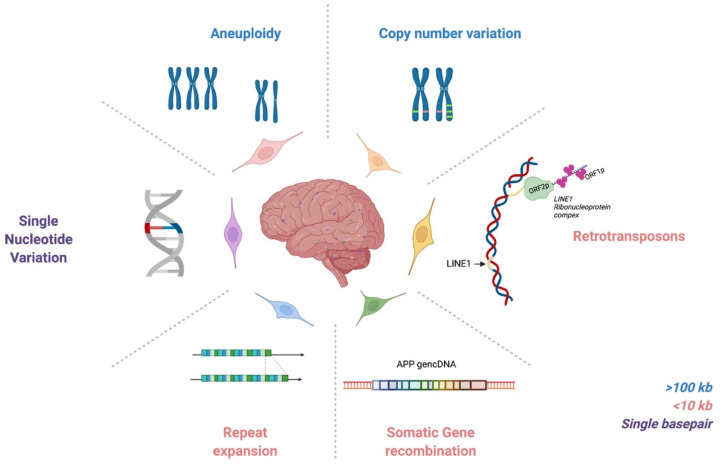
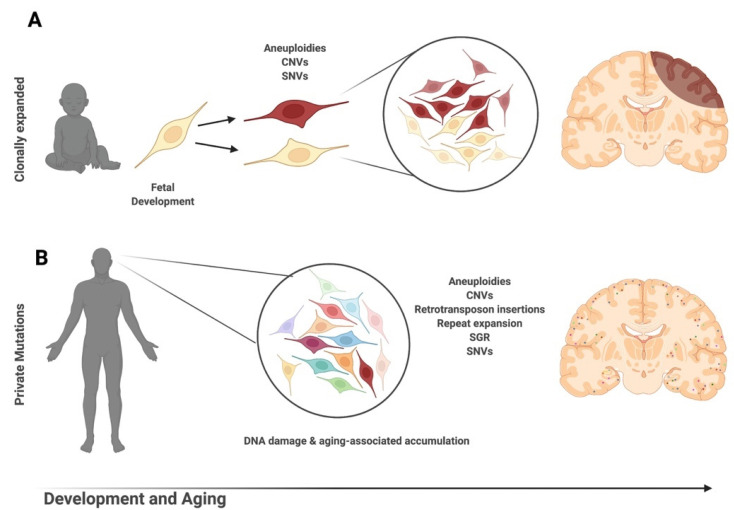
Over the past 20 years, analyses of single brain cell genomes have revealed that the brain is composed of cells with myriad distinct genomes: the brain is a genomic mosaic, generated by a host of DNA sequence-altering processes that occur somatically and do not affect the germline. As such, these sequence changes are not heritable. Some processes appear to occur during neurogenesis, when cells are mitotic, whereas others may also function in post-mitotic cells. Here, we review multiple forms of DNA sequence alterations that have now been documented: aneuploidies and aneusomies, smaller copy number variations (CNVs), somatic repeat expansions, retrotransposons, genomic cDNAs (gencDNAs) associated with somatic gene recombination (SGR), and single nucleotide variations (SNVs). A catch-all term of DNA content variation (DCV) has also been used to describe the overall phenomenon, which can include multiple forms within a single cell's genome. A requisite step in the analyses of genomic mosaicism is ongoing technology development, which is also discussed. Genomic mosaicism alters one of the most stable biological molecules, DNA, which may have many repercussions, ranging from normal functions including effects of aging, to creating dysfunction that occurs in neurodegenerative and other brain diseases, most of which show sporadic presentation, unlinked to causal, heritable genes.
在过去的 20 年中,对单个脑细胞基因组的分析表明,大脑由具有无数不同基因组的细胞组成:大脑是基因组镶嵌体,由一系列发生在体细胞中的、不影响生殖细胞的改变 DNA 序列的过程产生。因此,这些序列变化是不可遗传的。一些过程似乎发生在神经发生过程中,即细胞有丝分裂时,而另一些过程也可能在有丝分裂后细胞中发挥作用。在这里,我们回顾了现已记录的多种形式的 DNA 序列改变:非整倍体和非整倍性、较小的拷贝数变异 (CNV)、体细胞重复扩展、逆转录转座子、与体细胞基因重组 (SGR) 相关的基因组 cDNA (gencDNA) 和单核苷酸变异 (SNV)。DNA 含量变异 (DCV) 这一统称也被用来描述整体现象,它可以包括单个细胞基因组中的多种形式。基因组镶嵌性分析的一个必要步骤是正在进行的技术发展,这也在讨论之中。基因组镶嵌性改变了最稳定的生物分子之一——DNA,这可能会产生许多影响,从包括衰老影响在内的正常功能,到导致神经退行性和其他脑部疾病中出现的功能障碍,这些疾病大多数表现为散发性,与因果关系、可遗传的基因无关。