Department of Nursing, College of Nursing, Gachon University, Incheon 21936, Korea.
Neuroscience Research Institute, Gachon University, Incheon 21565, Korea.
Biomolecules. 2021 Jul 3;11(7):980. doi: 10.3390/biom11070980.
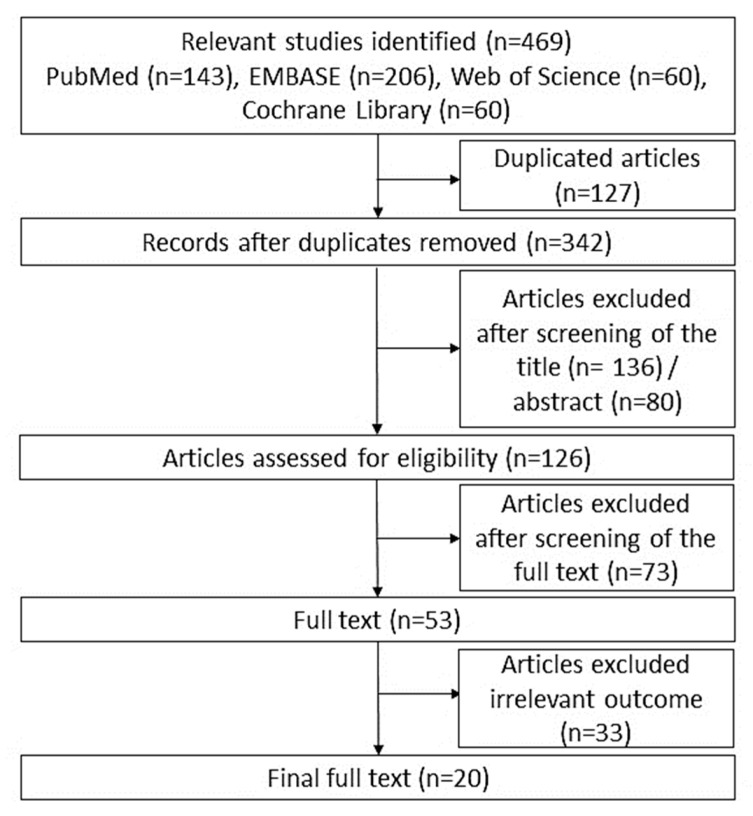
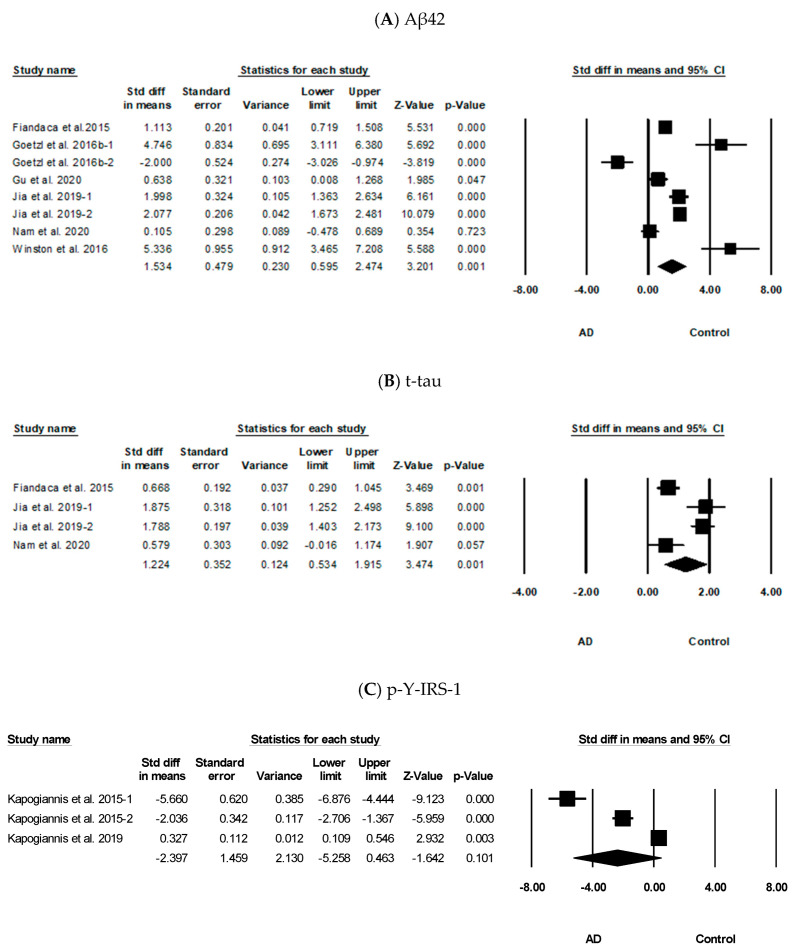
Alzheimer's disease (AD), a progressive neurodegenerative disease, affects approximately 50 million people worldwide, which warrants the search for reliable new biomarkers for early diagnosis of AD. Brain-derived exosomal (BDE) proteins, which are extracellular nanovesicles released by all cell lineages of the central nervous system, have been focused as biomarkers for diagnosis, screening, prognosis prediction, and monitoring in AD. This review focused on the possibility of BDE proteins as AD biomarkers. The articles published prior to 26 January 2021 were searched in PubMed, EMBASE, Web of Science, and Cochrane Library to identify all relevant studies that reported exosome biomarkers in blood samples of patients with AD. From 342 articles, 20 studies were selected for analysis. We conducted a meta-analysis of six BDE proteins and found that levels of amyloid-β42 (standardized mean difference (SMD) = 1.534, 95% confidence interval [CI]: 0.595-2.474), total-tau (SMD = 1.224, 95% CI: 0.534-1.915), tau phosphorylated at threonine 181 (SMD = 4.038, 95% CI: 2.312-5.764), and tau phosphorylated at serine 396 (SMD = 2.511, 95% CI: 0.795-4.227) were significantly different in patients with AD compared to those in control. Whereas, those of p-tyrosine-insulin receptor substrate-1 and heat shock protein 70 did not show significant differences. This review suggested that Aβ42, t-tau, p-T181-tau, and p-S396-tau could be effective in diagnosing AD as blood biomarkers, despite the limitation in the meta-analysis based on the availability of data. Therefore, certain BDE proteins could be used as effective biomarkers for AD.
阿尔茨海默病(AD)是一种进行性神经退行性疾病,全球约有 5000 万人受其影响,因此需要寻找可靠的新生物标志物来进行 AD 的早期诊断。脑源性外泌体(BDE)蛋白是由中枢神经系统所有细胞谱系释放的细胞外纳米囊泡,已被作为 AD 诊断、筛查、预后预测和监测的生物标志物。本综述重点探讨了 BDE 蛋白作为 AD 生物标志物的可能性。在 PubMed、EMBASE、Web of Science 和 Cochrane Library 中检索了截至 2021 年 1 月 26 日之前发表的所有相关研究,以确定报道 AD 患者血液样本中外泌体生物标志物的所有相关研究。从 342 篇文章中,选择了 20 项研究进行分析。我们对 6 种 BDE 蛋白进行了荟萃分析,发现淀粉样蛋白-β42(标准化均数差(SMD)=1.534,95%置信区间[CI]:0.595-2.474)、总 tau(SMD=1.224,95%CI:0.534-1.915)、磷酸化 tau 苏氨酸 181(SMD=4.038,95%CI:2.312-5.764)和磷酸化 tau 丝氨酸 396(SMD=2.511,95%CI:0.795-4.227)在 AD 患者中与对照组相比差异有统计学意义。然而,p-酪氨酸胰岛素受体底物-1 和热休克蛋白 70 的差异无统计学意义。本综述表明,尽管基于数据可用性的限制,Aβ42、t-tau、p-T181-tau 和 p-S396-tau 作为血液生物标志物可有效用于 AD 的诊断,Aβ42、t-tau、p-T181-tau 和 p-S396-tau 可能成为 AD 的有效生物标志物。