Kusumoto Ken-Ichi, Yamagata Youhei, Tazawa Rina, Kitagawa Manabu, Kato Taeko, Isobe Kenji, Kashiwagi Yutaka
Food Research Institute, National Agriculture and Food Research Organization, Tsukuba 305-8642, Japan.
Division of Applied Biological Chemistry, Institute of Agriculture, Tokyo University of Agriculture and Technology, Fuchu, Tokyo 183-8509, Japan.
J Fungi (Basel). 2021 Jul 20;7(7):579. doi: 10.3390/jof7070579.
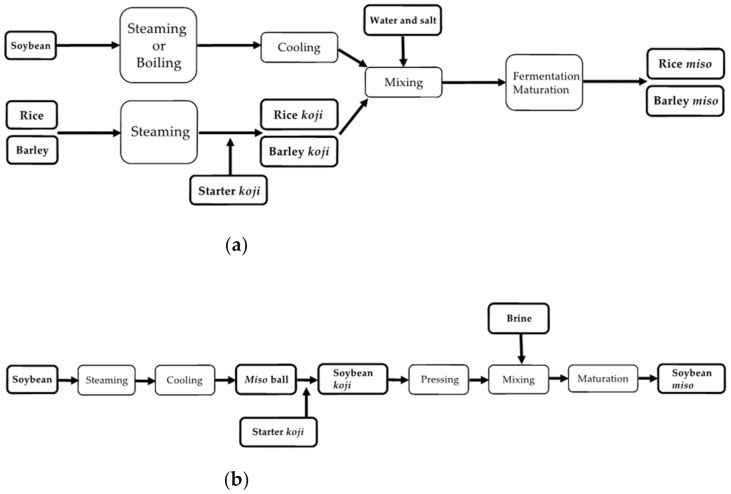
is a traditional Japanese seasoning paste produced by fermenting soybeans using the power of mold. A recent Japanese cohort study has shown that increased consumption of fermented soybean products is associated with a reduced risk of death in both men and women. In this review, we briefly explain what means in the Japanese culture and food industry, varieties of available today, and steps involved in making. Then, we review early and latest scientific researches in mold species, their safety, and beneficial enzymes they produce during fermentation and maturation processes, which play a major part in determining the quality and sensory profile of .
是一种通过利用霉菌的力量发酵大豆而制成的传统日本调味酱。最近一项日本队列研究表明,食用发酵大豆制品的增加与男性和女性死亡风险的降低有关。在这篇综述中,我们简要解释了在日本文化和食品工业中的含义、当今可用的品种以及制作过程中的步骤。然后,我们回顾了关于霉菌种类的早期和最新科学研究、它们的安全性以及它们在发酵和成熟过程中产生的有益酶,这些在决定的质量和感官特征方面起着重要作用。