Departments of Emergency Medicine and Neurology, University of Rochester, Rochester, New York, USA.
Department of Emergency, Wayne State University School of Medicine, Detroit, Michigan, USA.
Acad Emerg Med. 2021 Nov;28(11):1308-1317. doi: 10.1111/acem.14366. Epub 2021 Sep 7.
The objective was to determine the accuracy of a new, rapid blood test combining measurements of both glial fibrillary acidic protein (GFAP) and ubiquitin carboxyl-terminal hydrolase L1 (UCH-L1) for predicting acute traumatic intracranial injury (TII) on head CT scan after mild traumatic brain injury (mTBI).
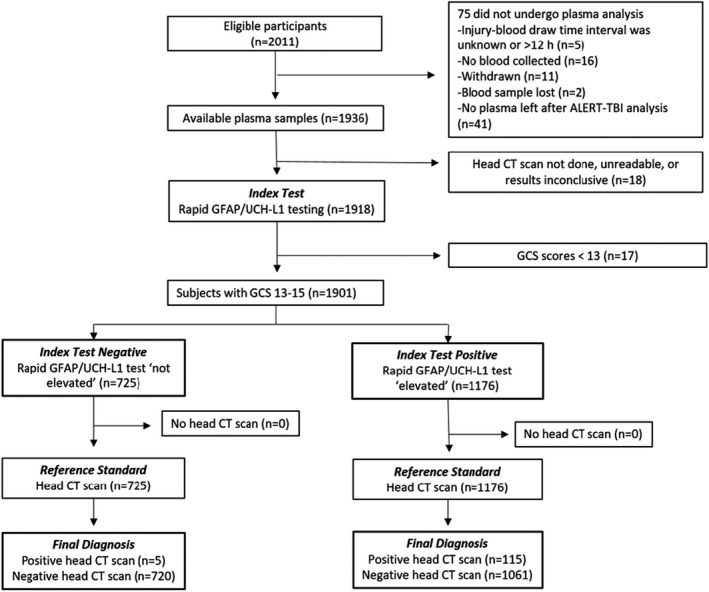
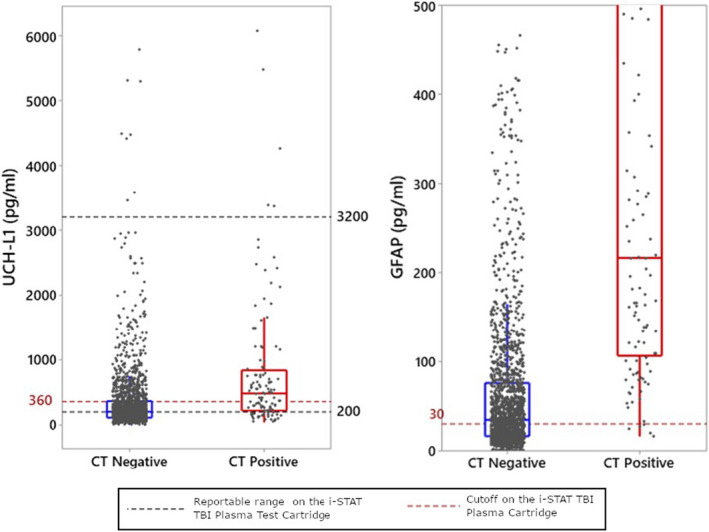
Analysis of banked venous plasma samples from subjects completing the Prospective Clinical Evaluation of Biomarkers of Traumatic Brain Injury (ALERT-TBI) trial, enrolled 2012-2014 at 22 investigational sites in the United States and Europe. All subjects were ≥18 years old, presented to an emergency department (ED) with a nonpenetrating head injury and Glasgow Coma Scale score (GCS) 9-15 (mild to moderate TBI), underwent head CT scanning as part of their clinical care, and had blood sampling within 12 h of injury. Plasma concentrations of GFAP and UCH-L1 were measured using i-STAT Alinity and TBI plasma cartridge and compared to acute TII on head CT scan.
Of the 2011 subjects enrolled in ALERT-TBI, 1918 had valid CT scans and plasma specimens for testing and 1901 (99.1%) had GCS 13-15 (mTBI), for which the rapid test was intended. Among these subjects, the rapid test had a sensitivity of 0.958 (95% confidence interval [CI] = 0.906 to 0.982), specificity of 0.404 (95% CI = 0.382 to 0.427), negative predictive value of 0.993 (95% CI = 0.985 to 0.997), and positive predictive value of 0.098 (95% CI = 0.082 to 0.116) for acute TII.
A rapid i-STAT-based test had high sensitivity for prediction of acute TII, comparable to lab-based platforms. The speed, portability, and high accuracy of this test may facilitate clinical adoption of brain biomarker testing as an aid to head CT decision making in EDs.
本研究旨在评估一种新的快速血液检测方法,该方法联合检测胶质纤维酸性蛋白(GFAP)和泛素羧基末端水解酶 L1(UCH-L1),用于预测轻度创伤性脑损伤(mTBI)后头部 CT 扫描的急性创伤性颅内损伤(TII)。
分析 2012 年至 2014 年在美国和欧洲 22 个研究地点参加前瞻性临床评估创伤性脑损伤生物标志物(ALERT-TBI)试验的受试者的银行静脉血浆样本。所有受试者年龄均≥18 岁,因非穿透性头部损伤就诊于急诊室(ED),格拉斯哥昏迷量表(GCS)评分为 9-15 分(轻度至中度 TBI),头部 CT 扫描作为其临床治疗的一部分,并在受伤后 12 小时内进行血液采样。使用 i-STAT Alinity 和 TBI 血浆试剂盒测量 GFAP 和 UCH-L1 的血浆浓度,并与头部 CT 扫描的急性 TII 进行比较。
在 ALERT-TBI 中,共有 2011 名受试者入组,其中 1918 名受试者的 CT 扫描和血浆标本有效,1901 名受试者(99.1%)GCS 评分为 13-15 分(mTBI),这是快速检测的目的。在这些受试者中,快速检测的敏感性为 0.958(95%置信区间[CI]:0.906 至 0.982),特异性为 0.404(95%CI:0.382 至 0.427),阴性预测值为 0.993(95%CI:0.985 至 0.997),阳性预测值为 0.098(95%CI:0.082 至 0.116)。
一种基于 i-STAT 的快速检测方法对急性 TII 的预测具有较高的敏感性,与实验室检测平台相当。该测试的速度、便携性和高精度可能有助于将脑生物标志物测试作为 ED 头部 CT 决策的辅助手段进行临床应用。