Department of Animal Science, Federal University of Rio Grande do Sul, 91540-000, Brazil.
Elanco Brasil, São Paulo, 04703-002, Brazil.
Poult Sci. 2021 Sep;100(9):101338. doi: 10.1016/j.psj.2021.101338. Epub 2021 Jun 24.
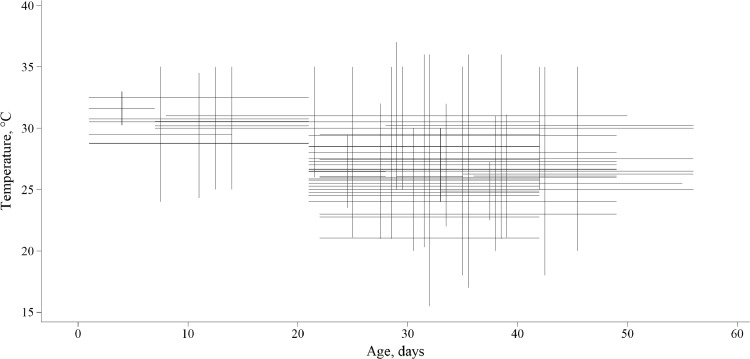
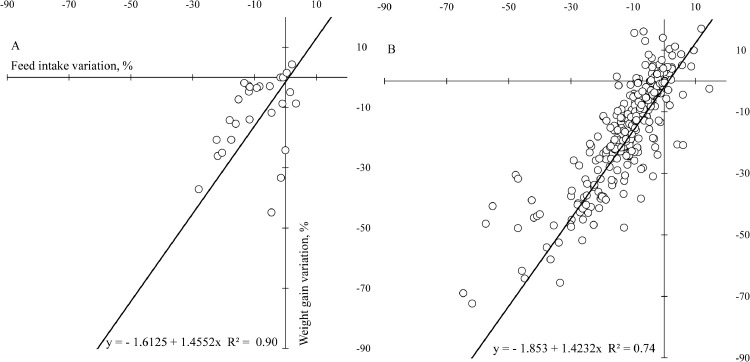
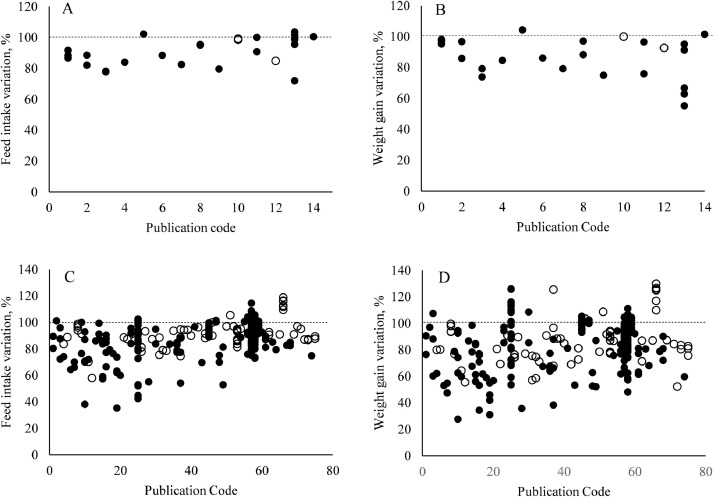
A meta-analysis was developed to model performance depression in heat stress (HS), to analyze the influence of HS type (cyclic or constant), and to assess the correlation between dietary electrolyte balance (DEB) and HS in broilers. Two databases (Dat) with performance and temperature were constructed (initial phase - up to 21 d of age - 14 articles, 7,667 animals, average replicate number treatment-ARN/T, 5 and growing phase - over 21 d of age - 74 articles and 25,145 broilers, ARN/T, 7). The criteria for article selection were (1) experiments using at least 2 temperatures (thermoneutral and high temperature); (2) results of ADFI and ADG; (3) feed and water ad libitum during the experiment. Each treatment was classified as cyclic or constant HS and the HS group response was calculated relative to the thermoneutral group. Performance was evaluated as raw data or as relativized information (indicated as "HS effect or ≠"), expressed as a percentage of the difference between results. The models to predict "HS effect" showed that for the initial phase, only ADG was influenced by HS, while for the grower phase, prediction equations were created for ADFI and ADG. Considering the simplest models, there was a reduction of 1.4% in ADFI and 2.1% in ADG for each unit (°C) above the upper critical temperature for broilers older than 21 d. Feed conversion (FC) was not affected by HS in any of the studied phases. Constant HS proved to be more negative than cyclic HS to broiler performance after 21 d of age. The relation between DEB and performance of broilers under HS was analyzed considering broilers over 21 d of age, and very weak correlations were observed. It was concluded that HS affects broilers over 21 d more, although FC is not affected. ADFI is the most important variable affected by HS and the relation between the DEB of the diet and HS is very weak. The empirical models generated in this study accurately predicted ADG and ADFI of broilers exposed to HS and can be used to minimize those effects on poultry production.
进行了一项荟萃分析,以建立模型来模拟热应激(HS)下的性能下降,分析 HS 类型(循环或恒定)的影响,并评估饲料电解质平衡(DEB)与肉鸡 HS 之间的相关性。构建了两个包含性能和温度数据的数据库(Dat)(初始阶段-21 日龄-14 篇文章,7667 只动物,平均每个处理的重复数 ARN/T,5 个和生长阶段-21 日龄以上-74 篇文章和 25145 只肉鸡,ARN/T,7 个)。文章选择的标准是:(1)使用至少 2 个温度(温热和高温)进行实验;(2)ADFI 和 ADG 的结果;(3)实验期间自由采食饲料和水。每个处理均被归类为循环或恒定 HS,HS 组的反应相对于温热组进行计算。性能评估为原始数据或相对化信息(表示为“HS 效应或≠”),表示为结果之间差异的百分比。预测“HS 效应”的模型表明,对于初始阶段,仅 ADG 受到 HS 的影响,而对于生长阶段,为 ADFI 和 ADG 创建了预测方程。考虑到最简单的模型,对于 21 日龄以上的肉鸡,每升高 1°C(°C),ADFI 降低 1.4%,ADG 降低 2.1%。在任何研究阶段,HS 均未影响饲料转化率(FC)。21 日龄以上的肉鸡,与循环 HS 相比,恒定 HS 对肉鸡性能的负面影响更大。考虑到 21 日龄以上的肉鸡,分析了 DEB 与 HS 下肉鸡性能的关系,观察到非常弱的相关性。结论是,尽管 FC 不受影响,但 21 日龄以上的 HS 对肉鸡的影响更大。ADFI 是受 HS 影响最重要的变量,而饮食 DEB 与 HS 之间的关系非常弱。本研究生成的经验模型准确预测了暴露于 HS 的肉鸡的 ADG 和 ADFI,可以用于最大程度地减少对家禽生产的影响。