Piotti Patrizia, Albertini Mariangela, Trabucco Lidia Pia, Ripari Lucia, Karagiannis Christos, Bandi Claudio, Pirrone Federica
Department of Veterinary Medicine, University of Milan, Via dell'Università 6, 26900 Lodi, Italy.
Department of Bioscience, University of Milan, Via Celoria 26, 20133 Milano, Italy.
Animals (Basel). 2021 Jul 20;11(7):2144. doi: 10.3390/ani11072144.
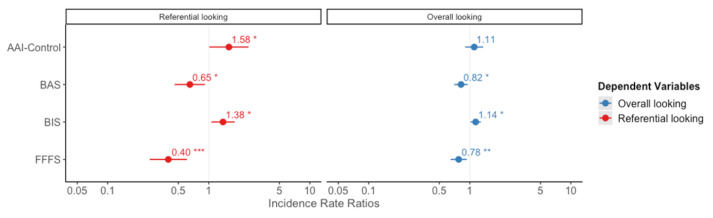
Dogs are biologically predisposed to communicate with humans in cooperative contexts. They show individual differences in dog-human communication and inhibition, potentially enhanced by life experience, e.g., Animal-Assisted Interventions. This study aimed to investigate whether dogs' personality, defined by biologically meaningful neural circuits described in the Reinforcement Sensitivity Theory of Personality (RST), predicted dogs' communication, task orientation, emotional state, and approach of an unsolvable task. We also investigated the differences between dogs experienced in Animal-Assisted Interventions (AAI) and inexperienced dogs. The results indicated that a high sensitivity to the RST personality trait related to managing uncertainty (Behavioural Inhibition System, BIS) predicted fewer task orientations but increased referential and non-referential looking, which we interpreted as a way to obtain directions from the owner. Conversely, a high sensitivity to the traits reflecting tendencies to approach rewards (Behavioural Approach System, BAS) and avoid punishment (Fight-Flight-Freeze System, FFFS) predicted lower looking. High sensitivity to the FFFS also predicted more frequent task orientations, which we interpreted as frustration. Finally, the dogs in the AAI program looked more at their owner and were less oriented towards the task. These results provide empirical evidence of individual differences tied to the psychobiological personality traits in canine cognitive skills. Understanding such cognitive profiles may have an enormous impact on activities that rely upon dog-human collaborative interaction.
狗在生物学上倾向于在合作情境中与人类交流。它们在与人类交流和抑制方面表现出个体差异,生活经历(如动物辅助干预)可能会增强这种差异。本研究旨在调查由人格强化敏感性理论(RST)中描述的具有生物学意义的神经回路所定义的狗的个性,是否能预测狗的交流、任务导向、情绪状态以及对无法解决的任务的应对方式。我们还研究了有动物辅助干预(AAI)经验的狗和无经验的狗之间的差异。结果表明,对与管理不确定性相关的RST人格特质(行为抑制系统,BIS)高度敏感,预示着任务导向较少,但参考性和非参考性注视增加,我们将其解释为从主人那里获取指示的一种方式。相反,对反映接近奖励倾向(行为趋近系统,BAS)和避免惩罚倾向(战斗-逃跑-冻结系统,FFFS)的特质高度敏感,预示着注视较少。对FFFS高度敏感还预示着更频繁的任务导向,我们将其解释为挫折感。最后,参与AAI项目的狗更多地看向主人,对任务的导向性更低。这些结果为犬类认知技能中与心理生物学人格特质相关的个体差异提供了实证证据。了解这种认知特征可能会对依赖狗-人协作互动的活动产生巨大影响。