Department of Sport and Well-Being, Polytechnic Institute of Castelo Branco, 6000-084 Castelo Branco, Portugal.
Sport, Health and Exercise Research Unit (SHERU), Polytechnic Institute of Castelo Branco, 6000-266 Castelo Branco, Portugal.
Int J Environ Res Public Health. 2021 Jul 30;18(15):8069. doi: 10.3390/ijerph18158069.
During a soccer game, the most diversified stimuli occur all the time, the physical condition level plays a determinant role, and there may be variations according to the competitive level. In this sense, the present study aimed to verify differences in body composition, lower limbs power, and anaerobic power, comparing senior soccer players of different competitive levels.
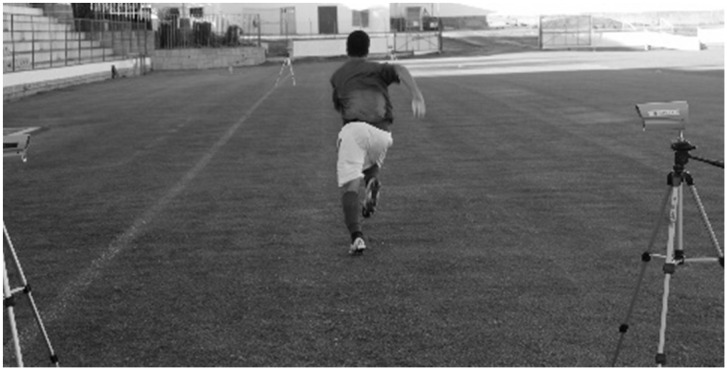
Participants were 81 players belonging to six soccer teams, aged between 18 and 35 years, with a mean age of 23.14 ± 4.23 years, who were divided into three distinct competitive levels: Elite, Sub-Elite and Non-Elite. The players performed bioimpedance evaluations on a tetrapolarInbody270 scale (body composition), the Countermovement Jump (CMJ) through the ChronoJump (lower limbs power), and Running Anaerobic Sprint Test (RAST) (anaerobic power).
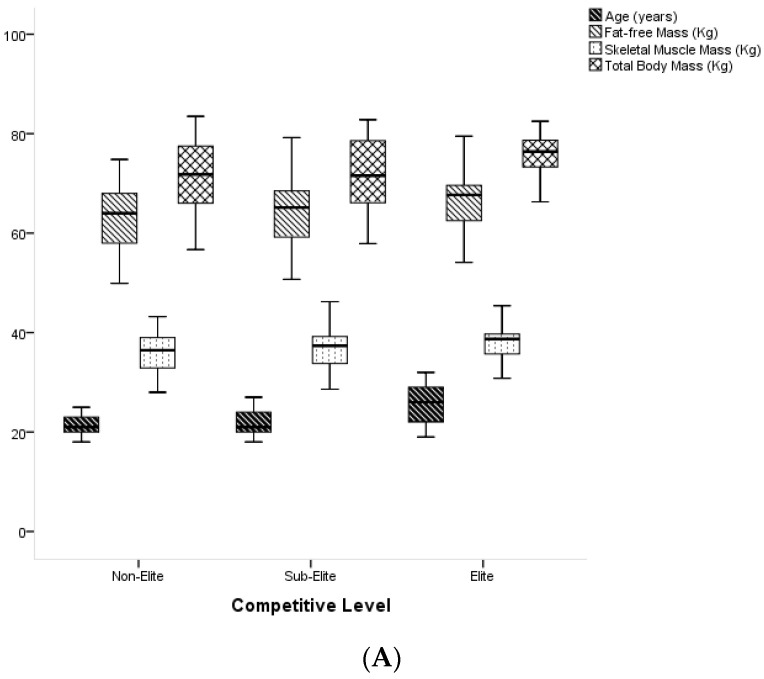
Based on the competitive level analysis, we verified that the players present body composition values similar to each other regardless of the competitive level in which they play. Concerning the performance evaluations, we verified that the elite players present higher values of highest jump ( = 0.012; d = 0.76, moderate; and = 0.022; d = 0.71, moderate) and maximum force produced ( = 0.05; d = 0.64, moderate; and = 0.002; d = 1.00, moderate), together with higher values of anaerobic power ( < 0.001; d = 2.43, very large; and < 0.001; d = 2.22, very large), compared to the others.
We can thus conclude that there is a homogeneity regarding the body composition of soccer players, regardless of their competitive level; in turn, elite players show better performance indicators in all variables.
在足球比赛中,球员会一直面对多样化的刺激,身体状况起着决定性的作用,而且可能会根据比赛水平的不同而有所变化。从这个意义上说,本研究旨在验证不同竞技水平的高级足球运动员在身体成分、下肢力量和无氧能力方面的差异。
参与者为属于六支足球队的 81 名球员,年龄在 18 岁至 35 岁之间,平均年龄为 23.14 ± 4.23 岁,他们分为三个不同的竞技水平:精英、次精英和非精英。球员们在 tetrapolarInbody270 秤(身体成分)上进行生物阻抗评估、通过 ChronoJump(下肢力量)进行反向跳跃(CMJ)和进行 Running Anaerobic Sprint Test(RAST)(无氧能力)。
根据竞技水平的分析,我们发现无论他们所参加的竞技水平如何,球员的身体成分值彼此相似。关于表现评估,我们发现精英球员的最高跳跃( = 0.012;d = 0.76,中度;和 = 0.022;d = 0.71,中度)和最大力量( = 0.05;d = 0.64,中度;和 = 0.002;d = 1.00,中度)的数值更高,同时无氧能力的数值也更高( < 0.001;d = 2.43,非常大;和 < 0.001;d = 2.22,非常大),与其他球员相比。
因此,我们可以得出结论,无论他们的竞技水平如何,足球运动员的身体成分都具有同质性;相反,精英球员在所有变量中的表现指标都更好。