Dalla Lana School of Public Health, University of Toronto, Toronto, ON L5L 1C6, Canada.
ICES, Toronto, ON M4N 3M5, Canada.
Int J Environ Res Public Health. 2021 Jul 31;18(15):8127. doi: 10.3390/ijerph18158127.
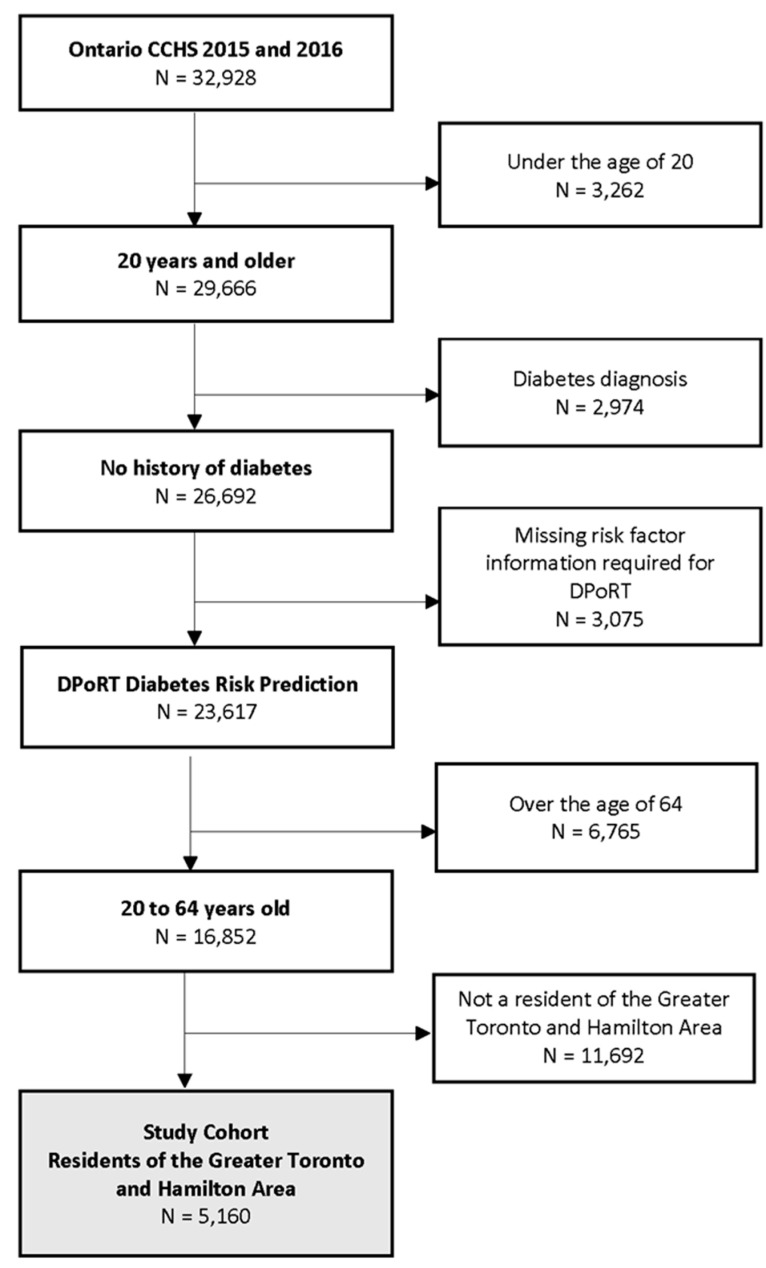
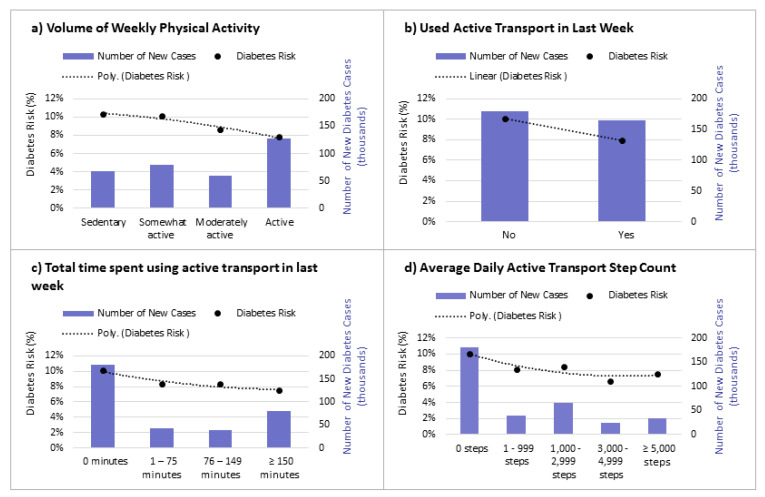
Promoting adequate levels of physical activity in the population is important for diabetes prevention. However, the scale needed to achieve tangible population benefits is unclear. We aimed to estimate the public health impact of increases in walking as a means of diabetes prevention and health care cost savings attributable to diabetes. We applied the validated Diabetes Population Risk Tool (DPoRT) to the 2015/16 Canadian Community Health Survey for adults aged 18-64, living in the Greater Toronto and Hamilton area, Ontario, Canada. DPoRT was used to generate three population-level scenarios involving increases in walking among individuals with low physical activity levels, low daily step counts and high dependency on non-active forms of travel, compared to a baseline scenario (no change in walking rates). We estimated number of diabetes cases prevented and health care costs saved in each scenario compared with the baseline. Each of the three scenarios predicted a considerable reduction in diabetes and related health care cost savings. In order of impact, the largest population benefits were predicted from targeting populations with low physical activity levels, low daily step counts, and non active transport use. Population increases of walking by 25 min each week was predicted to prevent up to 10.4 thousand diabetes cases and generate CAD 74.4 million in health care cost savings in 10 years. Diabetes reductions and cost savings were projected to be higher if increases of 150 min of walking per week could be achieved at the population-level (up to 54.3 thousand diabetes cases prevented and CAD 386.9 million in health care cost savings). Policy, programming, and community designs that achieve modest increases in population walking could translate to meaningful reductions in the diabetes burden and cost savings to the health care system.
促进人群中足够水平的身体活动对于预防糖尿病很重要。然而,实现切实的人群效益所需的规模尚不清楚。我们旨在估计增加步行作为预防糖尿病和节省与糖尿病相关的医疗保健成本的公共卫生影响。我们将经过验证的糖尿病人群风险工具(DPoRT)应用于 2015/16 年加拿大安大略省大多伦多和汉密尔顿地区 18-64 岁成年人的加拿大社区健康调查。DPoRT 用于生成三种人群水平的情景,涉及低体力活动水平、低日常步数和高度依赖非活跃形式的旅行的个体增加步行,与基线情景(步行率不变)相比。我们估计了每个情景与基线相比预防的糖尿病病例数和节省的医疗保健成本。三个情景中的每一个都预测了糖尿病和相关医疗保健成本节省的显著减少。按影响大小排序,最大的人群受益来自针对体力活动水平低、日常步数低和非活跃交通方式的人群。每周步行增加 25 分钟预计将预防多达 10400 例糖尿病病例,并在 10 年内节省 7440 万加元的医疗保健成本。如果每周步行增加 150 分钟可以在人群中实现,预计糖尿病的减少和成本的节省会更高(预防多达 54300 例糖尿病病例,节省 3869 万加元的医疗保健成本)。实现人群步行适度增加的政策、规划和社区设计,可以转化为对糖尿病负担和医疗保健系统成本节省的有意义的减少。