Center for Vascularized Composite Allotransplantation, Chang Gung Memorial Hospital, Taoyuan 333, Taiwan.
Int J Mol Sci. 2021 Jul 29;22(15):8148. doi: 10.3390/ijms22158148.
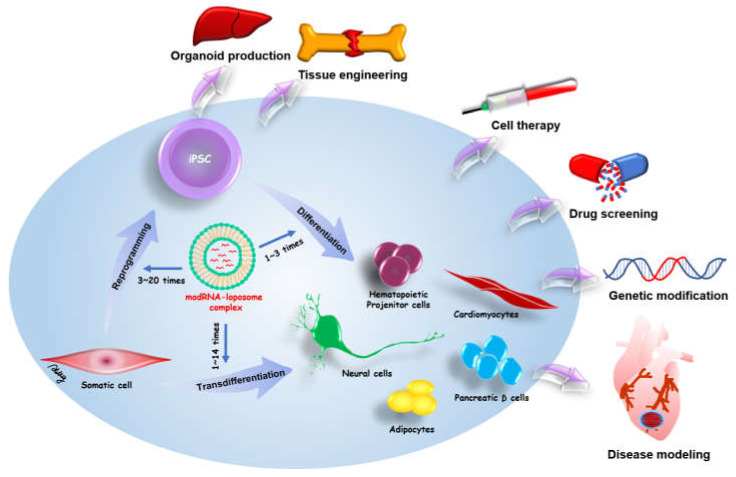
Modified mRNA (modRNA)-based somatic reprogramming is an effective and safe approach that overcomes the genomic mutation risk caused by viral integrative methods. It has improved the disadvantages of conventional mRNA and has better stability and immunogenicity. The modRNA molecules encoding multiple pluripotent factors have been applied successfully in reprogramming somatic cells such as fibroblasts, mesenchymal stem cells, and amniotic fluid stem cells to generate pluripotent stem cells (iPSCs). Moreover, it also can be directly used in the terminal differentiation of stem cells and fibroblasts into functional therapeutic cells, which exhibit great promise in disease modeling, drug screening, cell transplantation therapy, and regenerative medicine. In this review, we summarized the reprogramming applications of modified mRNA in iPSC generation and therapeutic applications of functionally differentiated cells.
基于修饰信使 RNA(modRNA)的体细胞核移植是一种有效且安全的方法,可克服病毒整合方法引起的基因组突变风险。它改善了传统 mRNA 的缺点,具有更好的稳定性和免疫原性。编码多种多能因子的 modRNA 分子已成功应用于重编程成纤维细胞、间充质干细胞和羊水干细胞等体细胞,以产生多能干细胞(iPSC)。此外,它还可以直接用于干细胞和成纤维细胞向功能性治疗细胞的终末分化,在疾病建模、药物筛选、细胞移植治疗和再生医学方面具有广阔的应用前景。在这篇综述中,我们总结了修饰 mRNA 在 iPSC 生成和功能分化细胞治疗应用中的重编程应用。