Ortega Miguel A, Fraile-Martínez Oscar, García-Montero Cielo, Álvarez-Mon Miguel A, Chaowen Chen, Ruiz-Grande Fernando, Pekarek Leonel, Monserrat Jorge, Asúnsolo Angel, García-Honduvilla Natalio, Álvarez-Mon Melchor, Bujan Julia
Department of Medicine and Medical Specialities, Faculty of Medicine and Health Sciences, University of Alcalá, 28801 Alcalá de Henares, Spain.
Ramón y Cajal Institute of Sanitary Research (IRYCIS), 28034 Madrid, Spain.
J Clin Med. 2021 Jul 22;10(15):3239. doi: 10.3390/jcm10153239.
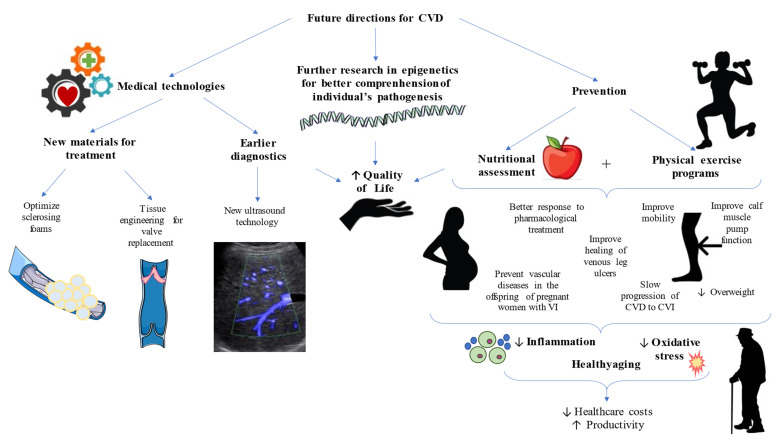
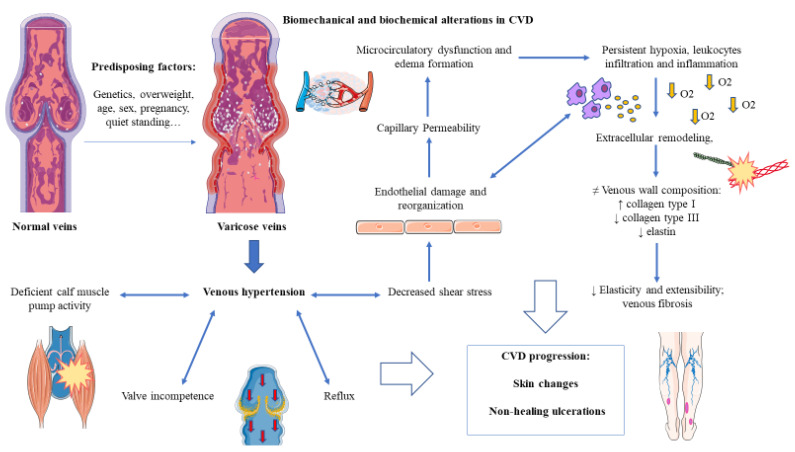
Chronic venous disease (CVD) is a multifactorial condition affecting an important percentage of the global population. It ranges from mild clinical signs, such as telangiectasias or reticular veins, to severe manifestations, such as venous ulcerations. However, varicose veins (VVs) are the most common manifestation of CVD. The explicit mechanisms of the disease are not well-understood. It seems that genetics and a plethora of environmental agents play an important role in the development and progression of CVD. The exposure to these factors leads to altered hemodynamics of the venous system, described as ambulatory venous hypertension, therefore promoting microcirculatory changes, inflammatory responses, hypoxia, venous wall remodeling, and epigenetic variations, even with important systemic implications. Thus, a proper clinical management of patients with CVD is essential to prevent potential harms of the disease, which also entails a significant loss of the quality of life in these individuals. Hence, the aim of the present review is to collect the current knowledge of CVD, including its epidemiology, etiology, and risk factors, but emphasizing the pathophysiology and medical care of these patients, including clinical manifestations, diagnosis, and treatments. Furthermore, future directions will also be covered in this work in order to provide potential fields to explore in the context of CVD.
慢性静脉疾病(CVD)是一种多因素疾病,影响着全球相当比例的人口。其范围从轻微的临床症状,如毛细血管扩张或网状静脉,到严重的表现,如静脉溃疡。然而,静脉曲张(VVs)是CVD最常见的表现形式。该疾病的确切机制尚未完全了解。似乎遗传因素和大量环境因素在CVD的发生和发展中起着重要作用。接触这些因素会导致静脉系统血流动力学改变,即所谓的动态静脉高压,从而促进微循环变化、炎症反应、缺氧、静脉壁重塑和表观遗传变异,甚至具有重要的全身影响。因此,对CVD患者进行适当的临床管理对于预防该疾病的潜在危害至关重要,而这也会导致这些个体的生活质量显著下降。因此,本综述的目的是收集有关CVD的现有知识,包括其流行病学、病因和危险因素,但重点是这些患者的病理生理学和医疗护理,包括临床表现、诊断和治疗。此外,本研究还将涵盖未来的方向,以便在CVD背景下提供潜在的探索领域。