Al-Saad Maha Saleh Habsan, Al-Jabri Basma, Almarzouki Abeer F
Faculty of Medicine, Department of Clinical Physiology, King Abdulaziz University, Jeddah, Saudi Arabia.
Public Health Sector, General Directorate of Health Affairs in Najran, Ministry of Health, Najran, Saudi Arabia.
Front Behav Neurosci. 2021 Jul 21;15:686873. doi: 10.3389/fnbeh.2021.686873. eCollection 2021.
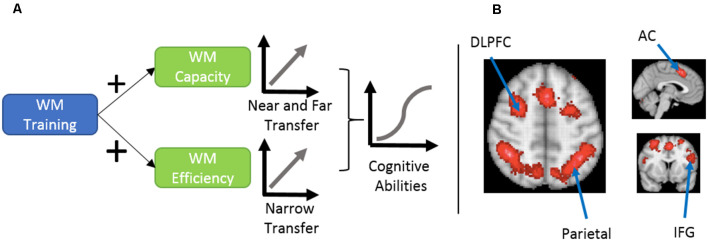
Attention deficit hyperactivity disorder (ADHD) is one of the most common neurodevelopmental disorders among children. Working memory deficits underlie many of the behavioural symptoms of ADHD. Alongside psychostimulant medications, strategies to improve working memory may play an important adjuvant role in the management of ADHD. In this study, we review the role of working memory deficits in ADHD, the evidence surrounding working memory training strategies in the management of the condition, and the factors affecting the success of these strategies in alleviating ADHD symptoms. More specifically, we review several non-pharmacological interventions that target working memory deficits in ADHD, with special emphasis on cognitive working memory training. We conclude that the development of evidence-based interventions such as computerised cognitive training (CCT) could provide an alternative or adjunct to the use of psychostimulants, especially in cases where side effects are a major issue.
注意缺陷多动障碍(ADHD)是儿童中最常见的神经发育障碍之一。工作记忆缺陷是ADHD许多行为症状的基础。除了精神兴奋剂药物外,改善工作记忆的策略可能在ADHD的管理中发挥重要的辅助作用。在本研究中,我们回顾了工作记忆缺陷在ADHD中的作用、围绕工作记忆训练策略在该病症管理中的证据,以及影响这些策略减轻ADHD症状成功与否的因素。更具体地说,我们回顾了几种针对ADHD工作记忆缺陷的非药物干预措施,特别强调认知工作记忆训练。我们得出结论,基于证据的干预措施如计算机化认知训练(CCT)的发展,可以为精神兴奋剂的使用提供替代或辅助,特别是在副作用是主要问题的情况下。