Trapp Wolfgang, Heid Andreas, Röder Susanne, Wimmer Franziska, Hajak Göran
Department of Psychiatry and Psychotherapy, Social Foundation Bamberg, 96049 Bamberg, Germany.
Fachhochschule des Mittelstands, Department of Psychology, University of Applied Sciences, 96050 Bamberg, Germany.
Brain Sci. 2022 May 24;12(6):683. doi: 10.3390/brainsci12060683.
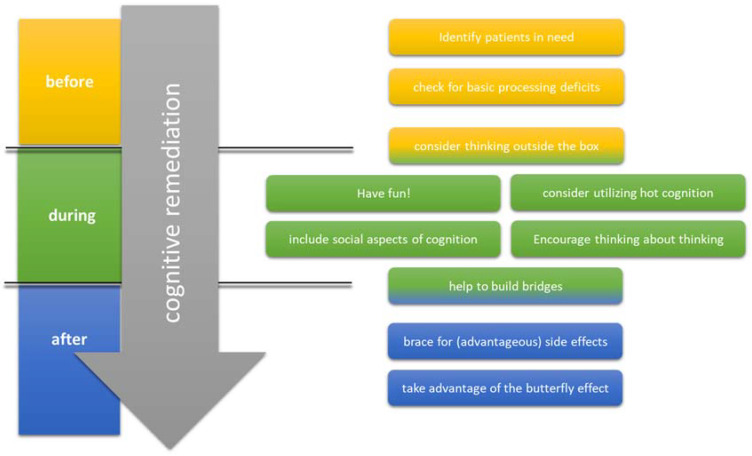
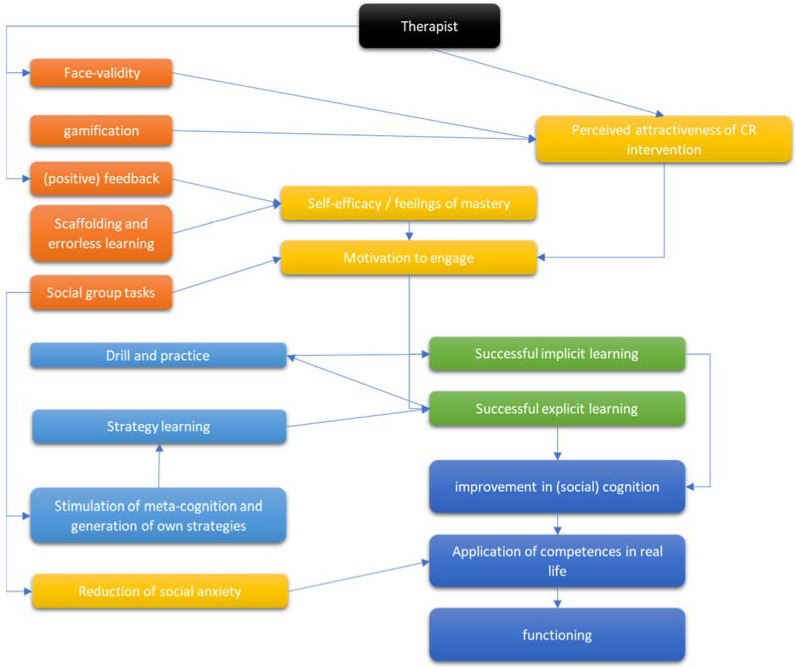
Many people with psychiatric disorders experience impairments in cognition. These deficits have a significant impact on daily functioning and sometimes even on the further course of their disease. Cognitive remediation (CR) is used as an umbrella term for behavioral training interventions to ameliorate these deficits. In most but not all studies, CR has proven effective in improving cognition and enhancing everyday functional outcomes. In this paper, after quickly summarizing the empirical evidence, practical advice to optimize the effects of CR interventions is provided. We advocate that CR interventions should be as fun and motivating as possible, and therapists should at least consider using positively toned emotional stimuli instead of neutral stimuli. Participants should be screened for basic processing deficits, which should be trained before CR of higher-order cognitive domains. CR should stimulate metacognition and utilize natural settings to invoke social cognition. Wherever possible, CR tasks should link to tasks that participants face in their everyday life. Therapists should consider that participants might also benefit from positive side effects on symptomatology. Finally, the CR approach might even be utilized in settings where the treatment of cognitive impairments is not a primary target.
许多患有精神疾病的人存在认知障碍。这些缺陷对日常功能有重大影响,有时甚至对其疾病的进一步发展产生影响。认知康复(CR)作为行为训练干预的统称,用于改善这些缺陷。在大多数但并非所有研究中,CR已被证明在改善认知和提高日常功能结果方面有效。在本文中,在快速总结实证证据后,提供了优化CR干预效果的实用建议。我们主张CR干预应尽可能有趣且具有激励性,治疗师至少应考虑使用积极色调的情感刺激而非中性刺激。应筛查参与者的基本加工缺陷,在对高阶认知领域进行CR之前应对这些缺陷进行训练。CR应刺激元认知,并利用自然环境来激发社会认知。只要有可能,CR任务应与参与者在日常生活中面临的任务相关联。治疗师应考虑到参与者可能也会从对症状的积极副作用中受益。最后,CR方法甚至可用于认知障碍治疗并非主要目标的环境中。