Wang Youhao, Luo Jingjing, Guo Yuzhu, Du Qiang, Cheng Qiying, Wang Hongbo
Academy for Engineering and Technology, Fudan University (FAET), Shanghai, China.
Jihua Laboratory, Foshan, China.
Front Hum Neurosci. 2021 Jun 24;15:627100. doi: 10.3389/fnhum.2021.627100. eCollection 2021.
In combined with neurofeedback, Motor Imagery (MI) based Brain-Computer Interface (BCI) has been an effective long-term treatment therapy for motor dysfunction caused by neurological injury in the brain (e.g., post-stroke hemiplegia). However, individual neurological differences have led to variability in the single sessions of rehabilitation training. Research on the impact of short training sessions on brain functioning patterns can help evaluate and standardize the short duration of rehabilitation training. In this paper, we use the electroencephalogram (EEG) signals to explore the brain patterns' changes after a short-term rehabilitation training.
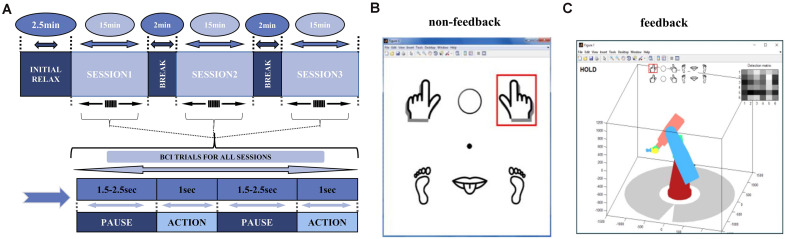
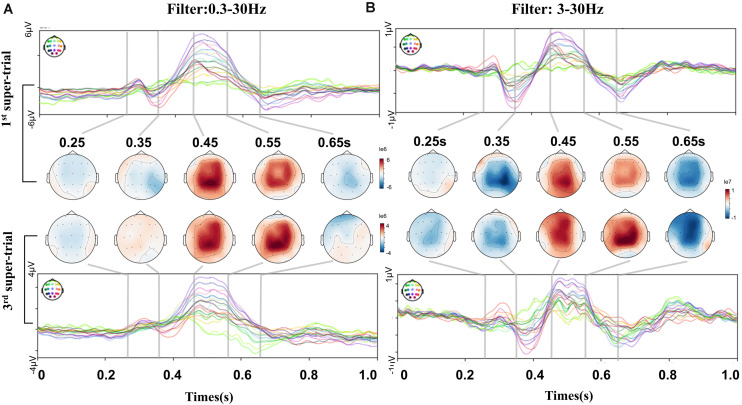
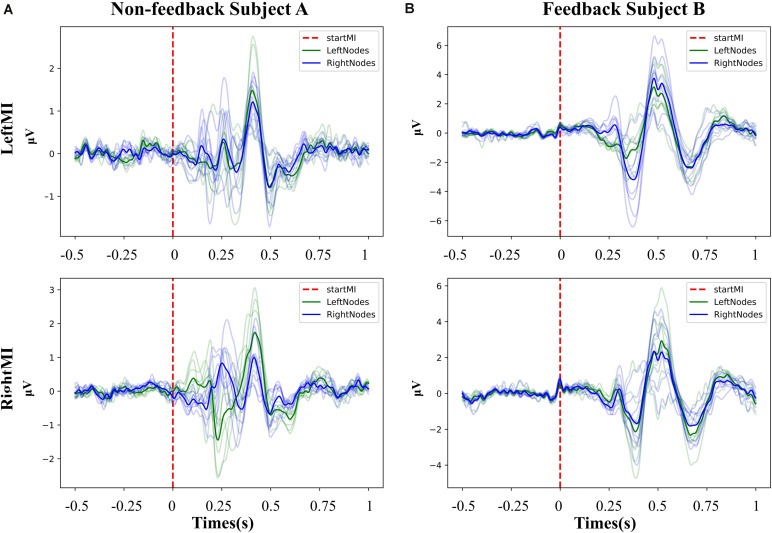
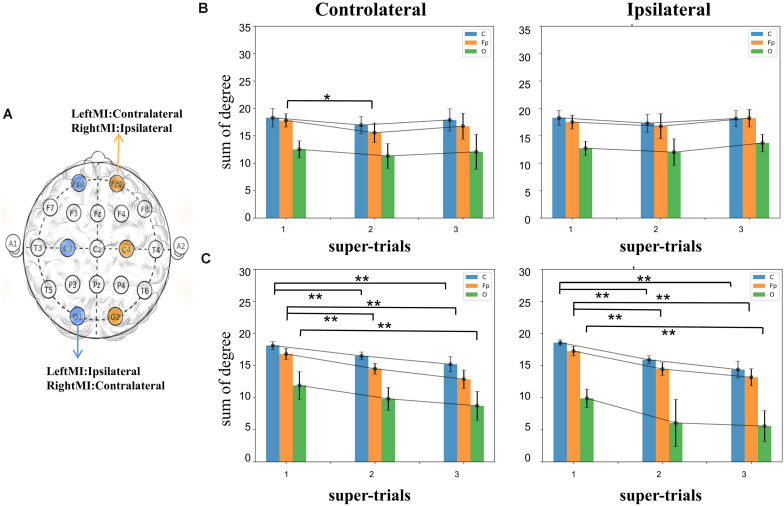
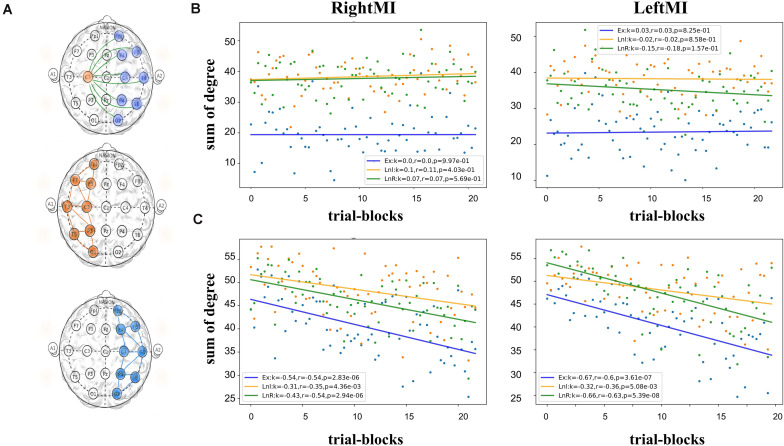
Using an EEG-BCI system, we analyzed the changes in short-term (about 1-h) MI training data with and without visual feedback, respectively. We first examined the EEG signal's Mu band power's attenuation caused by Event-Related Desynchronization (ERD). Then we use the EEG's Event-Related Potentials (ERP) features to construct brain networks and evaluate the training from multiple perspectives: small-scale based on single nodes, medium-scale based on hemispheres, and large-scale based on all-brain.
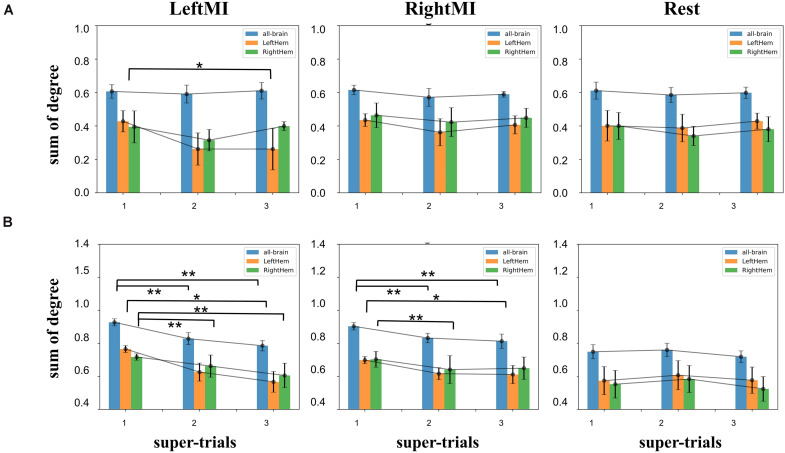
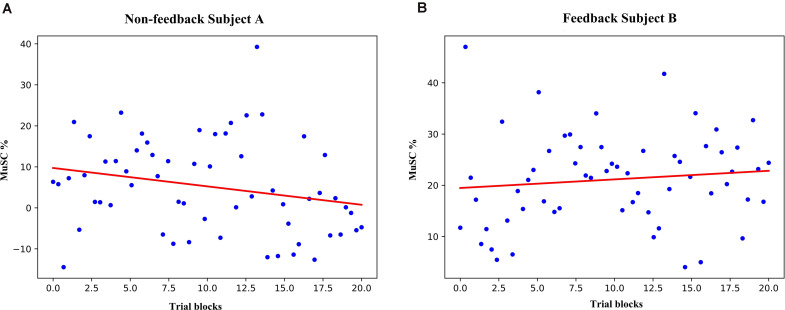
Results showed no significant difference in the ERD power attenuation estimation in both groups. But the neurofeedback group's ERP brain network parameters had substantial changes and trend properties compared to the group without feedback. The neurofeedback group's Mu band power's attenuation increased but not significantly (fitting line slope = 0.2, -test value > 0.05) after the short-term MI training, while the non-feedback group occurred an insignificant decrease (fitting line slope = -0.4, -test value > 0.05). In the ERP-based brain network analysis, the neurofeedback group's network parameters were attenuated in all scales significantly (-test value: < 0.01); while the non-feedback group's most network parameters didn't change significantly (-test value: > 0.05).
The MI-BCI training's short-term effects does not show up in the ERD analysis significantly but can be detected by ERP-based network analysis significantly. Results inspire the efficient evaluation of short-term rehabilitation training and provide a useful reference for subsequent studies.
结合神经反馈,基于运动想象(MI)的脑机接口(BCI)已成为治疗因脑部神经损伤(如中风后偏瘫)导致的运动功能障碍的一种有效的长期治疗方法。然而,个体神经差异导致康复训练单次疗程存在变异性。研究短时间训练对脑功能模式的影响有助于评估和规范康复训练的短疗程。在本文中,我们使用脑电图(EEG)信号来探究短期康复训练后脑模式的变化。
使用一个EEG-BCI系统,我们分别分析了有视觉反馈和无视觉反馈的短期(约1小时)MI训练数据的变化。我们首先检查了由事件相关去同步化(ERD)引起的EEG信号的Mu波段功率衰减。然后我们使用EEG的事件相关电位(ERP)特征来构建脑网络,并从多个角度评估训练:基于单个节点的小规模、基于半球的中规模和基于全脑的大规模。
结果显示两组在ERD功率衰减估计方面无显著差异。但与无反馈组相比,神经反馈组的ERP脑网络参数有实质性变化和趋势特性。短期MI训练后,神经反馈组的Mu波段功率衰减增加但不显著(拟合线斜率 = 0.2,检验值 > 0.05),而无反馈组出现不显著的下降(拟合线斜率 = -0.4,检验值 > 0.05)。在基于ERP的脑网络分析中,神经反馈组的网络参数在所有尺度上均显著衰减(检验值:< 0.01);而无反馈组的大多数网络参数无显著变化(检验值:> 0.05)。
MI-BCI训练的短期效果在ERD分析中未显著显现,但可通过基于ERP的网络分析显著检测到。结果为短期康复训练的有效评估提供了启示,并为后续研究提供了有用的参考。