Nag Moupriya, Lahiri Dibyajit, Mukherjee Dipro, Banerjee Ritwik, Garai Sayantani, Sarkar Tanmay, Ghosh Sujay, Dey Ankita, Ghosh Sougata, Pattnaik Smaranika, Edinur Hisham Atan, Kari Zulhisyam Abdul, Pati Siddhartha, Ray Rina Rani
Department of Biotechnology, University of Engineering & Management, Kolkata 700160, India.
Department of Food Technology and Bio-Chemical Engineering, Jadavpur University, Kolkata 700032, India.
Polymers (Basel). 2021 Jul 30;13(15):2533. doi: 10.3390/polym13152533.
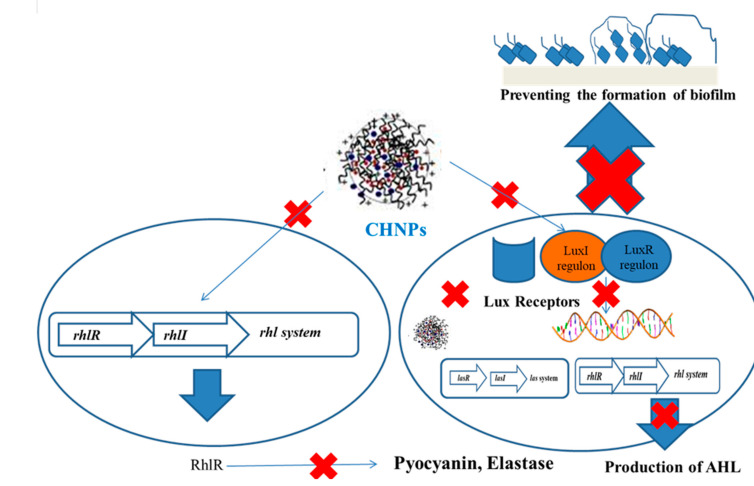
The biggest challenge in the present-day healthcare scenario is the rapid emergence and spread of antimicrobial resistance due to the rampant use of antibiotics in daily therapeutics. Such drug resistance is associated with the enhancement of microbial virulence and the acquisition of the ability to evade the host's immune response under the shelter of a biofilm. Quorum sensing (QS) is the mechanism by which the microbial colonies in a biofilm modulate and intercept communication without direct interaction. Hence, the eradication of biofilms through hindering this communication will lead to the successful management of drug resistance and may be a novel target for antimicrobial chemotherapy. Chitosan shows microbicidal activities by acting electrostatically with its positively charged amino groups, which interact with anionic moieties on microbial species, causing enhanced membrane permeability and eventual cell death. Therefore, nanoparticles (NPs) prepared with chitosan possess a positive surface charge and mucoadhesive properties that can adhere to microbial mucus membranes and release their drug load in a constant release manner. As the success in therapeutics depends on the targeted delivery of drugs, chitosan nanomaterial, which displays low toxicity, can be safely used for eradicating a biofilm through attenuating the quorum sensing (QS). Since the anti-biofilm potential of chitosan and its nano-derivatives are reported for various microorganisms, these can be used as attractive tools for combating chronic infections and for the preparation of functionalized nanomaterials for different medical devices, such as orthodontic appliances. This mini-review focuses on the mechanism of the downregulation of quorum sensing using functionalized chitosan nanomaterials and the future prospects of its applications.
当今医疗保健领域面临的最大挑战是,由于抗生素在日常治疗中的大量使用,抗菌药物耐药性迅速出现并传播。这种耐药性与微生物毒力增强以及在生物膜保护下逃避宿主免疫反应能力的获得有关。群体感应(QS)是生物膜中的微生物菌落无需直接相互作用就能调节和拦截通讯的机制。因此,通过阻碍这种通讯来根除生物膜将成功控制耐药性,这可能是抗菌化疗的一个新靶点。壳聚糖通过其带正电荷的氨基静电作用表现出杀菌活性,这些氨基与微生物表面的阴离子部分相互作用,导致膜通透性增强并最终导致细胞死亡。因此,用壳聚糖制备的纳米颗粒(NPs)具有正表面电荷和粘膜粘附特性,能够粘附在微生物粘膜上并以持续释放的方式释放其药物负载。由于治疗的成功取决于药物的靶向递送,壳聚糖纳米材料毒性低,可以安全地用于通过减弱群体感应(QS)来根除生物膜。由于壳聚糖及其纳米衍生物对多种微生物具有抗生物膜潜力,因此它们可作为对抗慢性感染的有吸引力的工具,并用于制备用于不同医疗设备(如正畸矫治器)的功能化纳米材料。本综述聚焦于使用功能化壳聚糖纳米材料下调群体感应的机制及其应用的未来前景。