Zhang Yanan, Hou Dajun, Wang Zelong, Cai Ning, Au Chaktong
Hubei Key Laboratory for Processing and Application of Catalytic Materials, College of Chemistry and Chemical Engineering, Huanggang Normal University, Huanggang 438000, China.
Key Laboratory for Green Chemical Process of Ministry of Education, Hubei Key Laboratory for Novel Reactor and Green Chemistry Technology, School of Chemical Engineering and Pharmacy, Wuhan Institute of Technology, Wuhan 430073, China.
Polymers (Basel). 2021 Jul 31;13(15):2540. doi: 10.3390/polym13152540.
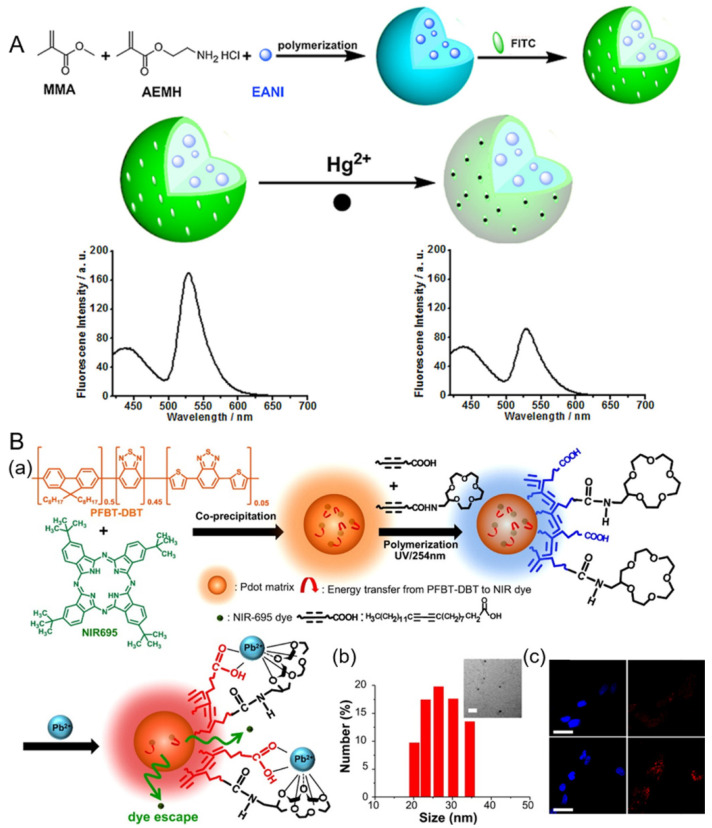
Owing to the unique optophysical properties of nanomaterials and their self-calibration characteristics, nanomaterial-based (e.g., polymer dots (Pdots) quantum dots (QDs), silicon nanorods (SiNRs), and gold nanoparticle (AuNPs), etc.) ratiometric fluorescent sensors play an essential role in numerous biosensing and cell imaging applications. The dual-emission ratiometric fluorescence technique has the function of effective internal referencing, thereby avoiding the influence of various analyte-independent confounding factors. The sensitivity and precision of the detection can therefore be greatly improved. In this review, the recent progress in nanomaterial-based dual-emission ratiometric fluorescent biosensors is systematically summarized. First, we introduce two general design approaches for dual-emission ratiometric fluorescent sensors, involving ratiometric fluorescence with changes of one response signal and two reversible signals. Then, some recent typical examples of nanomaterial-based dual-emission ratiometric fluorescent biosensors are illustrated in detail. Finally, probable challenges and future outlooks for dual-emission ratiometric fluorescent nanosensors for biosensing and cell imaging are rationally discussed.
由于纳米材料独特的光物理性质及其自校准特性,基于纳米材料的(如聚合物点(Pdots)、量子点(QDs)、硅纳米棒(SiNRs)和金纳米颗粒(AuNPs)等)比率荧光传感器在众多生物传感和细胞成像应用中发挥着重要作用。双发射比率荧光技术具有有效的内部参考功能,从而避免了各种与分析物无关的混杂因素的影响。因此,可以大大提高检测的灵敏度和精度。在这篇综述中,系统地总结了基于纳米材料的双发射比率荧光生物传感器的最新进展。首先,我们介绍了双发射比率荧光传感器的两种通用设计方法,包括具有一个响应信号变化的比率荧光和两个可逆信号。然后,详细说明了一些基于纳米材料的双发射比率荧光生物传感器的近期典型实例。最后,合理讨论了用于生物传感和细胞成像的双发射比率荧光纳米传感器可能面临的挑战和未来展望。