Coccia Francesca, Gryshchuk Liudmyla, Moimare Pierluigi, Bossa Ferdinando de Luca, Santillo Chiara, Barak-Kulbak Einav, Verdolotti Letizia, Boggioni Laura, Lama Giuseppe Cesare
Institute of Chemical Science and Technologies-"G. Natta", National Research Council, via A. Corti 12, 20133 Milan, Italy.
Leibniz-Institut für Verbundwerkstoffe GmbH, Technische Universität, Erwin-Schrödinger-Straße 58, 67663 Kaiserslautern, Germany.
Polymers (Basel). 2021 Jul 31;13(15):2556. doi: 10.3390/polym13152556.
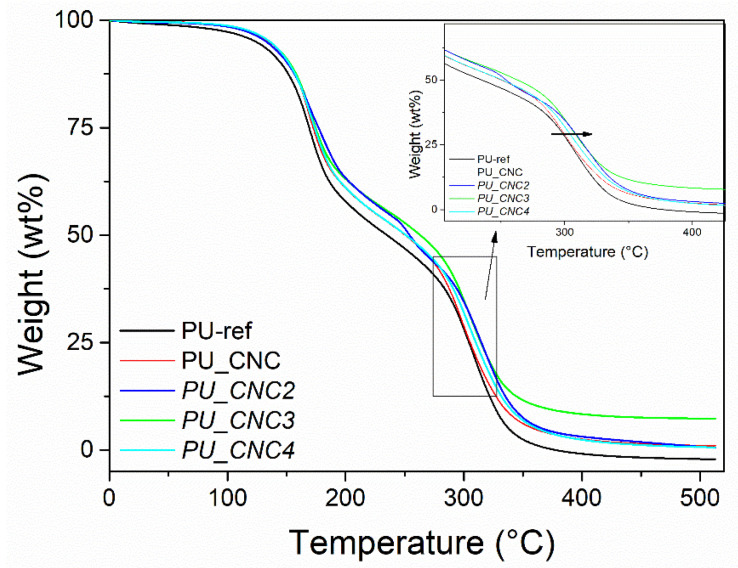
Cellulose Nanocrystals, CNC, opportunely functionalized are proposed as reactive fillers in bio-based flexible polyurethane foams to improve, mainly, their mechanical properties. To overcome the cellulose hydrophilicity, CNC was functionalized on its surface by linking covalently a suitable bio-based polyol to obtain a grafted-CNC. The polyols grafted with CNC will react with the isocyanate in the preparation of the polyurethane foams. An attractive way to introduce functionalities on cellulose surfaces in aqueous media is silane chemistry by using functional trialkoxy silanes, X-Si (OR). Here, we report the synthesis of CNC-grafted-biopolyol to be used as a successful reactive filler in bio-based polyurethane foams, PUFs. The alkyl silanes were used as efficient coupling agents for the grafting of CNC and bio-polyols. Four strategies to obtain CNC-grafted-polyol were fine-tuned to use CNC as an active filler in PUFs. The effective grafting of the bio polyol on CNC was evaluated by FTIR analysis, and the amount of grafted polyol by thermogravimetric analysis. Finally, the morphological, thermal and mechanical properties and hydrophobicity of filled PUFs were thoughtfully assessed as well as the structure of the foams and, in particular, of the edges and walls of the cell foams by means of the Gibson-Ashby model. Improved thermal stability and mechanical properties of PU foams containing CNC-functionalized-polyol are observed. The morphology of the PU foams is also influenced by the functionalization of the CNC.
经适当功能化处理的纤维素纳米晶体(CNC)被提议用作生物基柔性聚氨酯泡沫中的反应性填料,主要用于改善其机械性能。为克服纤维素的亲水性,通过将合适的生物基多元醇共价连接到CNC表面,对其进行功能化处理,以获得接枝CNC。接枝有CNC的多元醇将在聚氨酯泡沫的制备过程中与异氰酸酯发生反应。在水性介质中在纤维素表面引入官能团的一种有吸引力的方法是通过使用功能性三烷氧基硅烷X-Si(OR)进行硅烷化学处理。在此,我们报告了用于生物基聚氨酯泡沫(PUF)中作为成功反应性填料的接枝生物多元醇的CNC的合成。烷基硅烷用作CNC和生物多元醇接枝的有效偶联剂。对四种获得接枝多元醇的CNC的策略进行了微调,以便在PUF中使用CNC作为活性填料。通过傅里叶变换红外光谱(FTIR)分析评估生物多元醇在CNC上的有效接枝,并通过热重分析评估接枝多元醇的量。最后,通过吉布森-阿什比模型仔细评估了填充PUF的形态、热性能、机械性能和疏水性以及泡沫的结构,特别是泡孔泡沫边缘和壁的结构。观察到含有CNC功能化多元醇的PU泡沫的热稳定性和机械性能得到改善。PU泡沫的形态也受到CNC功能化的影响。