INL, Avenida Mestre José Veiga, s/n, 4715-330, Braga, Portugal.
IFIMUP-IN, Rua do Campo Alegre, 678, 4169-007, Porto, Portugal.
Sci Rep. 2021 Aug 9;11(1):16094. doi: 10.1038/s41598-021-95569-4.
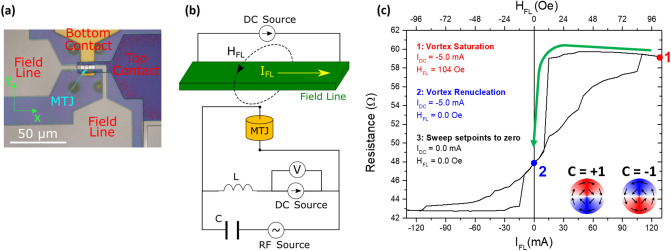
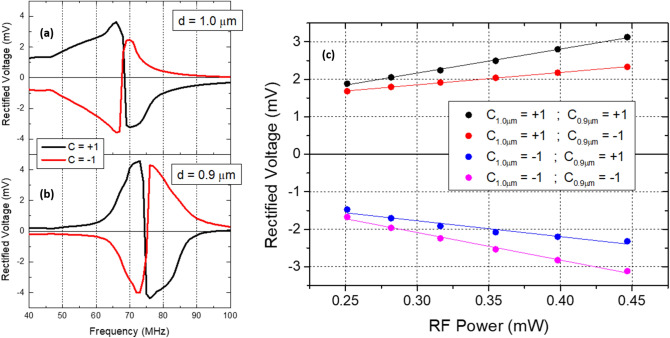
In this work, a new mechanism to combine a non-volatile behaviour with the spin diode detection of a vortex-based spin torque nano-oscillator (STVO) is presented. Experimentally, it is observed that the spin diode response of the oscillator depends on the vortex chirality. Consequently, fixing the frequency of the incoming signal and switching the vortex chirality results in a different rectified voltage. In this way, the chirality can be deterministically controlled via the application of electrical signals injected locally in the device, resulting in a non-volatile control of the output voltage for a given input frequency. Micromagnetic simulations corroborate the experimental results and show the main contribution of the Oersted field created by the input RF current density in defining two distinct spin diode detections for different chiralities. By using two non-identical STVOs, we show how these devices can be used as programmable non-volatile synapses in artificial neural networks.
在这项工作中,提出了一种新的机制,将非易失性行为与基于涡旋的自旋扭矩纳米振荡器 (STVO) 的自旋二极体检测相结合。实验观察到,振荡器的自旋二极体响应取决于涡旋手性。因此,固定输入信号的频率并切换涡旋手性会导致不同的整流电压。通过在设备中局部施加电信号来确定性地控制手性,可以实现给定输入频率下输出电压的非易失性控制。微磁模拟证实了实验结果,并表明由输入射频电流密度产生的奥斯特场的主要贡献在于为不同手性定义了两种不同的自旋二极体检测。通过使用两个非相同的 STVO,我们展示了如何将这些设备用作人工神经网络中的可编程非易失性突触。