Institute of Photoelectronic Thin Film Devices and Technology, Key Laboratory of Optoelectronic Thin Film Devices and Technology of Tianjin, College of Electrical Information and Optical Engineering, School of Materials Science and Engineering, National Institute for Advanced Materials, Nankai University, Tianjin, P. R. China.
Nat Commun. 2021 Feb 16;12(1):1068. doi: 10.1038/s41467-021-21319-9.
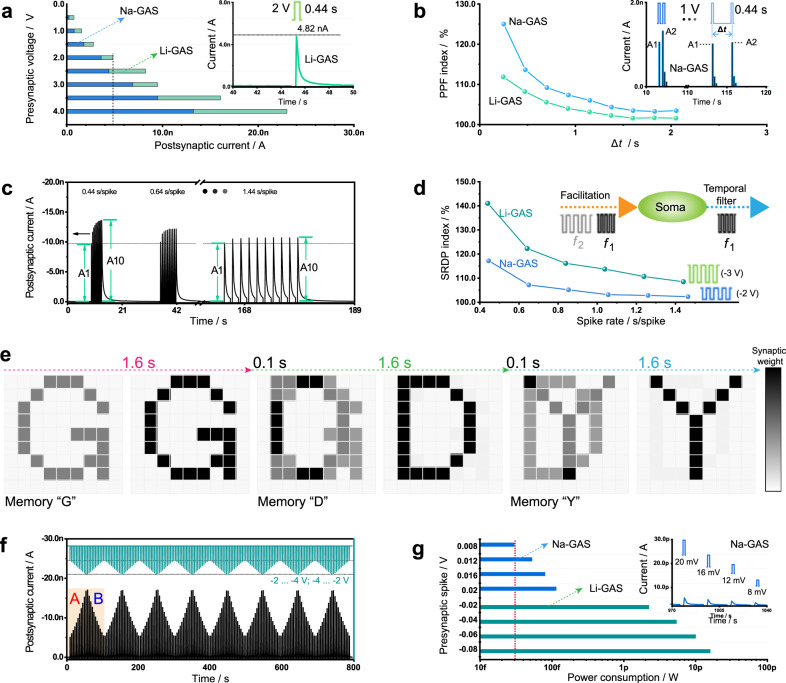
A graphdiyne-based artificial synapse (GAS), exhibiting intrinsic short-term plasticity, has been proposed to mimic biological signal transmission behavior. The impulse response of the GAS has been reduced to several millivolts with competitive femtowatt-level consumption, exceeding the biological level by orders of magnitude. Most importantly, the GAS is capable of parallelly processing signals transmitted from multiple pre-neurons and therefore realizing dynamic logic and spatiotemporal rules. It is also found that the GAS is thermally stable (at 353 K) and environmentally stable (in a relative humidity up to 35%). Our artificial efferent nerve, connecting the GAS with artificial muscles, has been demonstrated to complete the information integration of pre-neurons and the information output of motor neurons, which is advantageous for coalescing multiple sensory feedbacks and reacting to events. Our synaptic element has potential applications in bioinspired peripheral nervous systems of soft electronics, neurorobotics, and biohybrid systems of brain-computer interfaces.
基于石墨炔的人工突触(GAS)具有固有短期可塑性,被提议用于模拟生物信号传输行为。GAS 的脉冲响应已降低至几毫伏,具有竞争的毫微微瓦级消耗,超过了生物水平的几个数量级。最重要的是,GAS 能够并行处理来自多个前神经元传输的信号,从而实现动态逻辑和时空规则。还发现 GAS 具有热稳定性(在 353K 时)和环境稳定性(相对湿度高达 35%)。我们的人工传出神经,将 GAS 与人工肌肉连接起来,已经证明可以完成前神经元的信息整合和运动神经元的信息输出,这有利于融合多个感觉反馈并对事件做出反应。我们的突触元件在软电子、神经机器人学和脑机接口的生物混合系统的仿生周围神经系统中具有潜在的应用。