• 文献检索
  • 文档翻译
  • 深度研究
  • 学术资讯
  • Suppr Zotero 插件Zotero 插件
  • 邀请有礼
  • 套餐&价格
  • 历史记录
应用&插件
Suppr Zotero 插件Zotero 插件浏览器插件Mac 客户端Windows 客户端微信小程序
定价
高级版会员购买积分包购买API积分包
服务
文献检索文档翻译深度研究API 文档MCP 服务
关于我们
关于 Suppr公司介绍联系我们用户协议隐私条款
关注我们

Suppr 超能文献

核心技术专利:CN118964589B侵权必究
粤ICP备2023148730 号-1Suppr @ 2026

文献检索

告别复杂PubMed语法,用中文像聊天一样搜索,搜遍4000万医学文献。AI智能推荐,让科研检索更轻松。

立即免费搜索

文件翻译

保留排版,准确专业,支持PDF/Word/PPT等文件格式,支持 12+语言互译。

免费翻译文档

深度研究

AI帮你快速写综述,25分钟生成高质量综述,智能提取关键信息,辅助科研写作。

立即免费体验

深度学习和公民科学使我们能够从照片中自动预测植物特征。

Deep learning and citizen science enable automated plant trait predictions from photographs.

机构信息

Institute of Geography and Geoecology, Karlsruhe Institute of Technology (KIT), 76131, Karlsruhe, Germany.

Department of Environmental Science, Institute for Water and Wetland Research, Radboud University, Nijmegen, The Netherlands.

出版信息

Sci Rep. 2021 Aug 12;11(1):16395. doi: 10.1038/s41598-021-95616-0.

DOI:10.1038/s41598-021-95616-0
PMID:34385494
原文链接:https://pmc.ncbi.nlm.nih.gov/articles/PMC8361087/
Abstract

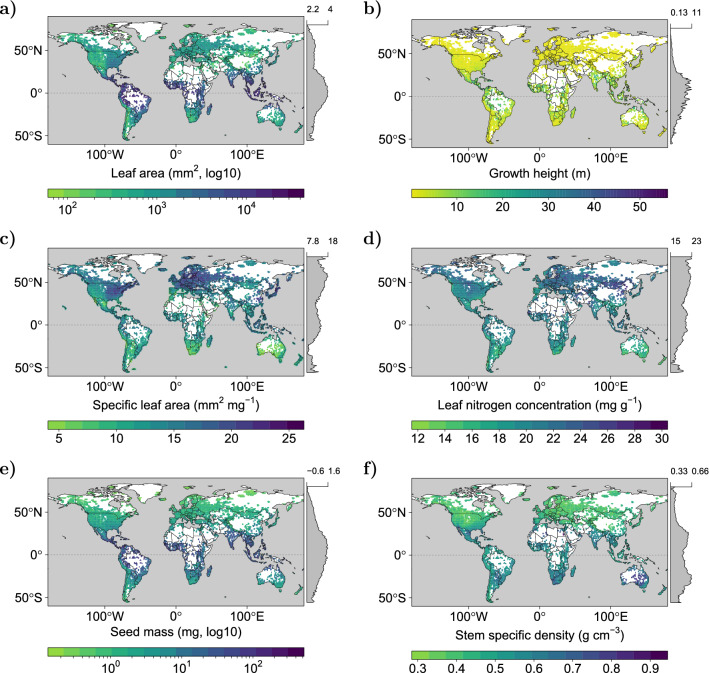
Plant functional traits ('traits') are essential for assessing biodiversity and ecosystem processes, but cumbersome to measure. To facilitate trait measurements, we test if traits can be predicted through visible morphological features by coupling heterogeneous photographs from citizen science (iNaturalist) with trait observations (TRY database) through Convolutional Neural Networks (CNN). Our results show that image features suffice to predict several traits representing the main axes of plant functioning. The accuracy is enhanced when using CNN ensembles and incorporating prior knowledge on trait plasticity and climate. Our results suggest that these models generalise across growth forms, taxa and biomes around the globe. We highlight the applicability of this approach by producing global trait maps that reflect known macroecological patterns. These findings demonstrate the potential of Big Data derived from professional and citizen science in concert with CNN as powerful tools for an efficient and automated assessment of Earth's plant functional diversity.

摘要

植物功能性状(“性状”)是评估生物多样性和生态系统过程的基础,但测量起来很繁琐。为了便于性状测量,我们通过卷积神经网络(CNN)将来自公民科学(iNaturalist)的异质照片与性状观测(TRY 数据库)结合起来,检验性状是否可以通过可见的形态特征来预测。结果表明,图像特征足以预测几个代表植物主要功能轴的性状。当使用 CNN 集成并纳入性状可塑性和气候的先验知识时,准确性会提高。我们的结果表明,这些模型在全球范围内的生长形式、分类群和生物群中具有通用性。我们通过生成反映已知宏观生态模式的全球性状图来突出这种方法的适用性。这些发现证明了来自专业和公民科学的大数据与 CNN 相结合作为一种高效和自动化评估地球植物功能多样性的强大工具的潜力。

https://cdn.ncbi.nlm.nih.gov/pmc/blobs/c78c/8361087/5860acbf88a4/41598_2021_95616_Fig5_HTML.jpg
https://cdn.ncbi.nlm.nih.gov/pmc/blobs/c78c/8361087/0cedf311053e/41598_2021_95616_Fig1_HTML.jpg
https://cdn.ncbi.nlm.nih.gov/pmc/blobs/c78c/8361087/4db88998afba/41598_2021_95616_Fig2_HTML.jpg
https://cdn.ncbi.nlm.nih.gov/pmc/blobs/c78c/8361087/7c6aa66ad601/41598_2021_95616_Fig3_HTML.jpg
https://cdn.ncbi.nlm.nih.gov/pmc/blobs/c78c/8361087/254337d67b15/41598_2021_95616_Fig4_HTML.jpg
https://cdn.ncbi.nlm.nih.gov/pmc/blobs/c78c/8361087/5860acbf88a4/41598_2021_95616_Fig5_HTML.jpg
https://cdn.ncbi.nlm.nih.gov/pmc/blobs/c78c/8361087/0cedf311053e/41598_2021_95616_Fig1_HTML.jpg
https://cdn.ncbi.nlm.nih.gov/pmc/blobs/c78c/8361087/4db88998afba/41598_2021_95616_Fig2_HTML.jpg
https://cdn.ncbi.nlm.nih.gov/pmc/blobs/c78c/8361087/7c6aa66ad601/41598_2021_95616_Fig3_HTML.jpg
https://cdn.ncbi.nlm.nih.gov/pmc/blobs/c78c/8361087/254337d67b15/41598_2021_95616_Fig4_HTML.jpg
https://cdn.ncbi.nlm.nih.gov/pmc/blobs/c78c/8361087/5860acbf88a4/41598_2021_95616_Fig5_HTML.jpg

相似文献

1
Deep learning and citizen science enable automated plant trait predictions from photographs.深度学习和公民科学使我们能够从照片中自动预测植物特征。
Sci Rep. 2021 Aug 12;11(1):16395. doi: 10.1038/s41598-021-95616-0.
2
Citizen science plant observations encode global trait patterns.公民科学植物观测记录全球性状模式。
Nat Ecol Evol. 2022 Dec;6(12):1850-1859. doi: 10.1038/s41559-022-01904-x. Epub 2022 Oct 20.
3
Using Convolutional Neural Networks to Efficiently Extract Immense Phenological Data From Community Science Images.利用卷积神经网络从社区科学图像中高效提取大量物候数据。
Front Plant Sci. 2022 Jan 17;12:787407. doi: 10.3389/fpls.2021.787407. eCollection 2021.
4
TRY plant trait database - enhanced coverage and open access.TRY 植物性状数据库——增强的涵盖范围和开放获取。
Glob Chang Biol. 2020 Jan;26(1):119-188. doi: 10.1111/gcb.14904. Epub 2019 Dec 31.
5
Climatic and soil factors explain the two-dimensional spectrum of global plant trait variation.气候和土壤因素解释了全球植物性状变化的二维谱。
Nat Ecol Evol. 2022 Jan;6(1):36-50. doi: 10.1038/s41559-021-01616-8. Epub 2021 Dec 23.
6
Large-bodied birds are over-represented in unstructured citizen science data.大体型鸟类在非结构化的公民科学数据中占比过高。
Sci Rep. 2021 Sep 24;11(1):19073. doi: 10.1038/s41598-021-98584-7.
7
Leaf and stem economics spectra drive diversity of functional plant traits in a dynamic global vegetation model.叶和茎经济谱驱动动态全球植被模型中功能性植物性状的多样性。
Glob Chang Biol. 2015 Jul;21(7):2711-2725. doi: 10.1111/gcb.12870. Epub 2015 Apr 9.
8
Multispecies deep learning using citizen science data produces more informative plant community models.利用公民科学数据进行多物种深度学习可生成更具信息量的植物群落模型。
Nat Commun. 2024 May 24;15(1):4421. doi: 10.1038/s41467-024-48559-9.
9
Evolutionary history resolves global organization of root functional traits.进化历史决定了根系功能性状的全球组织。
Nature. 2018 Mar 1;555(7694):94-97. doi: 10.1038/nature25783. Epub 2018 Feb 21.
10
Origin context of trait data matters for predictions of community performance in a grassland biodiversity experiment.性状数据的起源背景对草原生物多样性实验中群落表现的预测很重要。
Ecology. 2018 May;99(5):1214-1226. doi: 10.1002/ecy.2216. Epub 2018 Apr 18.

引用本文的文献

1
Using large language models to extract plant functional traits from unstructured text.使用大语言模型从非结构化文本中提取植物功能性状。
Appl Plant Sci. 2025 Jun 3;13(3):e70011. doi: 10.1002/aps3.70011. eCollection 2025 May-Jun.
2
Impacts of leaf traits on vegetation optical properties in Earth system modeling.叶片性状对地球系统建模中植被光学特性的影响。
Nat Commun. 2025 May 29;16(1):4968. doi: 10.1038/s41467-025-60149-x.
3
Evaluating the method reproducibility of deep learning models in biodiversity research.评估深度学习模型在生物多样性研究中的方法可重复性。

本文引用的文献

1
Assessing the reliability of predicted plant trait distributions at the global scale.评估全球尺度下预测的植物性状分布的可靠性。
Glob Ecol Biogeogr. 2020 Jun;29(6):1034-1051. doi: 10.1111/geb.13086. Epub 2020 Mar 20.
2
TRY plant trait database - enhanced coverage and open access.TRY 植物性状数据库——增强的涵盖范围和开放获取。
Glob Chang Biol. 2020 Jan;26(1):119-188. doi: 10.1111/gcb.14904. Epub 2019 Dec 31.
3
Convolutional Neural Networks enable efficient, accurate and fine-grained segmentation of plant species and communities from high-resolution UAV imagery.
PeerJ Comput Sci. 2025 Feb 5;11:e2618. doi: 10.7717/peerj-cs.2618. eCollection 2025.
4
Canopy functional trait variation across Earth's tropical forests.地球热带森林冠层功能性状的变化
Nature. 2025 May;641(8061):129-136. doi: 10.1038/s41586-025-08663-2. Epub 2025 Mar 5.
5
Artificial intelligence for geoscience: Progress, challenges, and perspectives.地球科学中的人工智能:进展、挑战与展望。
Innovation (Camb). 2024 Aug 22;5(5):100691. doi: 10.1016/j.xinn.2024.100691. eCollection 2024 Sep 9.
6
Global patterns of plant functional traits and their relationships to climate.全球植物功能性状模式及其与气候的关系。
Commun Biol. 2024 Sep 13;7(1):1136. doi: 10.1038/s42003-024-06777-3.
7
Crop Identification Using Deep Learning on LUCAS Crop Cover Photos.基于LUCAS作物覆盖照片的深度学习作物识别
Sensors (Basel). 2023 Jul 11;23(14):6298. doi: 10.3390/s23146298.
8
Temporal stability of the hybrid zone between magpie-jays revealed through comparison of museum specimens and iNaturalist photos.通过博物馆标本与iNaturalist照片的比较揭示喜鹊鸦杂交区的时间稳定性。
Ecol Evol. 2023 Mar 15;13(3):e9863. doi: 10.1002/ece3.9863. eCollection 2023 Mar.
9
Applicability of Point- and Polygon-Based Vegetation Monitoring Data to Identify Soil, Hydrological and Climatic Driving Forces of Biological Invasions-A Case Study of , and .基于点和多边形的植被监测数据在识别生物入侵的土壤、水文和气候驱动力方面的适用性——以……、……和……为例的案例研究
Plants (Basel). 2023 Feb 14;12(4):855. doi: 10.3390/plants12040855.
卷积神经网络可实现从高分辨率无人机图像中对植物物种和群落进行高效、准确和精细的分割。
Sci Rep. 2019 Nov 27;9(1):17656. doi: 10.1038/s41598-019-53797-9.
4
Tracking vegetation phenology across diverse biomes using Version 2.0 of the PhenoCam Dataset.利用 PhenoCam 数据集 2.0 版追踪不同生物群落的植被物候。
Sci Data. 2019 Oct 22;6(1):222. doi: 10.1038/s41597-019-0229-9.
5
Predicting pathogenicity of missense variants with weakly supervised regression.利用弱监督回归预测错义变异的致病性。
Hum Mutat. 2019 Sep;40(9):1579-1592. doi: 10.1002/humu.23826. Epub 2019 Aug 7.
6
Uncovering Ecological Patterns with Convolutional Neural Networks.卷积神经网络揭示生态模式。
Trends Ecol Evol. 2019 Aug;34(8):734-745. doi: 10.1016/j.tree.2019.03.006. Epub 2019 May 8.
7
Deep learning and process understanding for data-driven Earth system science.深度学习与过程理解在数据驱动的地球系统科学中的应用。
Nature. 2019 Feb;566(7743):195-204. doi: 10.1038/s41586-019-0912-1. Epub 2019 Feb 13.
8
Global trait-environment relationships of plant communities.全球植物群落的特质-环境关系。
Nat Ecol Evol. 2018 Dec;2(12):1906-1917. doi: 10.1038/s41559-018-0699-8. Epub 2018 Nov 19.
9
The spatial and temporal domains of modern ecology.现代生态学的时空领域。
Nat Ecol Evol. 2018 May;2(5):819-826. doi: 10.1038/s41559-018-0524-4. Epub 2018 Apr 2.
10
Future global productivity will be affected by plant trait response to climate.未来的全球生产力将受到植物特征对气候的响应的影响。
Sci Rep. 2018 Feb 12;8(1):2870. doi: 10.1038/s41598-018-21172-9.