Zhang Wensi, Wang Yinzhao, Liu Li, Pan Yongxin, Lin Wei
Key Laboratory of Earth and Planetary Physics, Institute of Geology and Geophysics, Chinese Academy of Sciences, Beijing, China.
France-China Joint Laboratory for Evolution and Development of Magnetotactic Multicellular Organisms, Chinese Academy of Sciences, Beijing, China.
Front Microbiol. 2021 Jul 27;12:690052. doi: 10.3389/fmicb.2021.690052. eCollection 2021.
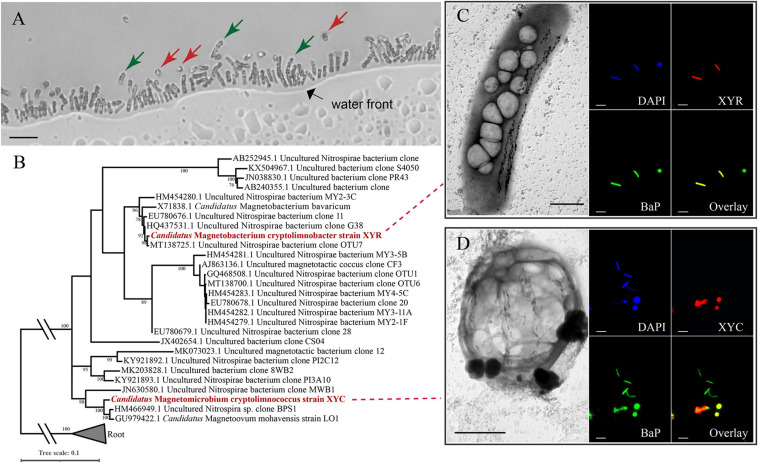
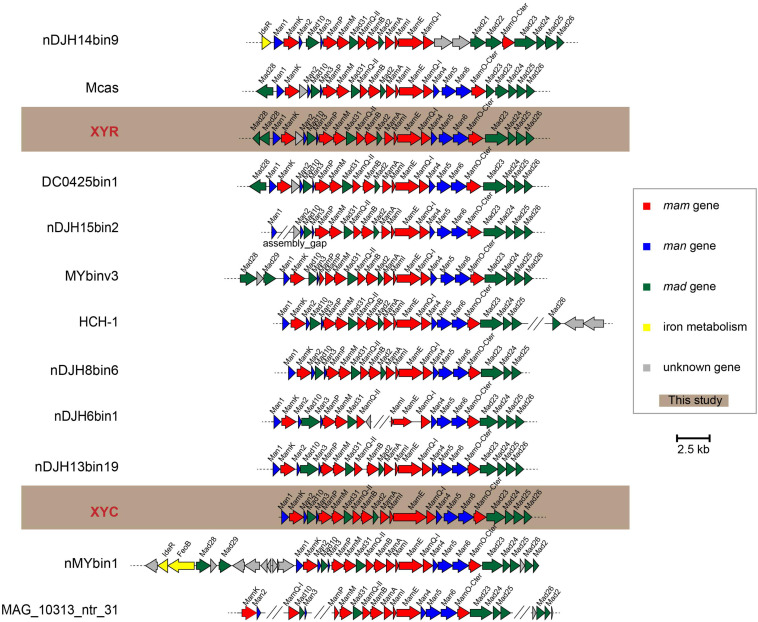
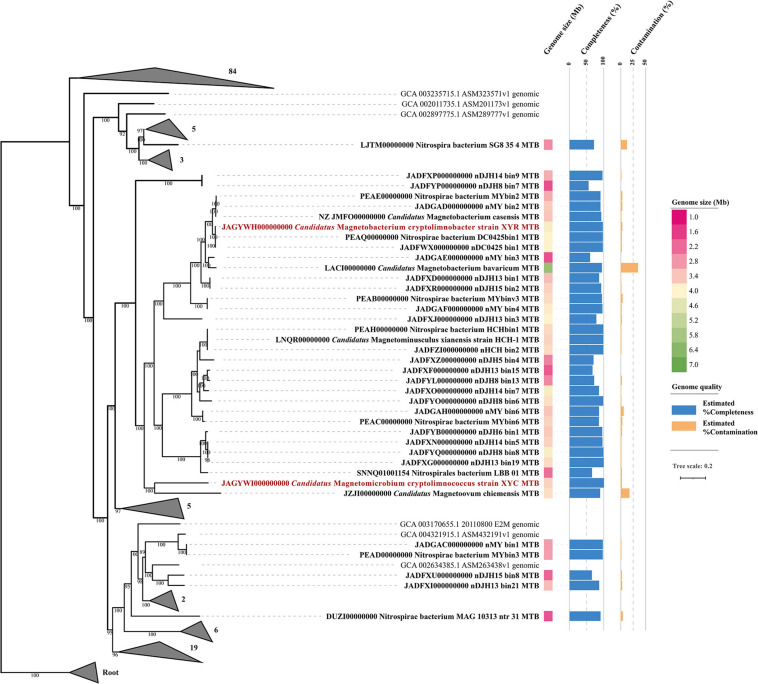
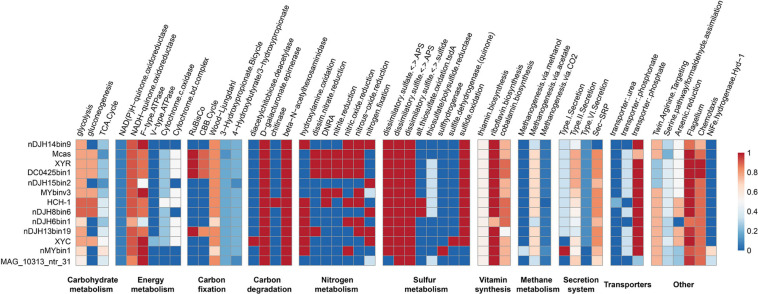
Magnetotactic bacteria (MTB) are a group of microbes that biomineralize membrane-bound, nanosized magnetite (FeO), and/or greigite (FeS) crystals in intracellular magnetic organelle magnetosomes. MTB belonging to the phylum can form up to several hundreds of FeO magnetosome crystals and dozens of sulfur globules in a single cell. These MTB are widespread in aquatic environments and sometimes account for a significant proportion of microbial biomass near the oxycline, linking these lineages to the key steps of global iron and sulfur cycling. Despite their ecological and biogeochemical importance, our understanding of the diversity and ecophysiology of magnetotactic is still very limited because this group of MTB remains unculturable. Here, we identify and characterize two previously unknown MTB populations within the phylum through a combination of 16S rRNA gene-based and genome-resolved metagenomic analyses. These two MTB populations represent distinct morphotypes (rod-shaped and coccoid, designated as XYR, and XYC, respectively), and both form more than 100 bullet-shaped magnetosomal crystals per cell. High-quality draft genomes of XYR and XYC have been reconstructed, and they represent a novel species and a novel genus, respectively, according to their average amino-acid identity values with respect to available genomes. Accordingly, the names Magnetobacterium cryptolimnobacter and Magnetomicrobium cryptolimnococcus for XYR and XYC, respectively, were proposed. Further comparative genomic analyses of XYR, XYC, and previously reported magnetotactic reveal the general metabolic potential of this MTB group in distinct microenvironments, including CO fixation, dissimilatory sulfate reduction, sulfide oxidation, nitrogen fixation, or denitrification processes. A remarkably conserved magnetosome gene cluster has been identified across MTB genomes, indicating its putative important adaptive roles in these bacteria. Taken together, the present study provides novel insights into the phylogenomic diversity and ecophysiology of this intriguing, yet poorly understood MTB group.
趋磁细菌(MTB)是一类微生物,它们在细胞内的磁性细胞器磁小体中生物矿化形成膜结合的纳米级磁铁矿(FeO)和/或硫复铁矿(FeS)晶体。属于该门的趋磁细菌在单个细胞中最多可形成数百个FeO磁小体晶体和数十个硫球。这些趋磁细菌广泛分布于水生环境中,有时在氧化还原cline附近的微生物生物量中占很大比例,将这些谱系与全球铁和硫循环的关键步骤联系起来。尽管它们在生态和生物地球化学方面具有重要意义,但我们对趋磁细菌的多样性和生态生理学的了解仍然非常有限,因为这一类趋磁细菌仍然无法培养。在这里,我们通过基于16S rRNA基因和基因组解析宏基因组分析相结合的方法,鉴定并表征了该门内两个先前未知的趋磁细菌种群。这两个趋磁细菌种群代表不同的形态类型(分别为杆状和球状,命名为XYR和XYC),并且每个细胞都形成超过100个子弹形磁小体晶体。已经重建了XYR和XYC的高质量草图基因组,根据它们与现有基因组的平均氨基酸同一性值,它们分别代表一个新物种和一个新属。因此分别为XYR和XYC提出了Cryptolimnobacter磁杆菌属和Cryptolimnococcus磁微菌属的名称。对XYR、XYC和先前报道的趋磁细菌进行的进一步比较基因组分析揭示了该趋磁细菌群体在不同微环境中的一般代谢潜力,包括CO固定、异化硫酸盐还原、硫化物氧化、固氮或反硝化过程。在所有趋磁细菌基因组中都鉴定出了一个非常保守的磁小体基因簇,表明其在这些细菌中可能具有重要的适应性作用。综上所述,本研究为这一有趣但了解甚少的趋磁细菌群体的系统基因组多样性和生态生理学提供了新的见解。