Wang Sheng, Gao Songsen, Li Yueran, Qian Xueyi, Luan Jiajie, Lv Xiongwen
Department of Pharmacy, The First Affiliated Hospital of Wannan Medical College, Yijishan Hospital of Wannan Medical College, Wuhu, China.
The Key Laboratory of Anti-inflammatory and Immune Medicines, Ministry of Education, School of Pharmacy, Institute for Liver Disease of Anhui Medical University, Hefei, China.
Front Cell Dev Biol. 2021 Jul 27;9:716842. doi: 10.3389/fcell.2021.716842. eCollection 2021.
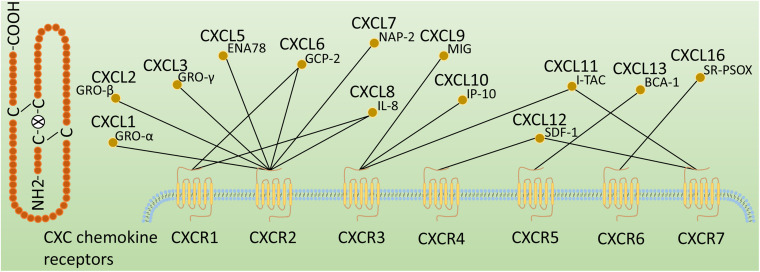
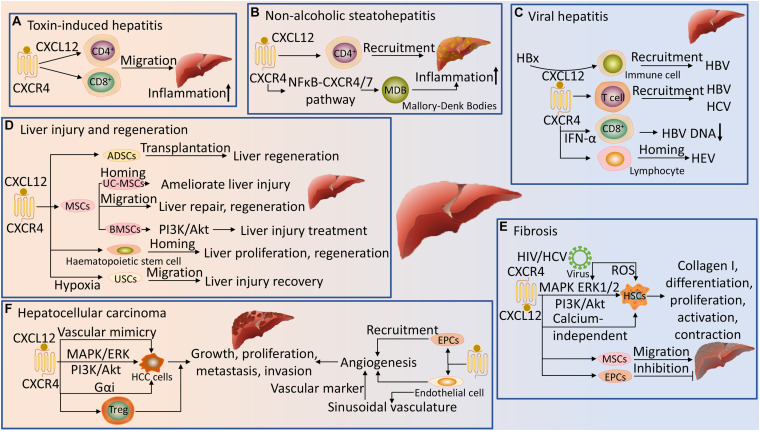
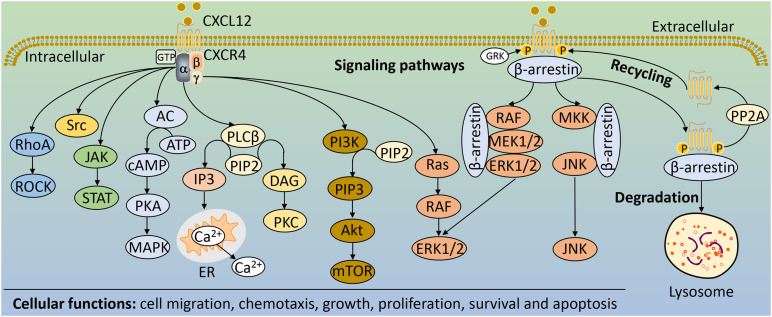
Chemokine receptors are members of the G protein-coupled receptor superfamily, which together with chemokine ligands form chemokine networks to regulate various cellular functions, immune and physiological processes. These receptors are closely related to cell movement and thus play a vital role in several physiological and pathological processes that require regulation of cell migration. CXCR4, one of the most intensively studied chemokine receptors, is involved in many functions in addition to immune cells recruitment and plays a pivotal role in the pathogenesis of liver disease. Aberrant CXCR4 expression pattern is related to the migration and movement of liver specific cells in liver disease through its cross-talk with a variety of significant cell signaling pathways. An in-depth understanding of CXCR4-mediated signaling pathway and its role in liver disease is critical to identifying potential therapeutic strategies. Current therapeutic strategies for liver disease mainly focus on regulating the key functions of specific cells in the liver, in which the CXCR4 pathway plays a crucial role. Multiple challenges remain to be overcome in order to more effectively target CXCR4 pathway and identify novel combination therapies with existing strategies. This review emphasizes the role of CXCR4 and its important cell signaling pathways in the pathogenesis of liver disease and summarizes the targeted therapeutic studies conducted to date.
趋化因子受体是G蛋白偶联受体超家族的成员,它与趋化因子配体共同构成趋化因子网络,以调节各种细胞功能、免疫和生理过程。这些受体与细胞运动密切相关,因此在需要调节细胞迁移的多种生理和病理过程中发挥着至关重要的作用。CXCR4是研究最为深入的趋化因子受体之一,除了参与免疫细胞募集外,还在多种功能中发挥作用,并且在肝脏疾病的发病机制中起关键作用。异常的CXCR4表达模式通过与多种重要的细胞信号通路相互作用,与肝脏疾病中肝脏特异性细胞的迁移和移动有关。深入了解CXCR4介导的信号通路及其在肝脏疾病中的作用对于确定潜在的治疗策略至关重要。目前肝脏疾病的治疗策略主要集中在调节肝脏中特定细胞的关键功能,其中CXCR4通路起着关键作用。为了更有效地靶向CXCR4通路并确定与现有策略的新型联合疗法,仍有多个挑战有待克服。本综述强调了CXCR4及其重要的细胞信号通路在肝脏疾病发病机制中的作用,并总结了迄今为止进行的靶向治疗研究。