Poeppl Timm B, Schecklmann Martin, Sakreida Katrin, Landgrebe Michael, Langguth Berthold, Eickhoff Simon B
Department of Psychiatry, Psychotherapy and Psychosomatics, Faculty of Medicine, RWTH Aachen University, Aachen, Germany.
Department of Psychiatry and Psychotherapy, Universität Regensburg, Regensburg, Germany.
Brain Commun. 2021 May 27;3(3):fcab115. doi: 10.1093/braincomms/fcab115. eCollection 2021.
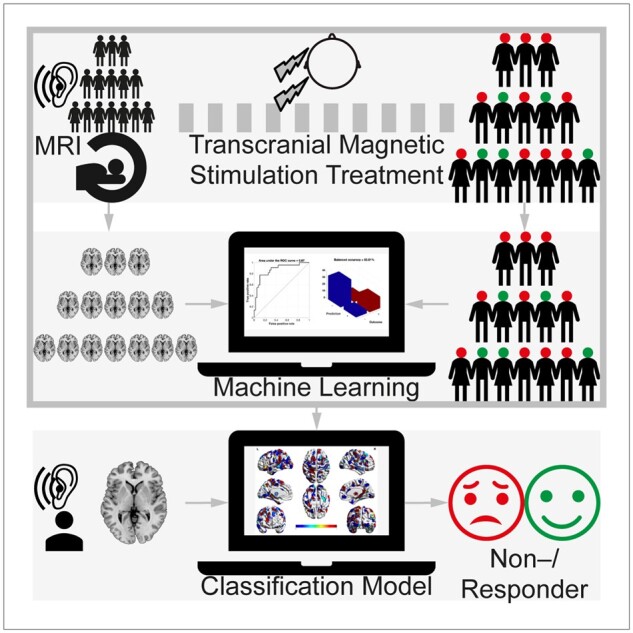
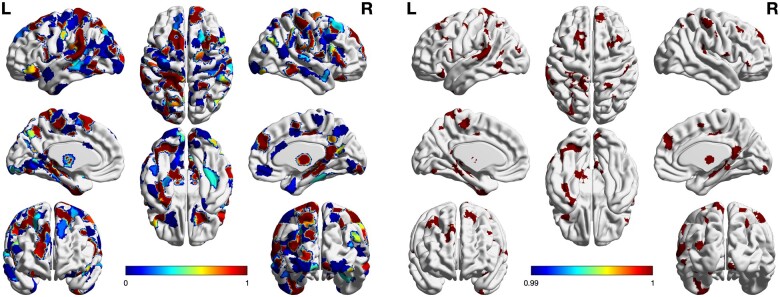
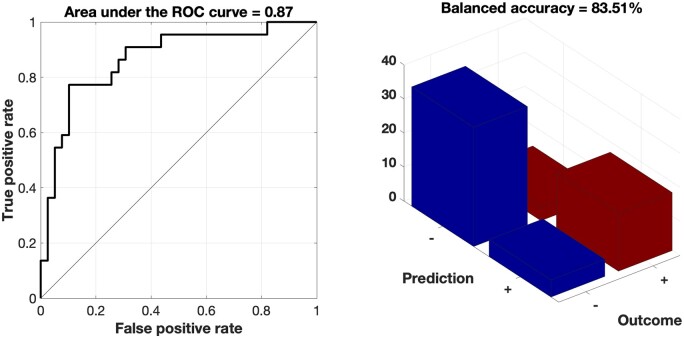
Non-invasive brain stimulation can reduce the severity of tinnitus phantom sounds beyond the time of stimulation by inducing regional neuroplastic changes. However, there are no good clinical predictors for treatment outcome. We used machine learning to investigate whether brain anatomy can predict therapeutic outcome. Sixty-one chronic tinnitus patients received repetitive transcranial magnetic stimulation of left dorsolateral prefrontal and temporal cortex. Before repetitive transcranial magnetic stimulation, a structural magnetic resonance image was obtained from all patients. To predict individual treatment response in new subjects, we employed a support vector machine ensemble for individual out-of-sample prediction. In the cross-validation, the support vector machine ensemble based on stratified sub-sampling and feature selection yielded an area under the curve of 0.87 for prediction of therapy success in new, previously unseen subjects. This corresponded to a balanced accuracy of 83.5%, sensitivity of 77.2% and specificity of 87.2%. Investigating the most selected features showed the involvement of the auditory cortex but also revealed a network of non-auditory brain areas. These findings suggest that idiosyncratic brain patterns accurately predict individual responses to repetitive transcranial magnetic stimulation treatment for tinnitus. Our findings may hence pave the way for future investigations into the precision treatment of tinnitus, involving automatic identification of the appropriate treatment method for the individual patient.
非侵入性脑刺激可通过诱导局部神经可塑性变化,在刺激结束后减轻耳鸣幻听的严重程度。然而,目前尚无良好的临床指标可预测治疗效果。我们运用机器学习来研究脑解剖结构是否能够预测治疗结果。61名慢性耳鸣患者接受了左侧背外侧前额叶和颞叶皮质的重复经颅磁刺激。在重复经颅磁刺激之前,对所有患者进行了结构磁共振成像检查。为了预测新受试者的个体治疗反应,我们采用支持向量机集成方法进行个体样本外预测。在交叉验证中,基于分层子采样和特征选择的支持向量机集成方法预测新的、先前未见过的受试者治疗成功的曲线下面积为0.87。这对应着83.5%的平衡准确率、77.2%的灵敏度和87.2%的特异性。对最常被选中的特征进行研究发现,听觉皮层参与其中,但同时也揭示了一个非听觉脑区网络。这些发现表明,个体特异性脑模式能够准确预测耳鸣患者对重复经颅磁刺激治疗的个体反应。因此,我们的研究结果可能为未来耳鸣精准治疗的研究铺平道路,包括为个体患者自动识别合适的治疗方法。