Jang Hee-Seong, Noh Mi Ra, Ha Ligyeom, Kim Jinu, Padanilam Babu J
Department of Urology, Tisch Cancer Institute, Icahn School of Medicine at Mount Sinai, New York, New York.
Department of Cellular and Integrative Physiology, University of Nebraska Medical Center, Omaha, Nebraska.
Am J Physiol Renal Physiol. 2021 Oct 1;321(4):F431-F442. doi: 10.1152/ajprenal.00171.2021. Epub 2021 Aug 16.
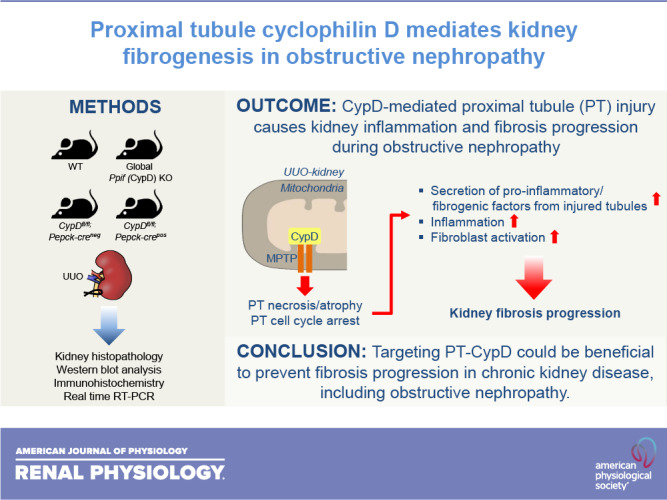
The proximal tubule (PT) is highly vulnerable to acute injury, including ischemic insult and nephrotoxins, and chronic kidney injury. It has been established that PT injury is a primary cause of the development of chronic kidney disease, but the underlying molecular mechanism remains to be defined. Here, we tested whether PT cyclophilin D (CypD), a mitochondrial matrix protein, is a critical factor to cause kidney fibrosis progression. To define the role of CypD in kidney fibrosis, we used an established mouse model for kidney fibrosis: the unilateral ureteral obstruction (UUO) model in global and PT-specific CypD knockout (KO). Global CypD KO blunted kidney fibrosis progression with inhibition of myofibroblast activation and fibrosis. UUO-induced tubular atrophy was suppressed in kidneys of global CypD KO but not tubular dilation or apoptotic cell death. PT cell cycle arrest was highly increased in wild-type UUO kidneys but was markedly attenuated in global CypD KO UUO kidneys. The number of macrophages and neutrophils was less in UUO kidneys of global CypD KO than those of wild-type kidneys. Proinflammatory and profibrotic factors were all inhibited in global CypD KO. In line with those of global CypD KO, PT-specific CypD KO also blunted kidney fibrosis progression, along with less tubular atrophy, renal parenchymal loss, cell cycle arrest in PT, and inflammation, indicating a critical role for PT CypD in fibrogenesis. Collectively, our data demonstrate that CypD in the PT is a critical factor contributing to kidney fibrosis in UUO, providing a new paradigm for mitochondria-targeted therapeutics of fibrotic diseases. It has been established that renal proximal tubule (PT) injury is a primary cause of the development of chronic kidney disease, but the underlying molecular mechanism remains to be defined. Here, we show that cyclophilin D, a mitochondrial matrix protein, in the PT causes kidney fibrogenesis in obstructive nephropathy. Our data suggest that targeting PT cyclophilin D could be beneficial to prevent fibrosis progression.
近端小管(PT)极易受到急性损伤,包括缺血性损伤和肾毒素以及慢性肾损伤的影响。已经确定,PT损伤是慢性肾脏病发展的主要原因,但其潜在的分子机制仍有待明确。在此,我们测试了作为线粒体基质蛋白的PT亲环素D(CypD)是否是导致肾纤维化进展的关键因素。为了确定CypD在肾纤维化中的作用,我们使用了一种已建立的肾纤维化小鼠模型:在全身和PT特异性CypD基因敲除(KO)小鼠中建立单侧输尿管梗阻(UUO)模型。全身CypD基因敲除可抑制肌成纤维细胞活化和纤维化,从而减弱肾纤维化进展。在全身CypD基因敲除小鼠的肾脏中,UUO诱导的肾小管萎缩受到抑制,但肾小管扩张或凋亡性细胞死亡未受抑制。野生型UUO小鼠肾脏中的PT细胞周期停滞显著增加,但在全身CypD基因敲除的UUO小鼠肾脏中则明显减弱。全身CypD基因敲除的UUO小鼠肾脏中的巨噬细胞和中性粒细胞数量少于野生型小鼠。全身CypD基因敲除可抑制促炎和促纤维化因子。与全身CypD基因敲除小鼠一致,PT特异性CypD基因敲除也减弱了肾纤维化进展,同时肾小管萎缩、肾实质损失、PT细胞周期停滞和炎症减少,表明PT CypD在纤维化形成中起关键作用。总体而言,我们的数据表明,PT中的CypD是导致UUO肾纤维化的关键因素,为纤维化疾病的线粒体靶向治疗提供了新的范例。已经确定,肾近端小管(PT)损伤是慢性肾脏病发展的主要原因,但其潜在的分子机制仍有待明确。在此,我们表明,PT中的线粒体基质蛋白亲环素D在梗阻性肾病中导致肾纤维化。我们的数据表明,靶向PT亲环素D可能有助于预防纤维化进展。