Department of Food and Nutrition Myongji University Yongin Korea.
Friedman School of Nutrition Science and Policy Tufts University Boston MA.
J Am Heart Assoc. 2021 Sep 7;10(17):e020646. doi: 10.1161/JAHA.120.020646. Epub 2021 Aug 16.
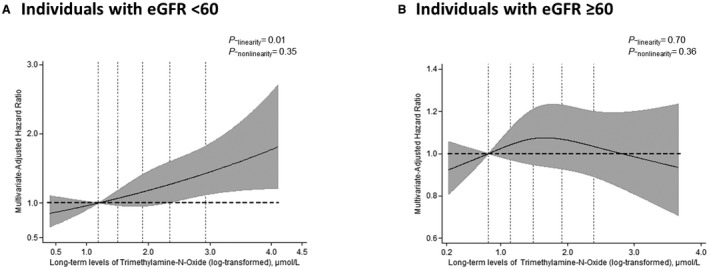
Background Trimethylamine N-oxide (TMAO) is a gut microbiota-dependent metabolite of dietary choline, L-carnitine, and phosphatidylcholine-rich foods. On the basis of experimental studies and patients with prevalent disease, elevated plasma TMAO may increase risk of atherosclerotic cardiovascular disease (ASCVD). TMAO is also renally cleared and may interact with and causally contribute to renal dysfunction. Yet, how serial TMAO levels relate to incident and recurrent ASCVD in community-based populations and the potential mediating or modifying role of renal function are not established. Methods and Results We investigated associations of serial measures of plasma TMAO, assessed at baseline and 7 years, with incident and recurrent ASCVD in a community-based cohort of 4131 (incident) and 1449 (recurrent) older US adults. TMAO was measured using stable isotope dilution liquid chromatography-tandem mass spectrometry (laboratory coefficient of variation, <6%). Incident ASCVD (myocardial infarction, fatal coronary heart disease, stroke, sudden cardiac death, or other atherosclerotic death) was centrally adjudicated using medical records. Risk was assessed by multivariable Cox proportional hazards regression, including time-varying demographics, lifestyle factors, medical history, laboratory measures, and dietary habits. Potential mediating effects and interaction by estimated glomerular filtration rate (eGFR) were assessed. During prospective follow-up, 1766 incident and 897 recurrent ASCVD events occurred. After multivariable adjustment, higher levels of TMAO were associated with a higher risk of incident ASCVD, with extreme quintile hazard ratio (HR) compared with the lowest quintile=1.21 (95% CI, 1.02-1.42; -trend=0.029). This relationship appeared mediated or confounded by eGFR (eGFR-adjusted HR, 1.07; 95% CI, 0.90-1.27), as well as modified by eGFR (-interaction <0.001). High levels of TMAO were associated with higher incidence of ASCVD in the presence of impaired renal function (eGFR <60 mL/min per 1.73 m: HR, 1.56 [95% CI, 1.13-2.14]; -trend=0.007), but not normal or mildly reduced renal function (eGFR ≥60 mL/min per 1.73 m: HR, 1.03 [95% CI, 0.85-1.25]; -trend=0.668). Among individuals with prior ASCVD, TMAO associated with higher risk of recurrent ASCVD (HR, 1.25 [95% CI, 1.01-1.56]; -trend=0.009), without significant modification by eGFR. Conclusions In this large community-based cohort of older US adults, serial measures of TMAO were associated with higher risk of incident ASCVD, with apparent modification by presence of impaired renal function and with higher risk of recurrent ASCVD.
三甲胺 N-氧化物(TMAO)是饮食胆碱、左旋肉碱和富含磷脂酰胆碱的食物中肠道微生物群依赖的代谢物。基于实验研究和现患疾病患者的研究结果,血浆 TMAO 水平升高可能会增加动脉粥样硬化性心血管疾病(ASCVD)的风险。TMAO 也通过肾脏清除,并且可能与肾功能障碍相互作用并导致肾功能障碍。然而,在基于社区的人群中,连续的 TMAO 水平与 ASCVD 事件的发生和复发之间的关系,以及肾功能的潜在介导或调节作用尚不清楚。
我们研究了 4131 例(新发)和 1449 例(复发)年龄较大的美国成年人的基线和 7 年时血浆 TMAO 的连续测量值与 ASCVD 新发和复发的相关性。采用稳定同位素稀释液相色谱-串联质谱法(实验室变异系数<6%)测量 TMAO。通过病历对 ASCVD(心肌梗死、致死性冠心病、中风、心脏性猝死或其他动脉粥样硬化性死亡)进行中心裁决。使用多变量 Cox 比例风险回归评估风险,包括随时间变化的人口统计学、生活方式因素、病史、实验室指标和饮食习惯。评估了潜在的中介效应和肾小球滤过率(eGFR)的交互作用。在前瞻性随访期间,发生了 1766 例新发和 897 例复发 ASCVD 事件。经过多变量调整后,TMAO 水平较高与 ASCVD 新发风险增加相关,与最低五分位数相比,极端五分位数的危险比(HR)为 1.21(95%CI,1.02-1.42;-趋势=0.029)。这种关系似乎通过 eGFR 被中介或混淆(eGFR 调整后的 HR,1.07;95%CI,0.90-1.27),并且受 eGFR 修饰(<0.001)。在肾功能受损(eGFR<60mL/min/1.73m:HR,1.56[95%CI,1.13-2.14];-趋势=0.007)的情况下,高水平的 TMAO 与 ASCVD 发生率较高相关,但在正常或轻度肾功能降低(eGFR≥60mL/min/1.73m:HR,1.03[95%CI,0.85-1.25];-趋势=0.668)的情况下则不相关。在有 ASCVD 病史的个体中,TMAO 与 ASCVD 复发风险增加相关(HR,1.25[95%CI,1.01-1.56];-趋势=0.009),而 eGFR 无明显修饰作用。
在这项针对美国年龄较大的大型基于社区的队列研究中,TMAO 的连续测量值与 ASCVD 新发风险增加相关,并且与肾功能障碍的存在明显相关,并且与 ASCVD 复发风险增加相关。