Temple University, Philadelphia, Pennsylvania 19122, USA.
Comprehensive Epilepsy Center, New York University, New York, New York 10016, USA.
Learn Mem. 2021 Aug 16;28(9):329-340. doi: 10.1101/lm.053438.121. Print 2021 Sep.
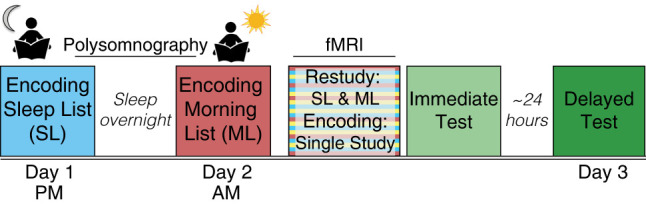
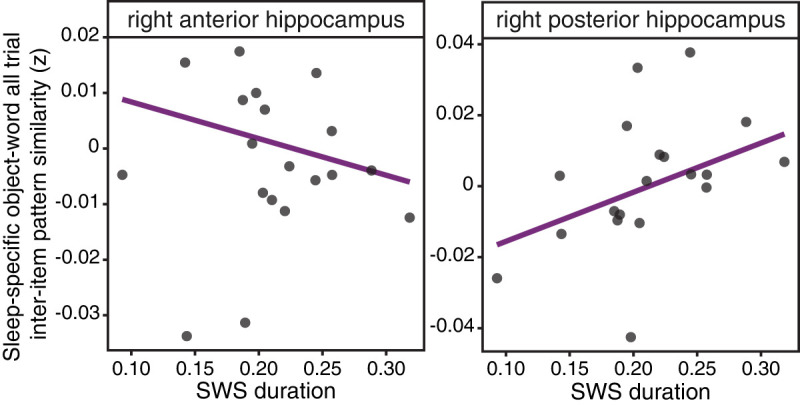
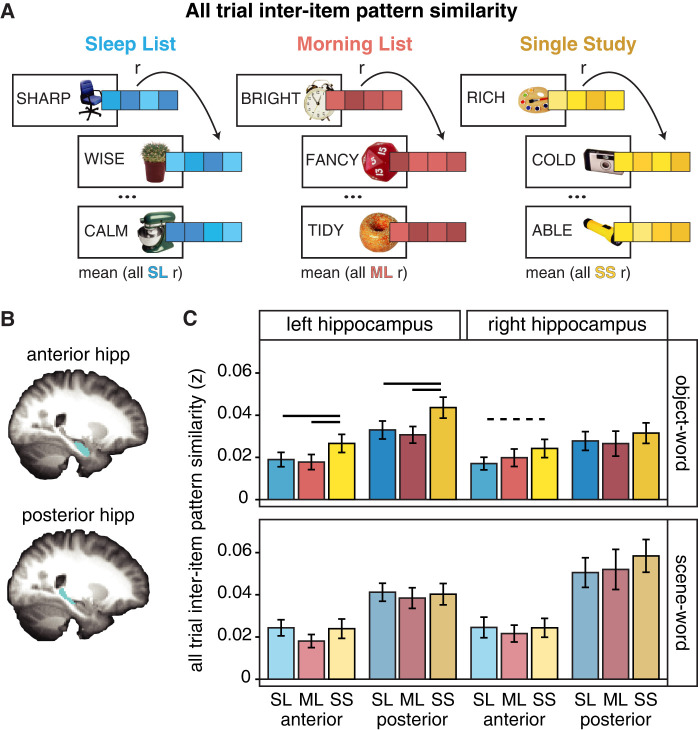
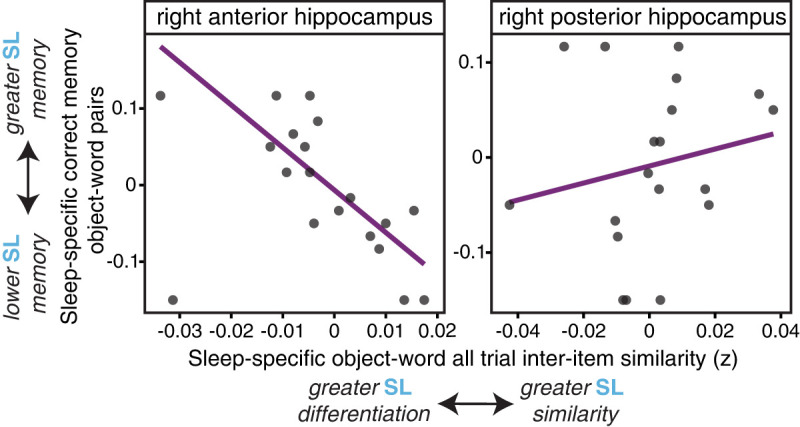
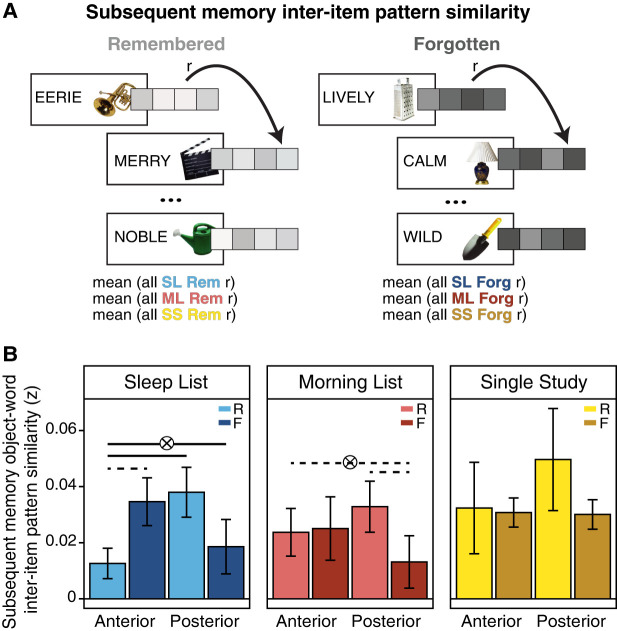
Research has shown that sleep is beneficial for the long-term retention of memories. According to theories of memory consolidation, memories are gradually reorganized, becoming supported by widespread, distributed cortical networks, particularly during postencoding periods of sleep. However, the effects of sleep on the organization of memories in the hippocampus itself remains less clear. In a 3-d study, participants encoded separate lists of word-image pairs differing in their opportunity for sleep-dependent consolidation. Pairs were initially studied either before or after an overnight sleep period, and were then restudied in a functional magnetic resonance imaging (fMRI) scan session. We used multivariate pattern similarity analyses to examine fine-grained effects of consolidation on memory representations in the hippocampus. We provide evidence for a dissociation along the long axis of the hippocampus that emerges with consolidation, such that representational patterns for object-word memories initially formed prior to sleep become differentiated in anterior hippocampus and more similar, or overlapping, in posterior hippocampus. Differentiation in anterior hippocampal representations correlated with subsequent behavioral performance. Furthermore, representational overlap in posterior hippocampus correlated with the duration of intervening slow wave sleep. Together, these results demonstrate that sleep-dependent consolidation promotes the reorganization of memory traces along the long axis of the hippocampus.
研究表明,睡眠对长期记忆的保留有益。根据记忆巩固理论,记忆在逐渐重组,在睡眠的后编码期尤其通过广泛分布的皮质网络得到支持。然而,睡眠对海马体自身记忆组织的影响仍不明确。在一项 3D 研究中,参与者分别对单词-图像对列表进行编码,这些列表在睡眠依赖巩固方面的机会不同。对这些对在一夜睡眠之前或之后进行初步学习,然后在功能磁共振成像(fMRI)扫描会话中重新学习。我们使用多元模式相似性分析来检查巩固对海马体中记忆表现的细微影响。我们提供了沿着海马体长轴出现的分离的证据,即与睡眠相关的初始形成的物体-单词记忆的表示模式在前海马体中变得不同,而在后海马体中变得更加相似或重叠。前海马体表示的分化与随后的行为表现相关。此外,后海马体中的表示重叠与中间慢波睡眠的持续时间相关。总之,这些结果表明,睡眠依赖性巩固促进了海马体长轴上记忆痕迹的重组。