3rd Department of Medicine, Cardiology and Intensive Care Medicine, Klinik Ottakring (Wilhelminenhospital), Montleartstraße 37, 1160, Vienna, Austria.
Medical University of Vienna, Vienna, Austria.
Wien Klin Wochenschr. 2022 Apr;134(7-8):286-293. doi: 10.1007/s00508-021-01924-w. Epub 2021 Aug 17.
Many patients with cardiac implantable electronic devices (CIED) undergo magnetic resonance imaging (MRI); however, a relevant proportion have a CIED system that has not been classified as MRI-conditional because of generators and leads from different brands (mixed-brand group). The available data concerning the outcome of these mixed patients undergoing MRI is limited.
A retrospective single center study, including all patients with CIEDs undergoing MRI between January 2013 until May 2020, was performed. Primary endpoints were defined as death or any adverse event necessitating hospitalization or CIED revision. Secondary endpoints were the occurrence of any sign for beginning device or lead failure or patient discomfort during MRI.
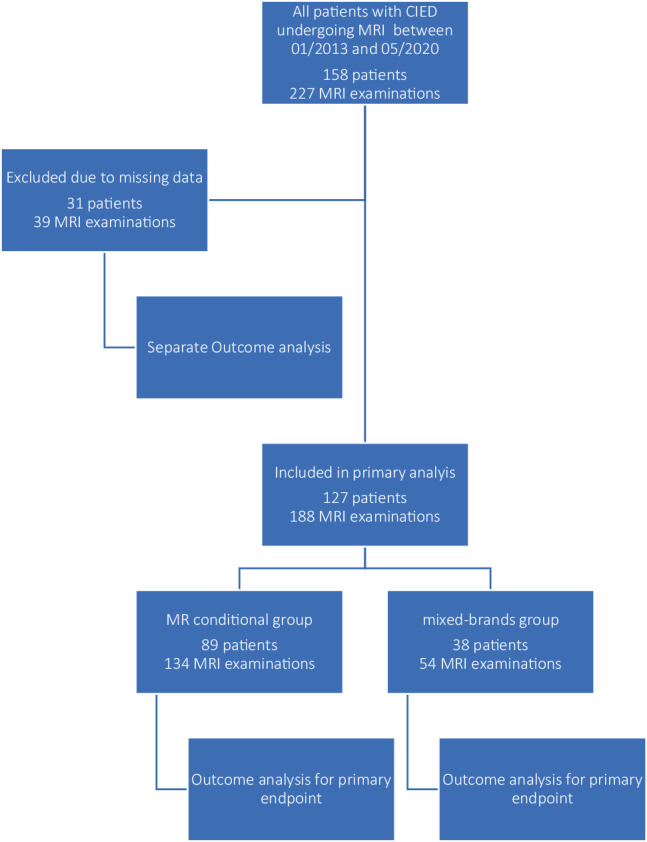
A total of 227 MRI examinations, including 10 thoracic MRIs, were carried out in 158 patients, with 1-9 MRIs per patient. Of the patients 38 underwent 54 procedures in the mixed-brand group and 89 patients underwent 134 MRIs in the MRI-conditional group. Of the patients 31 were excluded since the MRI conditionality could not be determined. No primary endpoints occurred within the mixed-brand group but in 2.2% of the MRI-conditional group (p = 1.000), with 2 patients developing new atrial fibrillation during MRI, of whom one additionally had a transient CIED dysfunction. No secondary endpoints were met in the mixed-brand group compared to 3.4% in the MRI-conditional group (p = 0.554). No complications occurred in the excluded patients.
The complication rate of CIED patients undergoing MRI was low. Patients with a mixed CIED system showed no signs of increased risk of adverse events compared to patients with MRI-conditional CIED systems.
许多植入式心脏电子设备(CIED)患者需要进行磁共振成像(MRI)检查;然而,由于不同品牌的设备(混合品牌组)的发生器和导联,一部分患者的 CIED 系统未被归类为 MRI 兼容。关于这些混合患者接受 MRI 检查的结果的现有数据有限。
回顾性单中心研究,纳入 2013 年 1 月至 2020 年 5 月期间所有接受 CIED 检查的患者。主要终点定义为死亡或任何需要住院或 CIED 修正的不良事件。次要终点为在 MRI 期间出现任何设备或导联故障或患者不适的迹象。
共进行了 227 例 MRI 检查,包括 10 例胸部 MRI,涉及 158 例患者,每位患者 1-9 次 MRI。在患者中,38 名患者在混合品牌组中进行了 54 次手术,89 名患者在 MRI 兼容组中进行了 134 次 MRI。由于无法确定 MRI 条件,31 名患者被排除在外。在混合品牌组中没有发生主要终点,但在 MRI 兼容组中有 2.2%(p=1.000),2 名患者在 MRI 期间发生新的心房颤动,其中 1 名患者还出现了短暂的 CIED 功能障碍。在混合品牌组中没有达到次要终点,而在 MRI 兼容组中有 3.4%(p=0.554)。被排除的患者没有发生并发症。
接受 MRI 检查的 CIED 患者的并发症发生率较低。与 MRI 兼容的 CIED 系统患者相比,混合 CIED 系统患者没有出现不良事件风险增加的迹象。