Ospedale degli Infermi, Rimini, Italy.
Department of Cardiology, Ospedale degli Infermi Viale Luigi Settembrini, 2, Rimini, 47923, Italy.
Sci Rep. 2024 Nov 6;14(1):27006. doi: 10.1038/s41598-024-73403-x.
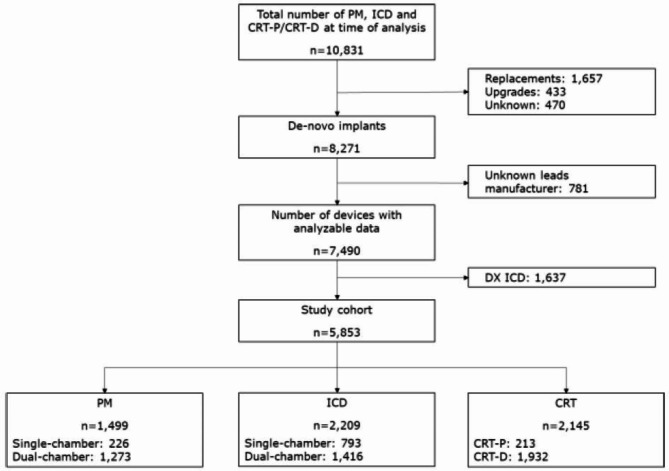
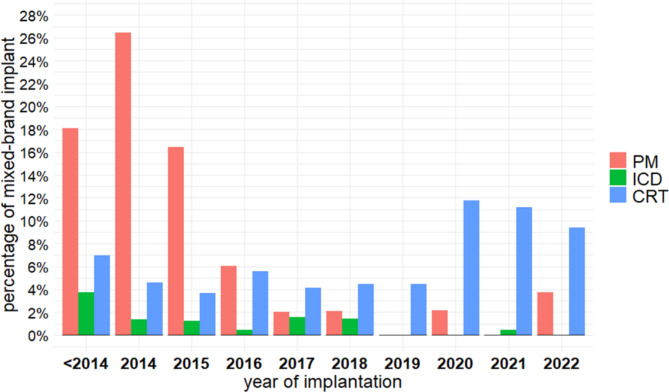
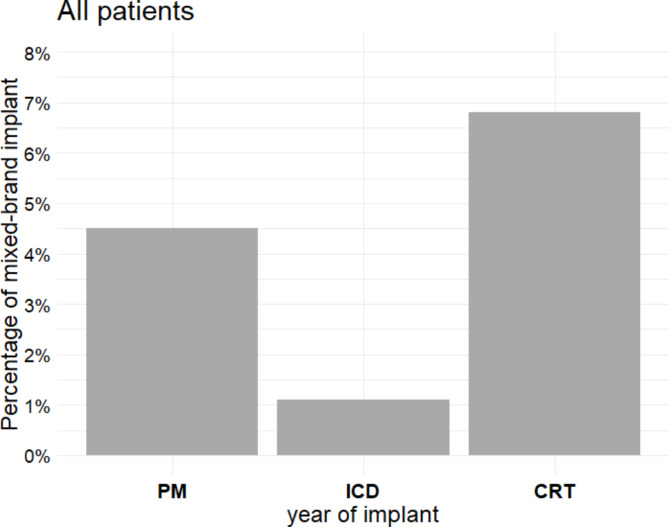
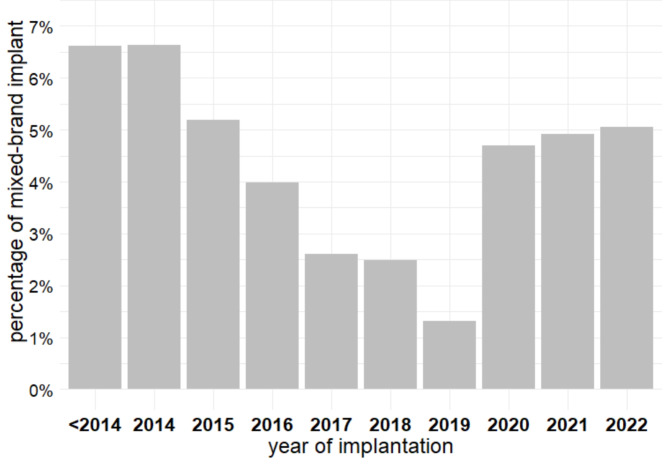
The historical restriction of magnetic resonance imaging (MRI) for patients with cardiac implantable electronic devices (CIEDs) has been lifted by certified MRI-conditional systems in recent years. Mixed-brand CIED systems consisting of a generator from one manufacturer and at least one lead from another manufacturer are not certified for MRI. We evaluated the temporal trend in the prevalence of mixed-brand systems in the era of MRI-conditional systems. Data were analyzed on 5853 CIEDs implanted de novo between 2012 and 2022 in 81 Italian centers linked to the nationwide Home Monitoring Expert Alliance network. The percentage of mixed-brand implants was calculated by device type (pacemaker, implantable cardioverter-defibrillator [ICD], cardiac resynchronization therapy [CRT] device) and over time. A mixed-brand system was implanted in 4.1% (95% CI, 3.6-4.6%) of analyzed patients or, by device type, in 4.5% (3.5-5.7%) of pacemaker patients, 1.1% (0.7-1.7%) of ICD patients, and 6.8% (5.7-7.9%) of CRT pacemaker/defibrillator patients (p < 0.001). Prevalence of mixed-brand implants exhibited significant temporal fluctuations, first declining from 6.6% (2012-2014) to 1.3% (2019), and then increasing to 5.1% (2022). Temporal changes were statistically significant for pacemakers (p < 0.001) and CRT devices (p = 0.001), but not for ICDs (p = 0.438). In the decade between 2012 and 2022, mixed-brand CIED systems were more prevalent in patients treated with pacemakers and CRT devices than in ICD recipients. A decline in the prevalence of mixed-brand systems was observed after the introduction of MRI-conditional systems, reaching a minimum in 2019, followed by a progressive increase in the subsequent years.
近年来,经过认证的磁共振成像(MRI)兼容系统已经解除了对心脏植入式电子设备(CIED)患者进行 MRI 的历史限制。由一家制造商生产的发生器和另一家制造商生产的至少一根导线组成的混合品牌 CIED 系统未经过 MRI 认证。我们评估了在 MRI 兼容系统时代混合品牌系统的流行趋势。对 2012 年至 2022 年间在意大利 81 个与全国家庭监测专家联盟网络相连的中心新植入的 5853 例 CIED 进行了数据分析。通过设备类型(起搏器、植入式心律转复除颤器[ICD]、心脏再同步治疗[CRT]装置)和随时间计算混合品牌植入物的百分比。在分析的患者中,混合品牌系统的植入率为 4.1%(95%CI,3.6-4.6%),按设备类型计算,起搏器患者为 4.5%(3.5-5.7%),ICD 患者为 1.1%(0.7-1.7%),CRT 起搏器/除颤器患者为 6.8%(5.7-7.9%)(p<0.001)。混合品牌植入物的流行率显示出显著的时间波动,首先从 2012-2014 年的 6.6%下降到 2019 年的 1.3%,然后上升到 2022 年的 5.1%。对于起搏器(p<0.001)和 CRT 设备(p=0.001),时间变化具有统计学意义,但对于 ICD 则没有(p=0.438)。在 2012 年至 2022 年的十年间,与 ICD 接受者相比,在接受起搏器和 CRT 设备治疗的患者中,混合品牌 CIED 系统更为普遍。在引入 MRI 兼容系统后,混合品牌系统的流行率有所下降,在 2019 年达到最低点,随后在随后几年中呈逐步上升趋势。