Mamun Mohammed A
Director, CHINTA Research Bangladesh, Savar, Dhaka, Bangladesh, and Department of Public Health and Informatics, Jahangirnagar University, Savar, Dhaka, Bangladesh.
BJPsych Open. 2021 Aug 19;7(5):e150. doi: 10.1192/bjo.2021.984.
The COVID-19 pandemic is a public health threat of international concern, intensifying peoples' psychological risk and vulnerability by strengthening mental health stressors such as fear, panic and uncertainty. The unexpected fear of COVID-19 has been reported to be associated with suicide occurrences, similar to prior pandemics.
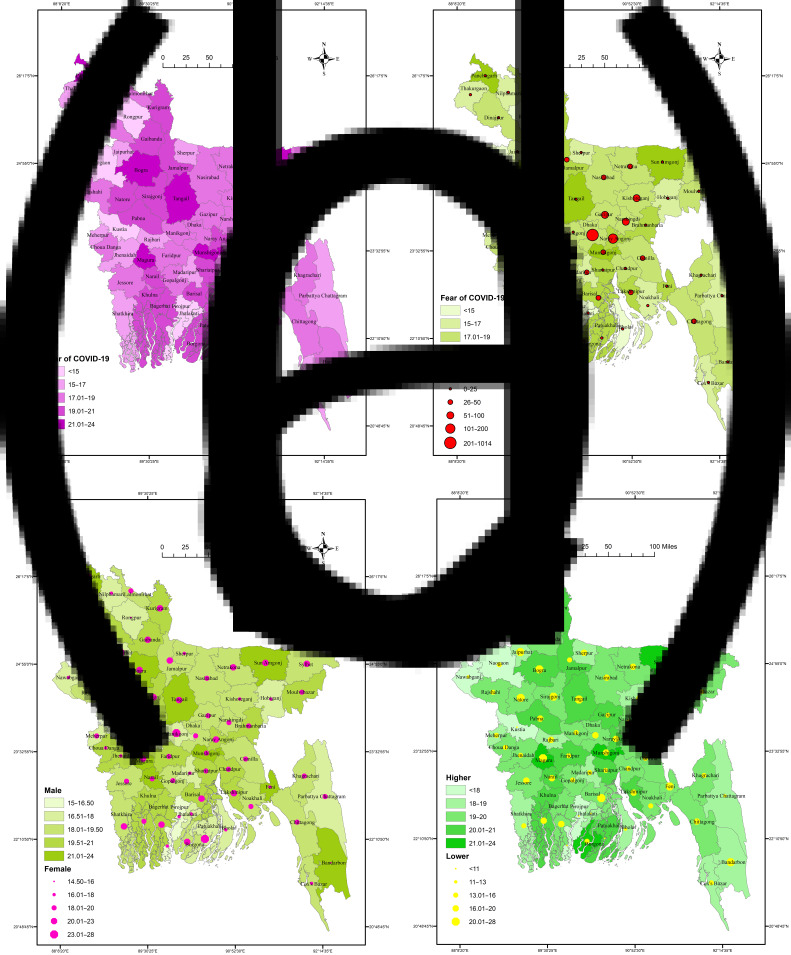
Identifying the factors associated with fear of COVID-19 could help us to develop better mental health strategy and practice to improve the situation here in Bangladesh. This was the first attempt to present a Geographic Information System (GIS)-based distribution of fear of COVID-19 across the country's administrative districts in a nationwide sample.
Data for a total of 10 067 individuals were collected by an online survey during the first wave of the pandemic (1 to 10 April 2020); data for 10 052 participants were finally analysed after excluding 15 transgender individuals. The survey questionnaire included items concerning sociodemographic, behavioural and health-related variables, COVID-19-related issues, and the Bangla Fear of COVID-19 Scale.
The mean fear of COVID-19 scores was 21.30 ± 6.01 (out of a possible 35) in the present sample. Female gender, highly educated, non-smoker, non-alcohol consumer, having chronic diseases, using social media, and using social media and not using newspapers as COVID-19 information sources were associated with a higher level of fear of COVID-19. Higher levels of fear of COVID-19 were found in districts of Magura, Panchagarh, Tangail, Sunamganj and Munshiganj; by contrast, Kushtia, Pirojpur, Chapainawabganj, Jhalokathi and Naogaon districts had lower fear of COVID-19. Based on the GIS-distribution, fear of COVID-19 was significantly associated with the district as well as in respect to its gender-based and education-level-based associations. However, fear of COVID-19 and COVID-19 cases were heterogeneously distributed across the districts; that is, no consistent association of higher COVID-19 cases with higher fear of COVID-19 was found.
This study being exploratory in nature may help to facilitate further studies, as well as directing governmental initiatives for reducing fear of COVID-19 in at-risk individuals. Providing adequate resources and mental health services in the administrative regions identified as highly vulnerable to fear of COVID-19 is recommended.
新冠疫情是一项国际关注的公共卫生威胁,通过强化恐惧、恐慌和不确定性等心理健康压力源,加剧了人们的心理风险和脆弱性。据报道,对新冠疫情突如其来的恐惧与自杀事件有关,这与以往的疫情类似。
确定与对新冠疫情的恐惧相关的因素,有助于我们制定更好的心理健康策略和措施,以改善孟加拉国的现状。这是首次尝试在全国范围内的样本中,展示基于地理信息系统(GIS)的全国各行政区对新冠疫情恐惧程度的分布情况。
在疫情第一波期间(2020年4月1日至10日)通过在线调查收集了总共10067人的数据;在排除15名跨性别者后,最终对10052名参与者的数据进行了分析。调查问卷包括有关社会人口统计学、行为和健康相关变量、与新冠疫情相关的问题,以及孟加拉语版新冠疫情恐惧量表的项目。
在本样本中,对新冠疫情恐惧程度的平均得分是21.30 ± 6.01(满分35分)。女性、受过高等教育、不吸烟、不饮酒、患有慢性病、使用社交媒体,以及使用社交媒体但不将报纸作为新冠疫情信息来源的人群,对新冠疫情的恐惧程度较高。在马古拉、潘查加尔、坦盖尔、苏纳甘杰和蒙希甘杰等地区,对新冠疫情的恐惧程度较高;相比之下,库什蒂亚、皮罗杰布尔、查派纳瓦布甘杰、贾洛卡蒂和瑙冈等地区对新冠疫情的恐惧程度较低。基于GIS分布,对新冠疫情的恐惧与地区显著相关,且在性别和教育水平方面的关联也很显著。然而,各地区对新冠疫情的恐惧程度和新冠疫情病例分布并不一致;也就是说,未发现新冠疫情病例数越高,对新冠疫情的恐惧程度也越高的一致关联。
本研究具有探索性质,可能有助于推动进一步的研究,并指导政府采取举措减少高危人群对新冠疫情的恐惧。建议在被确定为极易对新冠疫情产生恐惧的行政区提供充足的资源和心理健康服务。