Instituto de Matemática, Estatística e Computação Científica, Universidade Estadual de Campinas, 13083-859 São Paulo, Brazil.
Instituto de Ciências Matemáticas e Computação, Universidade de São Paulo, 13566-590 São Paulo, Brazil.
Proc Natl Acad Sci U S A. 2021 Aug 31;118(35). doi: 10.1073/pnas.2104640118.
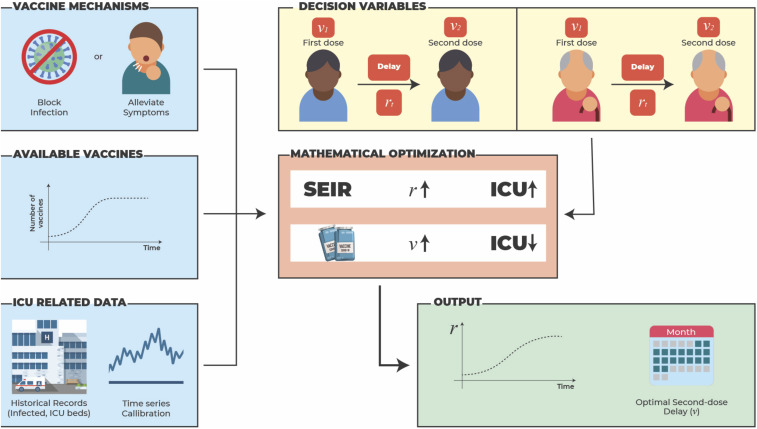
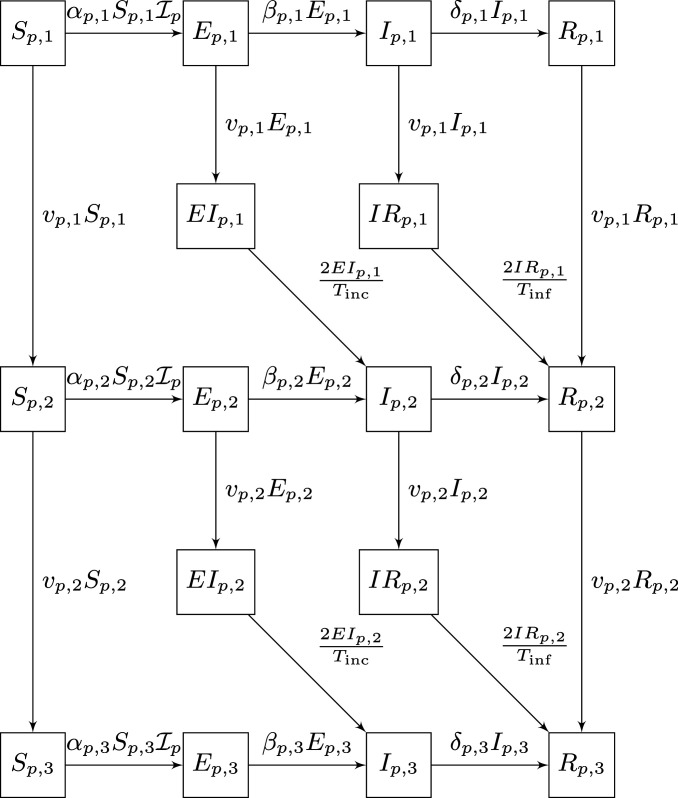
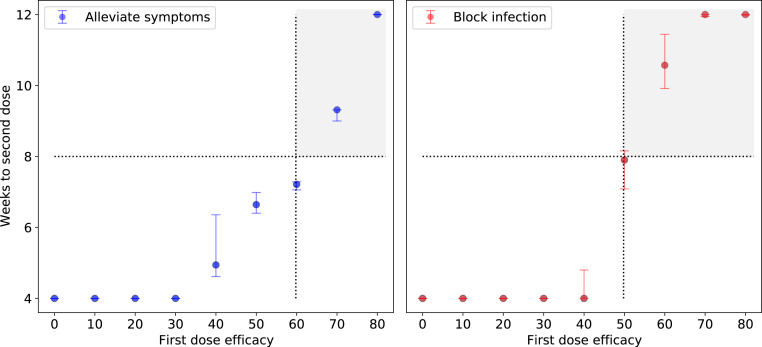
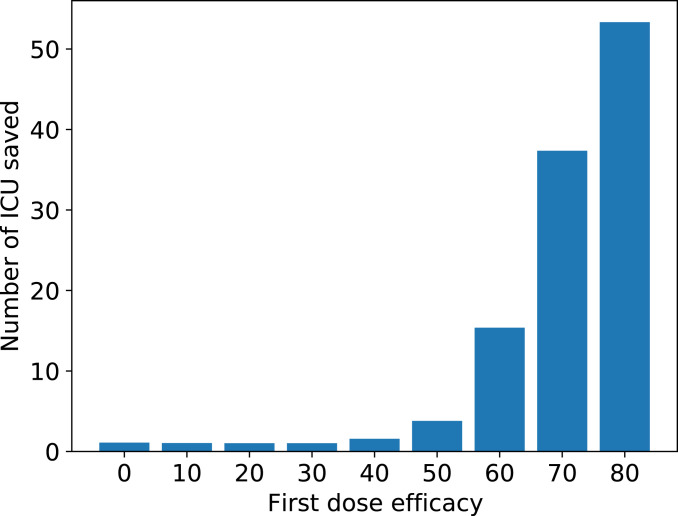
Slower than anticipated, COVID-19 vaccine production and distribution have impaired efforts to curtail the current pandemic. The standard administration schedule for most COVID-19 vaccines currently approved is two doses administered 3 to 4 wk apart. To increase the number of individuals with partial protection, some governments are considering delaying the second vaccine dose. However, the delay duration must take into account crucial factors, such as the degree of protection conferred by a single dose, the anticipated vaccine supply pipeline, and the potential emergence of more virulent COVID-19 variants. To help guide decision-making, we propose here an optimization model based on extended susceptible, exposed, infectious, and removed (SEIR) dynamics that determines the optimal delay duration between the first and second COVID-19 vaccine doses. The model assumes lenient social distancing and uses intensive care unit (ICU) admission as a key metric while selecting the optimal duration between doses vs. the standard 4-wk delay. While epistemic uncertainties apply to the interpretation of simulation outputs, we found that the delay is dependent on the vaccine mechanism of action and first-dose efficacy. For infection-blocking vaccines with first-dose efficacy ≥50%, the model predicts that the second dose can be delayed by ≥8 wk (half of the maximal delay), whereas for symptom-alleviating vaccines, the same delay is recommended only if the first-dose efficacy is ≥70%. Our model predicts that a 12-wk second-dose delay of an infection-blocking vaccine with a first-dose efficacy ≥70% could reduce ICU admissions by 400 people per million over 200 d.
新冠疫苗的生产和分发速度慢于预期,这削弱了遏制当前大流行的努力。目前批准的大多数新冠疫苗的标准接种方案是间隔 3 到 4 周接种两剂。为了增加部分人群的部分保护,一些政府正在考虑推迟第二剂疫苗的接种。然而,延迟时间必须考虑到一些关键因素,如单剂疫苗提供的保护程度、预期的疫苗供应渠道,以及更具毒性的新冠病毒变异株的出现。为了帮助指导决策,我们在这里提出了一个基于扩展的易感、暴露、感染和清除(SEIR)动力学的优化模型,用于确定第一剂和第二剂新冠疫苗之间的最佳延迟时间。该模型假设宽松的社交距离,并使用重症监护病房(ICU)入院作为关键指标,同时选择最佳的剂量间隔,而不是标准的 4 周延迟。虽然对模拟结果的解释存在认知不确定性,但我们发现延迟时间取决于疫苗的作用机制和第一剂的疗效。对于第一剂疗效≥50%的抗感染疫苗,该模型预测第二剂可以延迟≥8 周(最长延迟的一半),而对于缓解症状的疫苗,只有在第一剂疗效≥70%时,才建议同样的延迟。我们的模型预测,对于第一剂疗效≥70%的抗感染疫苗,如果将第二剂的接种时间推迟 12 周,在 200 天内,每百万人口的 ICU 入院人数将减少 400 人。