Development Innovation Lab, University of Chicago, Chicago, IL 60637;
Douglas B. Marshall Jr. Family Foundation, Houston, TX 77002.
Proc Natl Acad Sci U S A. 2022 Feb 22;119(8). doi: 10.1073/pnas.2116932119.
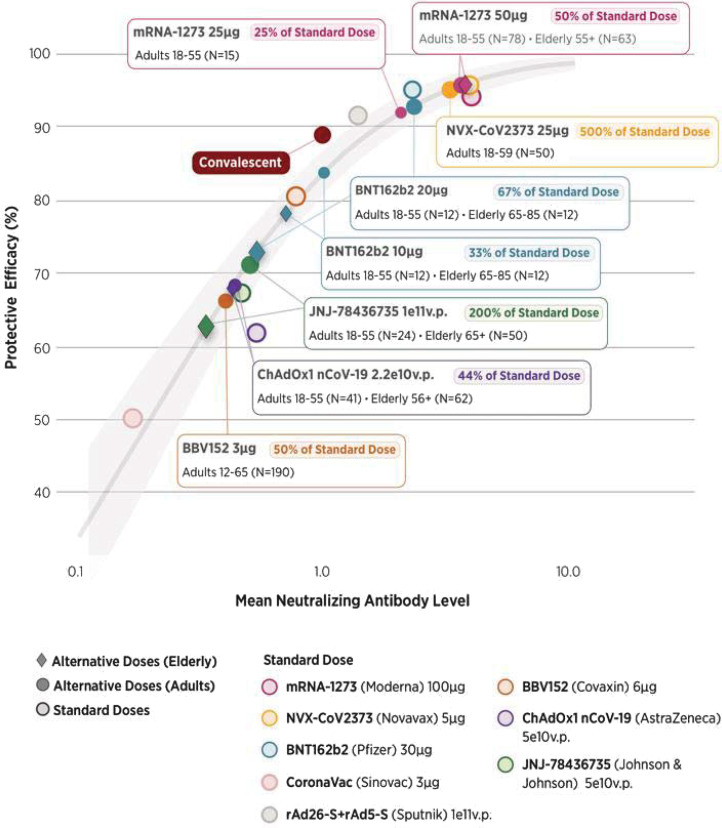
Due to the enormous economic, health, and social costs of the COVID-19 pandemic, there are high expected social returns to investing in parallel in multiple approaches to accelerating vaccination. We argue there are high expected social returns to investigating the scope for lowering the dosage of some COVID-19 vaccines. While existing evidence is not dispositive, available clinical data on the immunogenicity of lower doses combined with evidence of a high correlation between neutralizing antibody response and vaccine efficacy suggests that half or even quarter doses of some vaccines could generate high levels of protection, particularly against severe disease and death, while potentially expanding supply by 450 million to 1.55 billion doses per month, based on supply projections for 2021. An epidemiological model suggests that, even if fractional doses are less effective than standard doses, vaccinating more people faster could substantially reduce total infections and deaths. The costs of further testing alternative doses are much lower than the expected public health and economic benefits. However, commercial incentives to generate evidence on fractional dosing are weak, suggesting that testing may not occur without public investment. Governments could support either experimental or observational evaluations of fractional dosing, for either primary or booster shots. Discussions with researchers and government officials in multiple countries where vaccines are scarce suggests strong interest in these approaches.
由于 COVID-19 大流行带来了巨大的经济、健康和社会成本,因此投资于多种加速疫苗接种的方法预计会带来很高的社会回报。我们认为,研究降低某些 COVID-19 疫苗剂量的范围有望带来很高的社会回报。虽然现有证据尚无定论,但现有关于较低剂量免疫原性的临床数据,加上中和抗体反应与疫苗效力之间高度相关的证据表明,某些疫苗的半剂量甚至四分之一剂量可能会产生高水平的保护,特别是针对严重疾病和死亡,同时还可能根据 2021 年的供应预测,每月增加 4.5 亿至 15.5 亿剂的供应。一项流行病学模型表明,即使分剂量比标准剂量效果差,更快地为更多人接种疫苗也可以大大减少总感染和死亡人数。进一步测试替代剂量的成本远低于预期的公共卫生和经济效益。然而,产生分剂量证据的商业动机较弱,这表明如果没有公共投资,测试可能不会进行。政府可以支持对分剂量进行实验或观察性评估,无论是用于初级还是加强针。与疫苗短缺的多个国家的研究人员和政府官员进行的讨论表明,人们对这些方法非常感兴趣。