Oliveira Carol, Amstutz Florian, Vuong Diem, Bogowicz Marta, Hüllner Martin, Foerster Robert, Basler Lucas, Schröder Christina, Eboulet Eric I, Pless Miklos, Thierstein Sandra, Peters Solange, Hillinger Sven, Tanadini-Lang Stephanie, Guckenberger Matthias
Department of Radiation Oncology, University Hospital Zurich, University of Zurich, Zurich, Switzerland.
Division of Radiation Oncology, Cancer Center of Southeastern Ontario, Queen's University, Kingston, ON, Canada.
EJNMMI Res. 2021 Aug 21;11(1):79. doi: 10.1186/s13550-021-00809-3.
Radiomics is a promising tool for identifying imaging-based biomarkers. Radiomics-based models are often trained on single-institution datasets; however, multi-centre imaging datasets are preferred for external generalizability owing to the influence of inter-institutional scanning differences and acquisition settings. The study aim was to determine the value of preselection of robust radiomic features in routine clinical positron emission tomography (PET) images to predict clinical outcomes in locally advanced non-small cell lung cancer (NSCLC).
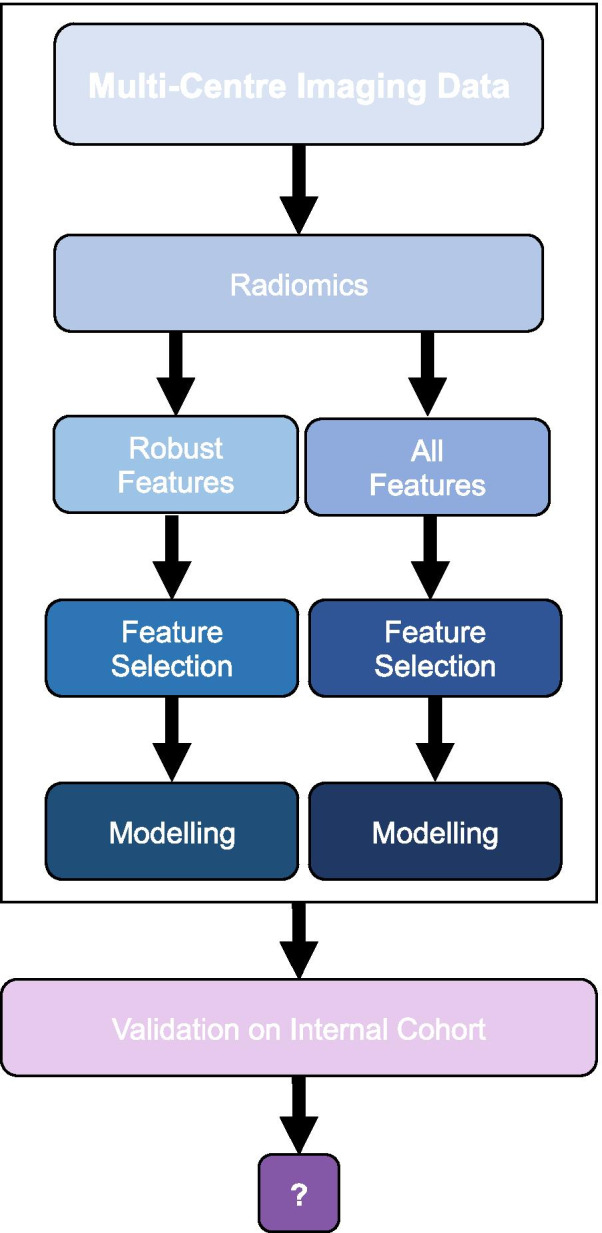
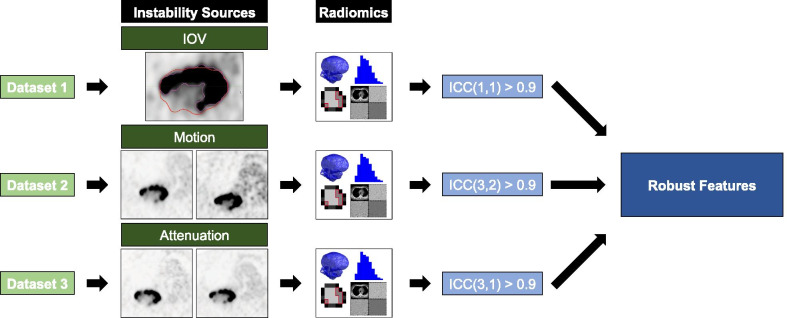
A total of 1404 primary tumour radiomic features were extracted from pre-treatment [F]fluorodeoxyglucose (FDG)-PET scans of stage IIIA/N2 or IIIB NSCLC patients using a training cohort (n = 79; prospective Swiss multi-centre randomized phase III trial SAKK 16/00; 16 centres) and an internal validation cohort (n = 31; single centre). Robustness studies investigating delineation variation, attenuation correction and motion were performed (intraclass correlation coefficient threshold > 0.9). Two 12-/24-month event-free survival (EFS) and overall survival (OS) logistic regression models were trained using standardized imaging: (1) with robust features alone and (2) with all available features. Models were then validated using fivefold cross-validation, and validation on a separate single-centre dataset. Model performance was assessed using area under the receiver operating characteristic curve (AUC).
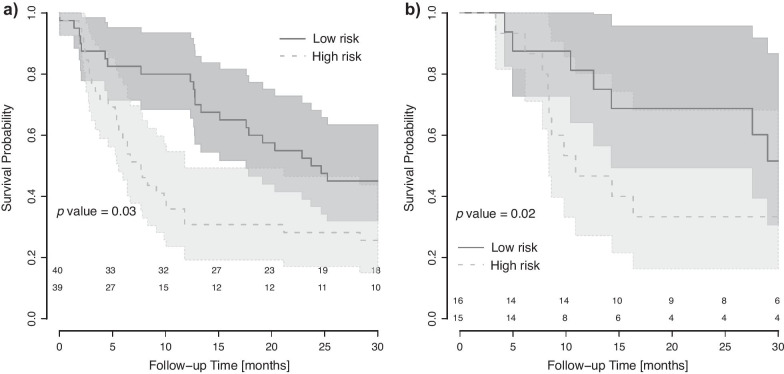
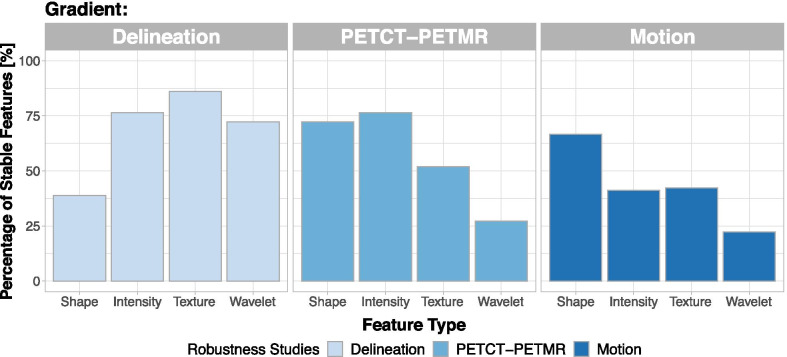
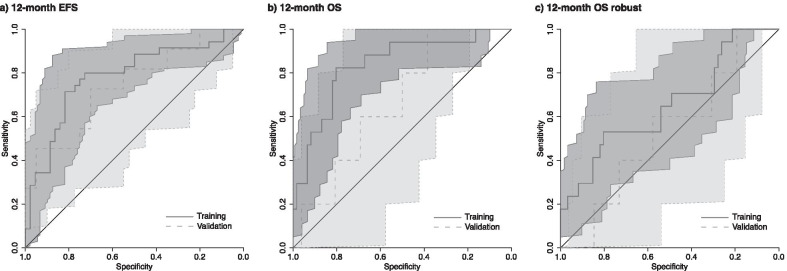
Robustness studies identified 179 stable features (13%), with 25% stable features for 3D versus 4D acquisition, 31% for attenuation correction and 78% for delineation. Univariable analysis found no significant robust features predicting 12-/24-month EFS and 12-month OS (p value > 0.076). Prognostic models without robust preselection performed well for 12-month EFS in training (AUC = 0.73) and validation (AUC = 0.74). Patient stratification into two risk groups based on 12-month EFS was significant for training (p value = 0.02) and validation cohorts (p value = 0.03).
A PET-based radiomics model using a standardized, multi-centre dataset to predict EFS in locally advanced NSCLC was successfully established and validated with good performance. Prediction models with robust feature preselection were unsuccessful, indicating the need for a standardized imaging protocol.
放射组学是一种很有前景的用于识别基于影像的生物标志物的工具。基于放射组学的模型通常在单机构数据集上进行训练;然而,由于机构间扫描差异和采集设置的影响,多中心影像数据集对于外部通用性而言更受青睐。本研究的目的是确定在常规临床正电子发射断层扫描(PET)图像中预先选择稳健的放射组学特征以预测局部晚期非小细胞肺癌(NSCLC)临床结局的价值。
使用一个训练队列(n = 79;前瞻性瑞士多中心随机III期试验SAKK 16/00;16个中心)和一个内部验证队列(n = 31;单中心),从IIIA/N2或IIIB期NSCLC患者的治疗前[F]氟脱氧葡萄糖(FDG)-PET扫描中提取总共1404个原发性肿瘤放射组学特征。进行了研究勾画变异、衰减校正和运动的稳健性研究(组内相关系数阈值>0.9)。使用标准化影像训练了两个12/24个月无事件生存(EFS)和总生存(OS)逻辑回归模型:(1)仅使用稳健特征,(2)使用所有可用特征。然后使用五折交叉验证对模型进行验证,并在一个单独的单中心数据集上进行验证。使用受试者操作特征曲线下面积(AUC)评估模型性能。
稳健性研究确定了179个稳定特征(13%),对于三维与四维采集,稳定特征为25%,对于衰减校正为31%,对于勾画为78%。单变量分析未发现预测12/24个月EFS和12个月OS的显著稳健特征(p值>0.076)。未经稳健预选择的预后模型在训练(AUC = 0.73)和验证(AUC = 0.74)中对12个月EFS表现良好。基于12个月EFS将患者分层为两个风险组在训练队列(p值 = 0.02)和验证队列(p值 = 0.03)中具有显著性。
成功建立并验证了一个基于PET的放射组学模型,该模型使用标准化的多中心数据集来预测局部晚期NSCLC的EFS,性能良好。具有稳健特征预选择的预测模型未成功,这表明需要一个标准化的影像协议。