Cui Zhouping, Zhang Jian, Sun Zhihui, Liu Bingzheng, Zhao Chong, Chang Yaqing
Key Laboratory of Mariculture and Stock Enhancement in North China Sea, Ministry of Agriculture and Rural Affairs, Dalian Ocean University, Dalian, China.
School of Life Science, Liaoning Normal University, Dalian, China.
Front Genet. 2021 Aug 5;12:717538. doi: 10.3389/fgene.2021.717538. eCollection 2021.
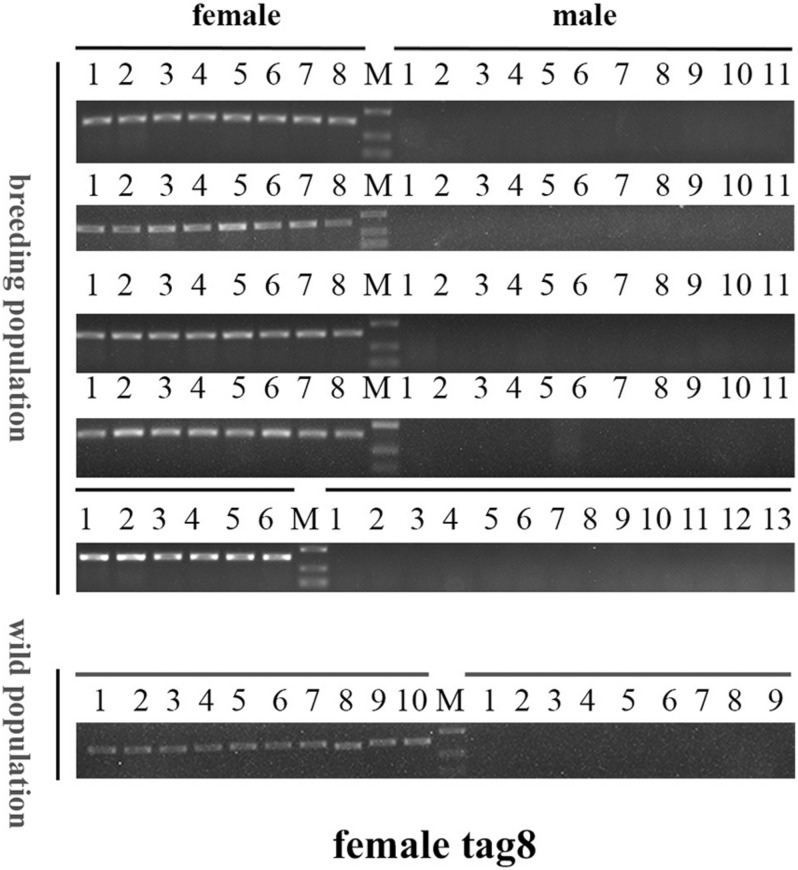
Sex-specific markers play an important role in revealing sex-determination mechanism. Sea urchin () is an economically important mariculture species in several Asian countries and its gonads are the sole edible parts for people. However, growth rate and immunocompetence differ by sex in this species, sex-specific markers have not been identified, and the sex-determination mechanism of sea urchin remains undetermined. In this study, type IIB endonuclease restriction-site associated DNA sequencing (2b-RAD-seq) and a genome survey of were performed, and three female-specific markers and three female heterogametic single nucleotide polymorphism (SNP) loci were identified. We validated these sex-specific markers via PCR amplification in a large number of individuals, including wild and artificially bred populations. Several open reading frames (ORFs) were predicted, although there are no potential genes known for sex determination and sex differentiation within the scaffold in which the sex-specific markers are located. Importantly, the female-specific sequences and female heterozygous SNP loci indicate that a female heterogametic and male homogametic ZW/ZZ sex-determination system should exist in . The results provide a solid basis for revealing the sex-determination mechanism of this species, and open up new possibilities for developing sex-control breeding in sea urchin.
性别特异性标记在揭示性别决定机制方面发挥着重要作用。海胆()是几个亚洲国家重要的经济海水养殖物种,其性腺是人们唯一可食用的部分。然而,该物种的生长速度和免疫能力存在性别差异,尚未鉴定出性别特异性标记,海胆的性别决定机制仍未确定。在本研究中,进行了IIB型核酸内切酶限制性位点相关DNA测序(2b-RAD-seq)和海胆的基因组调查,鉴定出三个雌性特异性标记和三个雌性异配单核苷酸多态性(SNP)位点。我们通过对包括野生和人工养殖群体在内的大量个体进行PCR扩增,验证了这些性别特异性标记。尽管在性别特异性标记所在的支架中没有已知的性别决定和性别分化潜在基因,但预测了几个开放阅读框(ORF)。重要的是,雌性特异性序列和雌性杂合SNP位点表明海胆中应存在雌性异配和雄性同配的ZW/ZZ性别决定系统。这些结果为揭示该物种的性别决定机制提供了坚实基础,并为开展海胆性别控制育种开辟了新的可能性。