Bertoglio Isabela Maria, Valim Juliana Miranda de Lucena, Daffre Danielle, Aikawa Nádia Emi, Silva Clovis Artur, Bonfá Eloisa, Ugolini-Lopes Michelle Remião
Hospital das Clinicas da Faculdade de Medicina da Universidade de São Paulo, São Paulo, Brazil.
ACR Open Rheumatol. 2021 Nov;3(11):804-811. doi: 10.1002/acr2.11329. Epub 2021 Aug 23.
Coronavirus disease 2019 (COVID-19) has progressed rapidly around the world, reaching a lethality of up to 20% due to acute respiratory distress syndrome (ARDS). This latter condition is a relevant concern for systemic lupus erythematosus (SLE); however, data on this topic are limited to few case series. Our objective was to evaluate in hospitalized patients with SLE and with COVID-19-associated ARDS (confirmed by reverse transcription-polymerase chain reaction) the risk of mortality and combined poor outcomes (death, intensive care unit [ICU] admission, and/or mechanical ventilation [MV] use) and to compare with that of patients without SLE.
This is a nationwide cross-sectional study of patients with severe acute respiratory syndrome coronavirus 2 nested in the national Influenza Epidemiological Surveillance Information System (Sistema de Informação de Vigilância Epidemiológica da Gripe [SIVEP-gripe]). Mortality rates, frequencies of ICU admissions, and MV use for 319 patients with SLE and 251 800 patients without SLE were calculated as well as relative risks (RRs). A fully adjusted multiple logistic regression was performed to adjust factors, such as age and well-known comorbidities, that might impact worse outcomes.
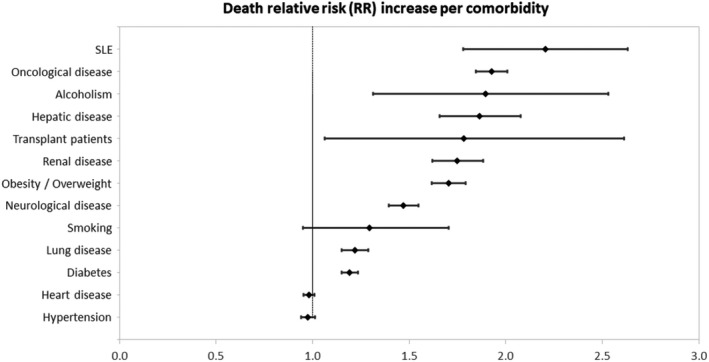
Patients with SLE had an increased risk of death and combined poor outcome compared with patients without SLE (RR = 1.738, 95% confidence interval [CI]: 1.557-1.914, and RR = 1.391, 95% CI: 1.282-1.492, respectively). Among all investigated comorbidities, SLE yielded the higher risk of death and combined poor outcomes (RR = 2.205, 95% CI: 1.780-2.633, and RR = 1.654, 95% CI: 1.410-1.88, respectively).
This study provides novel evidence that patients with SLE hospitalized because of COVID-19 have significantly higher risks of death and poor outcomes compared with patients without comorbidities and patients with other comorbidities.
2019冠状病毒病(COVID-19)在全球迅速蔓延,因急性呼吸窘迫综合征(ARDS)导致的死亡率高达20%。后者是系统性红斑狼疮(SLE)的一个相关问题;然而,关于这一主题的数据仅限于少数病例系列。我们的目的是评估住院的SLE患者以及伴有COVID-19相关ARDS(经逆转录-聚合酶链反应确诊)患者的死亡风险和综合不良结局(死亡、入住重症监护病房[ICU]和/或使用机械通气[MV]),并与无SLE的患者进行比较。
这是一项在全国范围内对严重急性呼吸综合征冠状病毒2患者进行的横断面研究,该研究嵌套于国家流感流行病学监测信息系统(Sistema de Informação de Vigilância Epidemiológica da Gripe [SIVEP-gripe])中。计算了319例SLE患者和251800例无SLE患者的死亡率、ICU入住频率和MV使用情况以及相对风险(RRs)。进行了完全调整的多因素逻辑回归分析,以调整可能影响不良结局的因素,如年龄和常见合并症。
与无SLE的患者相比,SLE患者的死亡风险和综合不良结局风险增加(RR分别为1.738,95%置信区间[CI]:1.557 - 1.914,以及RR为1.391,95% CI:1.282 - 1.492)。在所有调查的合并症中,SLE导致的死亡风险和综合不良结局风险更高(RR分别为2.205,95% CI:1.780 - 2.633,以及RR为1.654,95% CI:1.410 - 1.88)。
本研究提供了新的证据,即因COVID-19住院的SLE患者与无合并症患者及其他合并症患者相比,死亡风险和不良结局风险显著更高。