Department of Agricultural, Food and Environmental Sciences, Polytechnic University of Marche, via Brecce Bianche, Ancona, 60131, Italy.
Instituto de Biotecnología y Biología Molecular, UNLP-CONICET, CCT La Plata, La Plata, Argentina.
Plant J. 2021 Nov;108(3):646-660. doi: 10.1111/tpj.15472. Epub 2021 Sep 23.
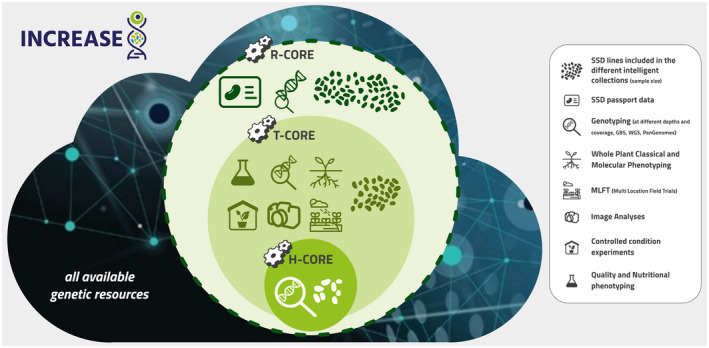
Food legumes are crucial for all agriculture-related societal challenges, including climate change mitigation, agrobiodiversity conservation, sustainable agriculture, food security and human health. The transition to plant-based diets, largely based on food legumes, could present major opportunities for adaptation and mitigation, generating significant co-benefits for human health. The characterization, maintenance and exploitation of food-legume genetic resources, to date largely unexploited, form the core development of both sustainable agriculture and a healthy food system. INCREASE will implement, on chickpea (Cicer arietinum), common bean (Phaseolus vulgaris), lentil (Lens culinaris) and lupin (Lupinus albus and L. mutabilis), a new approach to conserve, manage and characterize genetic resources. Intelligent Collections, consisting of nested core collections composed of single-seed descent-purified accessions (i.e., inbred lines), will be developed, exploiting germplasm available both from genebanks and on-farm and subjected to different levels of genotypic and phenotypic characterization. Phenotyping and gene discovery activities will meet, via a participatory approach, the needs of various actors, including breeders, scientists, farmers and agri-food and non-food industries, exploiting also the power of massive metabolomics and transcriptomics and of artificial intelligence and smart tools. Moreover, INCREASE will test, with a citizen science experiment, an innovative system of conservation and use of genetic resources based on a decentralized approach for data management and dynamic conservation. By promoting the use of food legumes, improving their quality, adaptation and yield and boosting the competitiveness of the agriculture and food sector, the INCREASE strategy will have a major impact on economy and society and represents a case study of integrative and participatory approaches towards conservation and exploitation of crop genetic resources.
食用豆类对于所有与农业相关的社会挑战都至关重要,包括减缓气候变化、保护农业生物多样性、可持续农业、粮食安全和人类健康。向以食用豆类为基础的植物性饮食转变,可能为适应和缓解提供重大机遇,为人类健康带来重大协同效益。食用豆类遗传资源的特征描述、维护和利用,迄今为止在很大程度上尚未得到开发,是可持续农业和健康食品体系发展的核心。INCREASE 将在鹰嘴豆(Cicer arietinum)、菜豆(Phaseolus vulgaris)、小扁豆(Lens culinaris)和羽扇豆(Lupinus albus 和 L. mutabilis)上实施一种新方法,用于保存、管理和描述遗传资源。智能集合由嵌套核心集合组成,核心集合由单粒传代纯化的系谱(即自交系)组成,利用基因库和田间保存的种质资源,并对其进行不同程度的基因型和表型特征描述。通过参与式方法,表型和基因发现活动将满足各种参与者的需求,包括育种者、科学家、农民以及农业食品和非食品行业,同时还利用大规模代谢组学和转录组学以及人工智能和智能工具的力量。此外,INCREASE 将通过公民科学实验,测试一种基于去中心化数据管理和动态保护方法的创新遗传资源保存和利用系统。通过推广食用豆类的使用、提高其质量、适应性和产量,以及提高农业和食品部门的竞争力,INCREASE 战略将对经济和社会产生重大影响,并且是一个关于综合和参与式方法来保护和利用作物遗传资源的案例研究。