Gao Ya, Li Weiru, Bu Xiaoyin, Xu Ying, Cai Shengchun, Zhong Jinman, Du Meixue, Sun Haitao, Huang Liping, He Yongjian, Hu Xiumei, Liu Qifa, Jin Hua, Wang Qian, Ping Baohong
Department of Hematology, Nanfang Hospital, Southern Medical University, Guangzhou, 510515, People's Republic of China.
Department of Laboratory Medicine, Zhujiang Hospital, Southern Medical University, Guangzhou, 510280, People's Republic of China.
J Inflamm Res. 2021 Aug 16;14:3985-3999. doi: 10.2147/JIR.S323054. eCollection 2021.
Acute graft versus host disease (aGVHD) remains a leading cause of transplant-related mortality following allogeneic haematopoietic cell transplantation (allo-HCT). Human amniotic mesenchymal stem cells (hAMSCs) are a novel mesenchymal stem cells (MSCs), which have stronger proliferation and immunomodulatory ability compared with bone marrow mesenchymal stem cells (BM-MSCs). Besides, as the amniotic membrane is often treated as medical waste after delivery, hAMSCs can be obtained conveniently and noninvasively. The aim of this study was to explore the therapeutic efficacy and underlying mechanisms of hAMSCs transplantation for the humanized aGVHD mouse model.
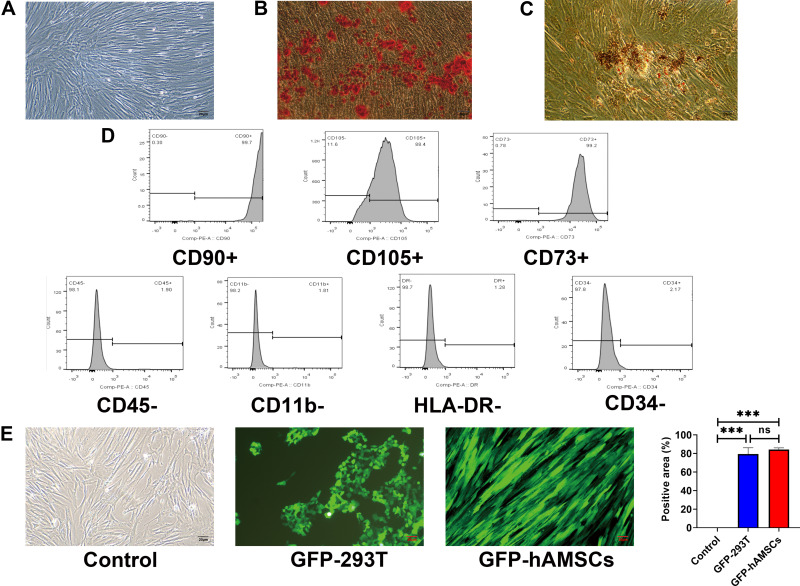
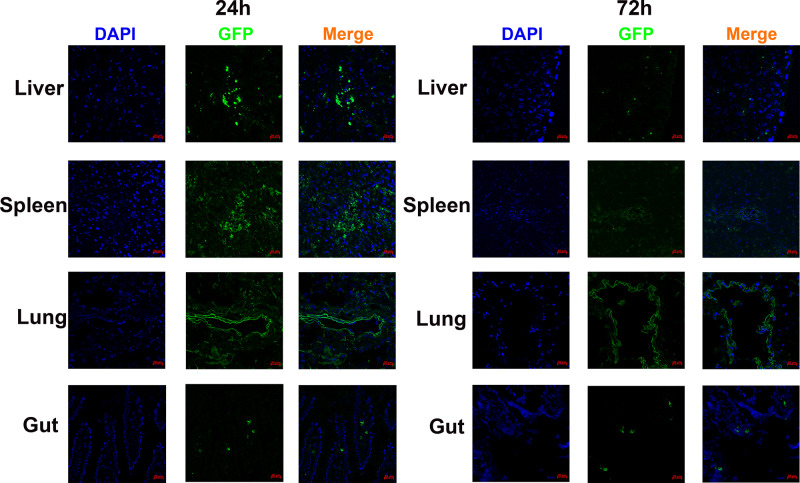
We established a humanized aGVHD mouse model by transplanting human peripheral blood mononuclear cells (PBMCs) into NOD-PrkdcIL2rγ (NPG) mice, human amniotic membrane collected from discarded placenta of healthy pregnant women after delivery and hAMSCs were extracted from amniotic membrane and expanded in vitro. Mice were divided into untreated group (Control), aGVHD group (aGVHD), and hAMSCs treatment group (aGVHD+hAMSCs), the hAMSCs labeled with GFP were administered to aGVHD mice to explore the homing ability of hAMSCs. T effector and regulatory T cells (Tregs) levels and cytokines of each group in target organs were detected by flow cytometry and cytometric bead array (CBA), respectively.
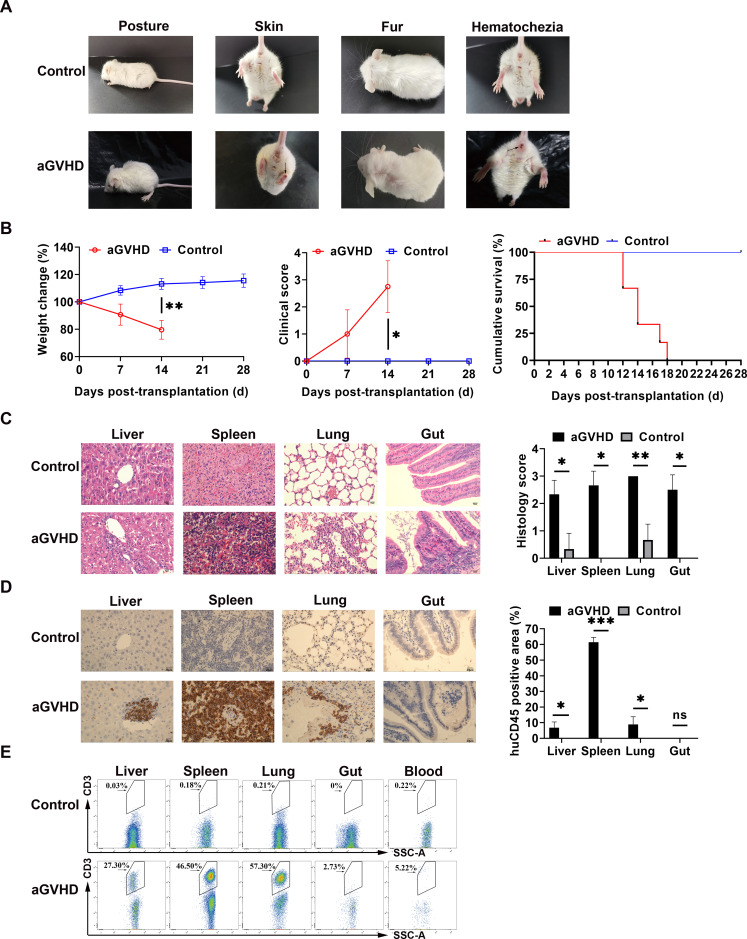
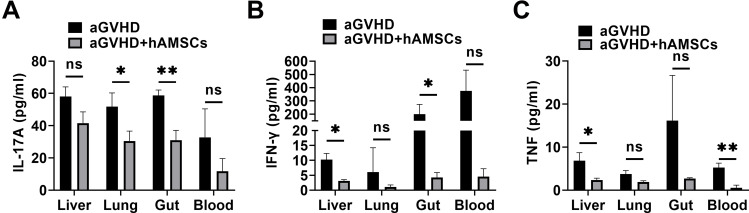
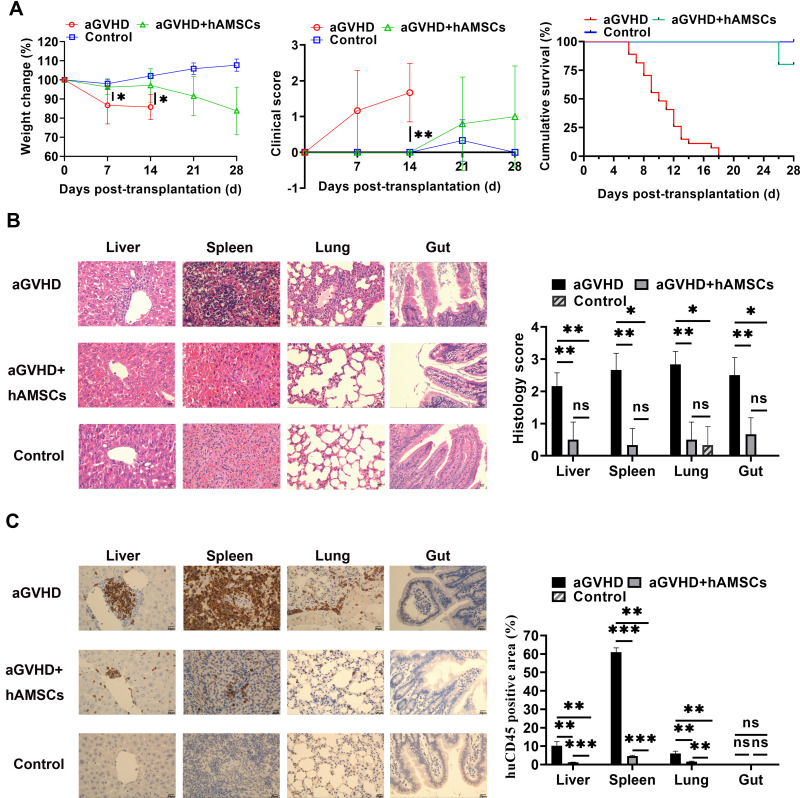
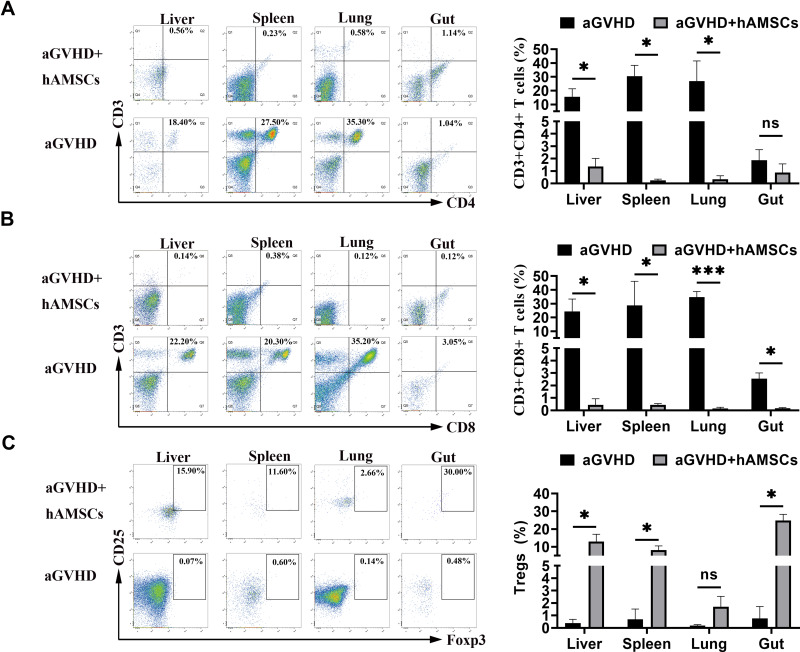
We successfully established a humanized aGVHD mouse model using NPG mice. The hAMSCs have the ability to inhibit aGVHD in this mouse model through reduced villous blunting and lymphocyte infiltration of the gut while reducing inflammatory edema, tissue destruction and lymphocyte infiltration into the parenchyma of the liver and lung. hAMSCs suppressed CD3+CD4+ T and CD3+CD8+ T cell expression and increased the proportion of Tregs, and besides, hAMSCs can reduce the levels of IL-17A, INF-γ, and TNF in aGVHD target organs.
The NPG murine environment was capable of activating human T cells to produce aGVHD pathology to mimic aGVHD as in humans. The hAMSCs controlled aGVHD by decreasing inflammatory cytokine secretion within target organs by modulating the balance of Tregs and T effector cells in humanized mice.
急性移植物抗宿主病(aGVHD)仍然是异基因造血细胞移植(allo-HCT)后移植相关死亡的主要原因。人羊膜间充质干细胞(hAMSCs)是一种新型的间充质干细胞(MSCs),与骨髓间充质干细胞(BM-MSCs)相比,具有更强的增殖和免疫调节能力。此外,由于羊膜在分娩后常被视为医疗废物,hAMSCs可以方便且无创地获得。本研究的目的是探讨hAMSCs移植对人源化aGVHD小鼠模型的治疗效果及潜在机制。
通过将人外周血单个核细胞(PBMCs)移植到NOD-PrkdcIL2rγ(NPG)小鼠中建立人源化aGVHD小鼠模型,收集健康孕妇分娩后废弃胎盘的人羊膜,从羊膜中提取hAMSCs并在体外扩增。将小鼠分为未治疗组(对照)、aGVHD组(aGVHD)和hAMSCs治疗组(aGVHD+hAMSCs),将用绿色荧光蛋白(GFP)标记的hAMSCs给予aGVHD小鼠以探索hAMSCs的归巢能力。分别通过流式细胞术和细胞计数珠阵列(CBA)检测各实验组靶器官中T效应细胞和调节性T细胞(Tregs)水平及细胞因子。
我们使用NPG小鼠成功建立了人源化aGVHD小鼠模型。hAMSCs能够在该小鼠模型中抑制aGVHD,表现为肠道绒毛变钝和淋巴细胞浸润减少,同时减轻肝脏和肺实质的炎症水肿、组织破坏及淋巴细胞浸润。hAMSCs抑制了CD3+CD4+T和CD3+CD8+T细胞的表达,增加了Tregs的比例,此外,hAMSCs还能降低aGVHD靶器官中IL-17A、INF-γ和TNF的水平。
NPG小鼠环境能够激活人T细胞产生aGVHD病理变化,以模拟人类的aGVHD。hAMSCs通过调节人源化小鼠中Tregs和T效应细胞的平衡,减少靶器官内炎性细胞因子的分泌来控制aGVHD。