Department of Behavioural Science and Health, University College London, London, UK.
Addiction. 2021 Jul;116(7):1859-1870. doi: 10.1111/add.15403. Epub 2021 Jan 22.
There have been substantial recent changes in youth tobacco product use in the United States-including, notably, a rapid increase in use of e-cigarettes. It is not known whether, and if so how far, these changes are reflected in levels of nicotine dependence. This study used data from a large, nationally representative sample of US adolescents to (i) estimate the annual prevalence of nicotine dependence in relation to current use of tobacco products, (ii) describe trends in dependence over time and (iii) evaluate whether the increase in youth use of tobacco products has been paralleled by a similar increase in the population burden of nicotine dependence.
Secondary analysis of National Youth Tobacco Surveys conducted annually, 2012-19.
United States.
A total of 86 902 high school students.
Prevalence of (i) strong cravings to use tobacco in the past 30 days and (ii) wanting to use nicotine products within 30 minutes of waking, in relation to type of product used (cigarettes, other combustible tobacco, smokeless tobacco, e-cigarettes).
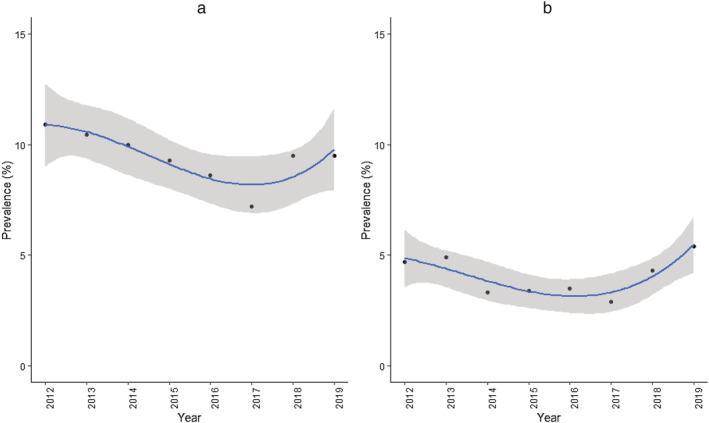
Between 2012 and 2019 there was a marked decline in past 30-day cigarette smoking and a surge in use of e-cigarettes. Different products were associated with differing levels of nicotine dependence, with cigarettes characterized by highest dependence (strong craving 42.3%; wanting to use within 30 minutes 16.8% among exclusive users in 2019) and e-cigarettes in otherwise tobacco-naive students by low dependence (16.1 and 8.8% respectively in 2019). The overall 33.8% increase in population use of nicotine products between 2012 and 2019 (from 23.2 to 31.2%) was not accompanied by an equivalent increase in overall population burden of dependence {percentage reporting craving 10.9% [95% confidence interval (CI) = 9.8-12.2%] in 2012 and 9.5% (95% CI = 7.5-12.0%) in 2019; wanting to use within 30 minutes 4.7% (95% CI = 4.0-5.5%) in 2012, 5.4% (95% CI = 4.0-7.2%) in 2019}.
Among US high school students, increases in the prevalence of nicotine product use from 2012 to 2019 do not appear to have been accompanied by a similar increase in the population burden of nicotine dependence. This may be at least partly attributable to a shift in the most common product of choice from cigarettes (on which users are most dependent) to e-cigarettes (on which users are least dependent).
近年来,美国青少年的烟草制品使用情况发生了重大变化,包括电子烟的使用迅速增加。目前尚不清楚这些变化是否以及在多大程度上反映在尼古丁依赖程度上。本研究使用了来自美国青少年的大型全国代表性样本的数据,(i)估计与当前使用烟草制品有关的尼古丁依赖的年度流行率,(ii)描述随时间推移的依赖趋势,(iii)评估青少年使用烟草制品的增加是否与尼古丁依赖人群负担的类似增加相平行。
每年进行的全国青少年烟草调查的二次分析,2012-19 年进行。
美国。
共有 86902 名高中生。
在过去 30 天内(i)强烈渴望使用烟草和(ii)在醒来后 30 分钟内使用尼古丁产品的流行率,与使用的产品类型(香烟、其他可燃烟草、无烟烟草、电子烟)有关。
在 2012 年至 2019 年期间,过去 30 天的吸烟率明显下降,电子烟的使用率猛增。不同的产品与不同程度的尼古丁依赖有关,香烟的依赖性最高(2019 年独家使用者中强烈渴望 42.3%;醒来后 30 分钟内使用 16.8%),而在其他烟草制品中,电子烟的依赖性最低(2019 年分别为 16.1%和 8.8%)。2012 年至 2019 年间,尼古丁产品的总使用量增加了 33.8%(从 23.2%增加到 31.2%),但尼古丁依赖的总人群负担并未相应增加{2012 年报告渴望 10.9%(95%置信区间 [CI]:9.8-12.2%),2019 年报告渴望 9.5%(95%CI:7.5-12.0%);2012 年报告醒来后 30 分钟内使用 4.7%(95%CI:4.0-5.5%),2019 年报告醒来后 5.4%(95%CI:4.0-7.2%)}。
在美国高中生中,2012 年至 2019 年尼古丁产品使用率的增加似乎并没有导致尼古丁依赖的人群负担类似增加。这至少部分归因于最常见的选择产品从香烟(使用者依赖性最强)转移到电子烟(使用者依赖性最弱)。