State Key Laboratory of Infectious Disease Prevention and Control, National Institute for Communicable Disease Control and Prevention, Chinese Center for Disease Control and Prevention, Beijing, China.
Key Laboratory of Medicine, Ministry of Education, School of Laboratory Medicine and Life Sciences, Wenzhou Medical University, Wenzhou, China.
PLoS Negl Trop Dis. 2021 Aug 26;15(8):e0009665. doi: 10.1371/journal.pntd.0009665. eCollection 2021 Aug.
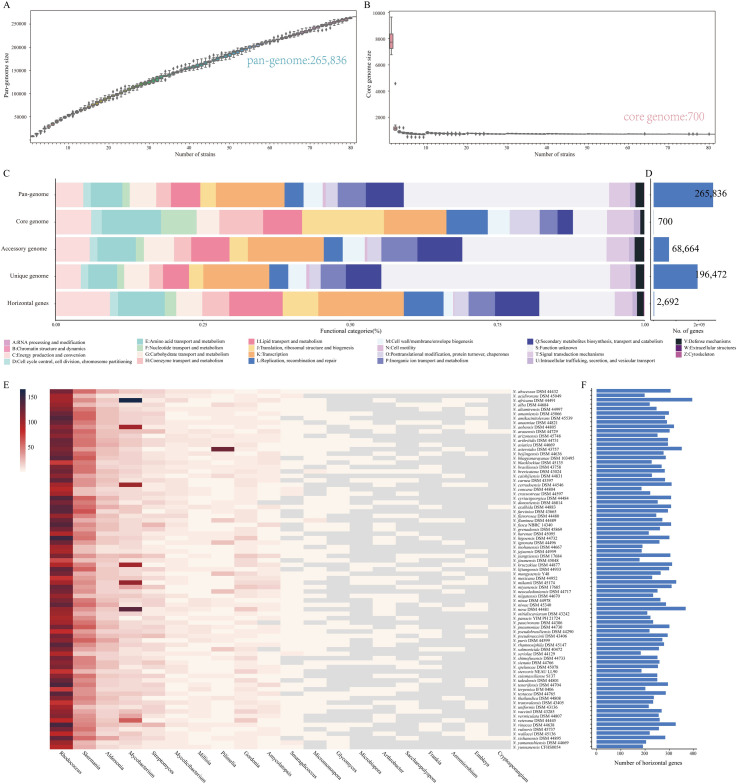
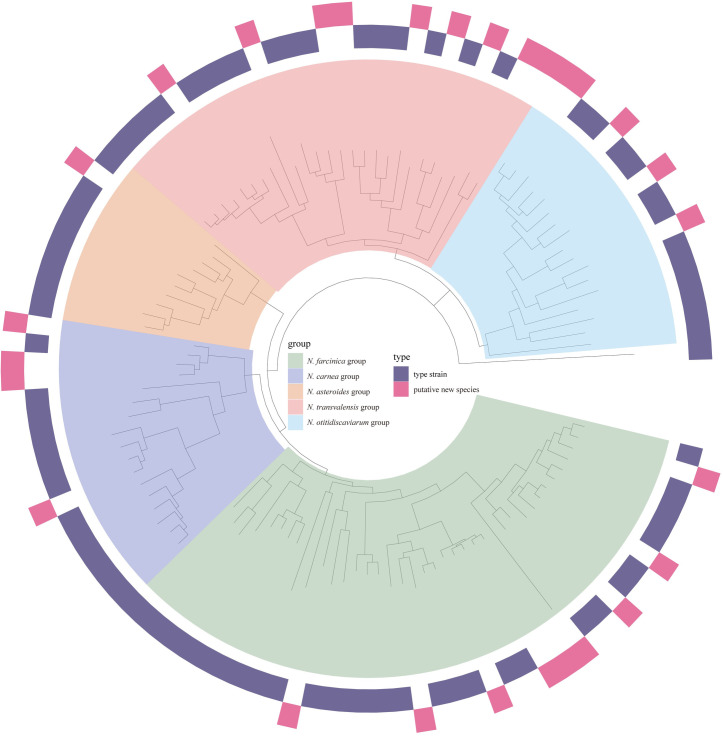
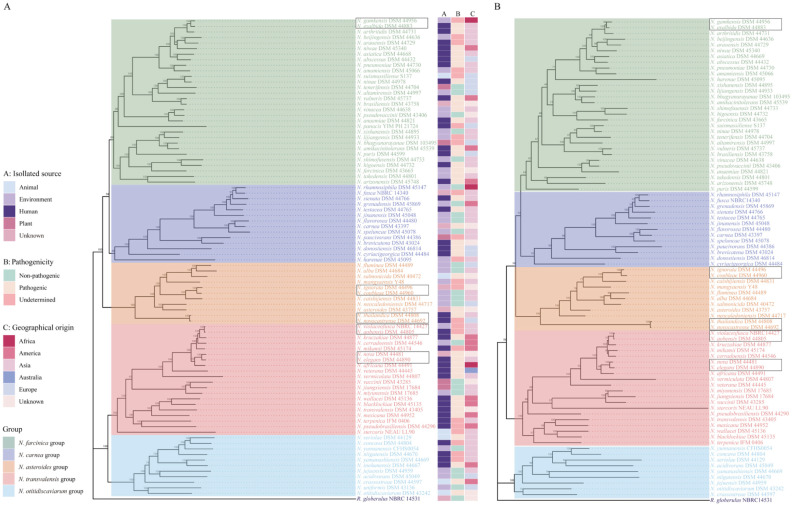
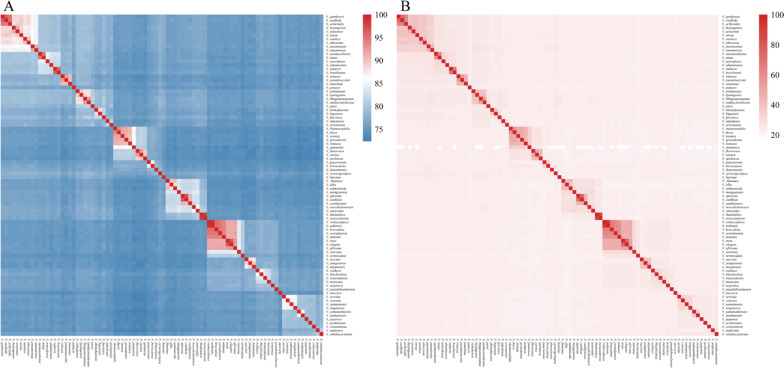
Nocardia is a complex and diverse genus of aerobic actinomycetes that cause complex clinical presentations, which are difficult to diagnose due to being misunderstood. To date, the genetic diversity, evolution, and taxonomic structure of the genus Nocardia are still unclear. In this study, we investigated the pan-genome of 86 Nocardia type strains to clarify their genetic diversity. Our study revealed an open pan-genome for Nocardia containing 265,836 gene families, with about 99.7% of the pan-genome being variable. Horizontal gene transfer appears to have been an important evolutionary driver of genetic diversity shaping the Nocardia genome and may have caused historical taxonomic confusion from other taxa (primarily Rhodococcus, Skermania, Aldersonia, and Mycobacterium). Based on single-copy gene families, we established a high-accuracy phylogenomic approach for Nocardia using 229 genome sequences. Furthermore, we found 28 potentially new species and reclassified 16 strains. Finally, by comparing the topology between a phylogenomic tree and 384 phylogenetic trees (from 384 single-copy genes from the core genome), we identified a novel locus for inferring the phylogeny of this genus. The dapb1 gene, which encodes dipeptidyl aminopeptidase BI, was far superior to commonly used markers for Nocardia and yielded a topology almost identical to that of genome-based phylogeny. In conclusion, the present study provides insights into the genetic diversity, contributes a robust framework for the taxonomic classification, and elucidates the evolutionary relationships of Nocardia. This framework should facilitate the development of rapid tests for the species identification of highly variable species and has given new insight into the behavior of this genus.
诺卡氏菌是需氧放线菌的一个复杂而多样化的属,可引起复杂的临床表现,由于被误解,这些临床表现难以诊断。迄今为止,诺卡氏菌属的遗传多样性、进化和分类结构仍不清楚。在这项研究中,我们研究了 86 株诺卡氏菌模式菌株的泛基因组,以阐明其遗传多样性。我们的研究揭示了诺卡氏菌的一个开放泛基因组,包含 265836 个基因家族,约 99.7%的泛基因组是可变性的。水平基因转移似乎是塑造诺卡氏菌基因组遗传多样性的一个重要进化驱动因素,可能导致了与其他分类群(主要是 Rhodococcus、Skermania、Aldersonia 和 Mycobacterium)的历史分类混淆。基于单拷贝基因家族,我们使用 229 个基因组序列为诺卡氏菌建立了一种高精度的系统基因组学方法。此外,我们发现了 28 个潜在的新种,并重新分类了 16 个菌株。最后,通过比较系统基因组树和 384 个系统发育树(来自核心基因组的 384 个单拷贝基因)之间的拓扑结构,我们确定了一个用于推断该属系统发育的新基因座。编码二肽基氨基肽酶 BI 的 dapb1 基因在诺卡氏菌的鉴定中优于常用的标记物,其拓扑结构几乎与基于基因组的系统发育树相同。总之,本研究深入了解了遗传多样性,为分类学提供了一个稳健的框架,并阐明了诺卡氏菌的进化关系。该框架应该有助于开发用于高度可变物种鉴定的快速测试,并为该属的行为提供了新的见解。