Wu Wen-Ling, Bamodu Oluwaseun Adebayo, Wang Yuan-Hung, Hu Su-Wei, Tzou Kai-Yi, Yeh Chi-Tai, Wu Chia-Chang
Department of Urology, Shuang Ho Hospital, Taipei Medical University, New Taipei City 235, Taiwan.
TMU Research Center of Urology and Kidney (TMU-RCUK), Taipei Medical University, Taipei City 110, Taiwan.
J Clin Med. 2021 Aug 16;10(16):3602. doi: 10.3390/jcm10163602.
Chronic prostatitis/chronic pelvic pain syndrome (CP/CPPS), affecting over 90% of patients with symptomatic prostatitis, remains a therapeutic challenge and adversely affects patients' quality of life (QoL). This study probed for likely beneficial effects of ESWT, evaluating its extent and durability.
Standardized indices, namely the pain, urinary, and QoL domains and total score of NIH-CPSI, IIEF-5, EHS, IPSS, and AUA QoL_US were employed in this study of patients with CP/CPPS who had been refractory to other prior treatments ( = 215; age range: 32-82 years; median age: 57.5 ± 12.4 years; modal age: 41 years).
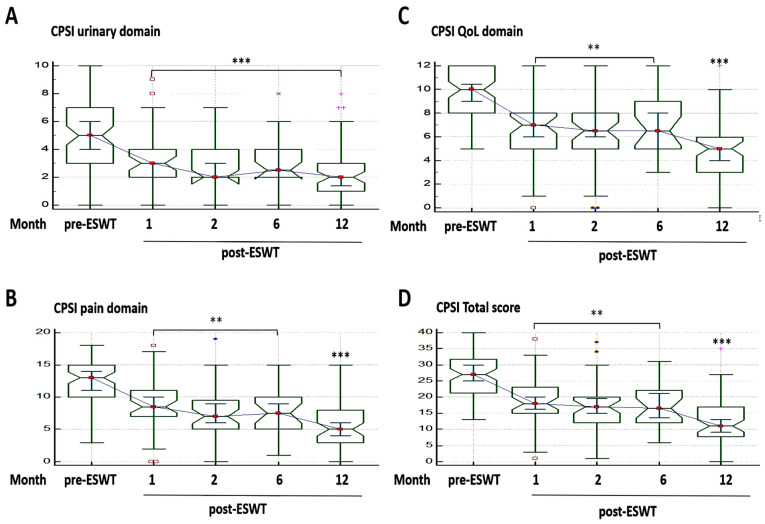
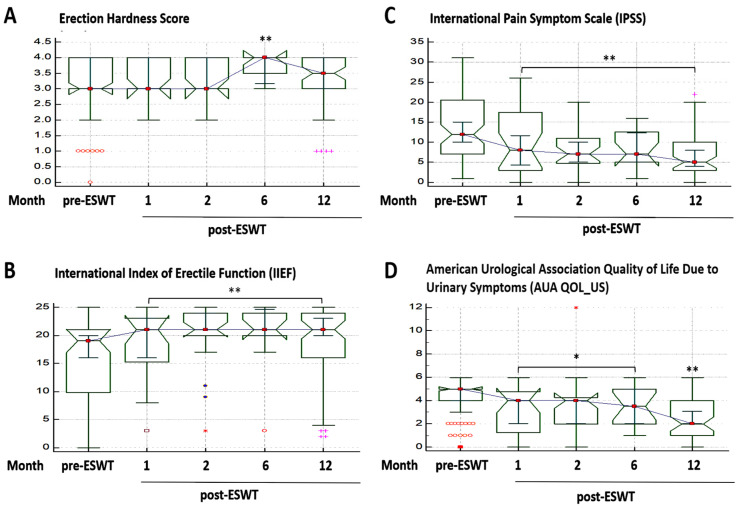
For CP symptoms, the mean pre-ESWT NIH-CPSI total score of 27.1 ± 6.8 decreased by 31.3-53.6% over 12 months after ESWT. The mean pre-ESWT NIH-CPSI pain (12.5 ± 3.3), urinary (4.98 ± 2.7), and QoL (9.62 ± 2.1) domain scores improved by 2.3-fold, 2.2-fold, and 2.0-fold, respectively, by month 12 post-ESWT. Compared with the baseline IPSS of 13.9 ± 8.41, we recorded 27.1-50.9% amelioration of urinary symptoms during the 12 months post-ESWT. For erectile function, compared to pre-ESWT values, the IIEF-5 also improved by ~1.3-fold by month 12 after ESWT. This was corroborated by EHS of 3.11 ± 0.99, 3.37 ± 0.65, 3.42 ± 0.58, 3.75 ± 0.45, and 3.32 ± 0.85 at baseline, 1, 2, 6, and 12 months post-ESWT. Compared to the mean pre-ESWT QoL score (4.29 ± 1.54), the mean QoL values were 3.26 ± 1.93, 3.45 ± 2.34, 3.25 ± 1.69, and 2.6 ± 1.56 for months 1, 2, 6, and 12 after ESWT, respectively.
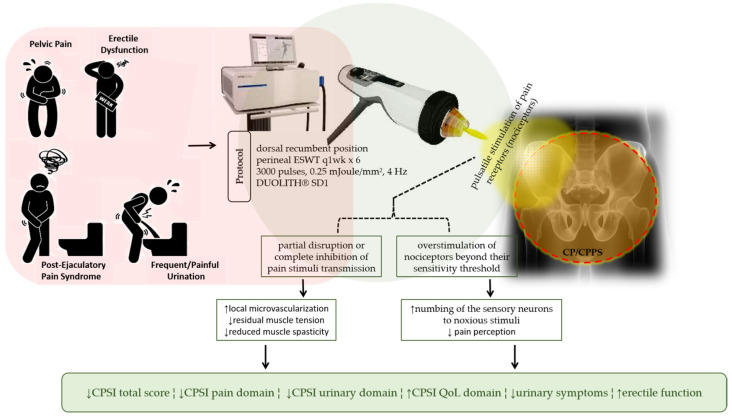
This study shows ESWT, an outpatient and easy-to-perform, minimally invasive procedure, effectively alleviates pain, improves erectile function, and ameliorates quality of life in patients with refractory CP/CPPS.
慢性前列腺炎/慢性盆腔疼痛综合征(CP/CPPS)影响着90%以上有症状的前列腺炎患者,仍然是一个治疗难题,并对患者的生活质量(QoL)产生不利影响。本研究探讨了体外冲击波疗法(ESWT)可能的有益效果,评估其程度和持久性。
本研究纳入了215例CP/CPPS患者(年龄范围:32 - 82岁;中位年龄:57.5±12.4岁;众数年龄:41岁),这些患者对先前的其他治疗均无效。采用标准化指标,即疼痛、泌尿和QoL领域以及美国国立卫生研究院慢性前列腺炎症状指数(NIH - CPSI)、国际勃起功能指数 - 5(IIEF - 5)、勃起硬度评分(EHS)、国际前列腺症状评分(IPSS)和美国泌尿协会生活质量量表(AUA QoL_US)的总分。
对于CP症状,ESWT前NIH - CPSI总分平均为27.1±6.8,在ESWT后12个月内下降了31.3% - 53.6%。ESWT前NIH - CPSI疼痛(12.5±3.3)、泌尿(4.98±2.7)和QoL(9.62±2.1)领域得分在ESWT后12个月时分别提高了2.3倍、2.2倍和2.0倍。与基线IPSS 13.9±8.41相比,ESWT后12个月内我们记录到泌尿症状改善了27.1% - 50.9%。对于勃起功能,与ESWT前的值相比,IIEF - 5在ESWT后12个月时也提高了约1.3倍。这在ESWT前、后1、2、6和12个月时的EHS分别为3.11±0.99、3.37±0.65、3.42±0.58、3.75±0.45和3.32±0.85中得到了证实。与ESWT前QoL平均得分(4.29±1.54)相比,ESWT后1、2、6和12个月时的平均QoL值分别为3.26±1.93、3.45±2.34、3.25±1.69和2.6±1.56。
本研究表明,ESWT是一种门诊且易于实施的微创治疗方法,能有效减轻难治性CP/CPPS患者的疼痛,改善勃起功能,并提高生活质量。