Centre for Addiction and Mental Health, Institute for Mental Health Policy Research, 33 Ursula Franklin Street, Toronto, ON M5S 2S1, Canada.
Institute of Clinical Psychology and Psychotherapy, Technische Universität Dresden, Chemnitzer Str. 46, 01187 Dresden, Germany.
Nutrients. 2021 Jul 30;13(8):2652. doi: 10.3390/nu13082652.
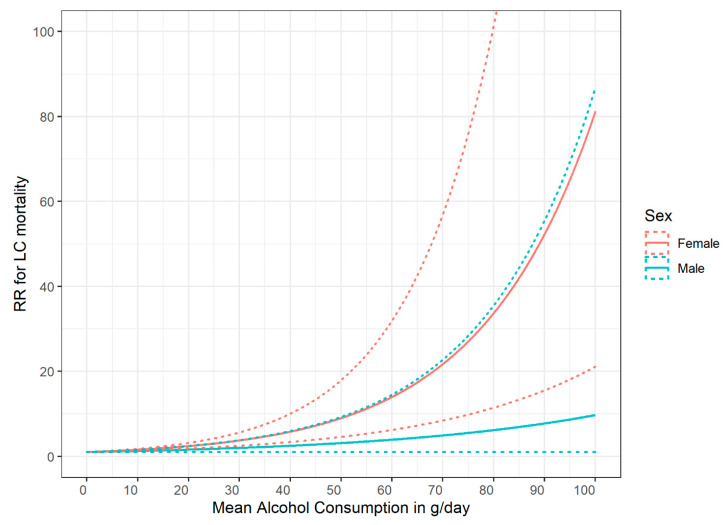
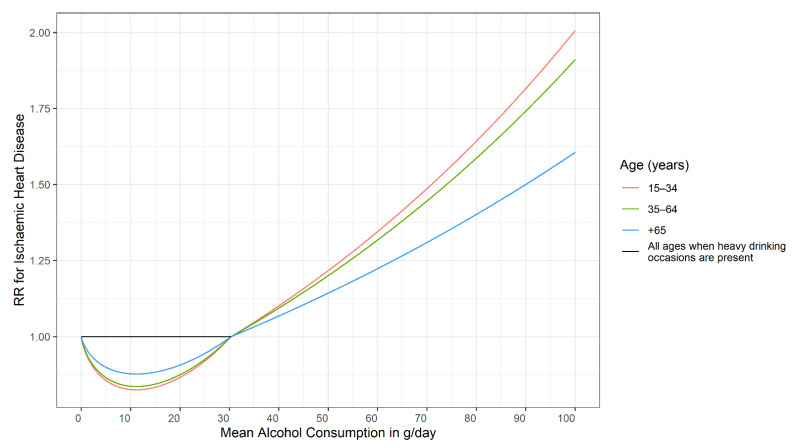
Alcohol use has been causally linked to more than 200 disease and injury conditions, as defined by three-digit ICD-10 codes. The understanding of how alcohol use is related to these conditions is essential to public health and policy research. Accordingly, this study presents a narrative review of different dose-response relationships for alcohol use. Relative-risk (RR) functions were obtained from various comparative risk assessments. Two main dimensions of alcohol consumption are used to assess disease and injury risk: (1) volume of consumption, and (2) patterns of drinking, operationalized via frequency of heavy drinking occasions. Lifetime abstention was used as the reference group. Most dose-response relationships between alcohol and outcomes are monotonic, but for diabetes type 2 and ischemic diseases, there are indications of a curvilinear relationship, where light to moderate drinking is associated with lower risk compared with not drinking (i.e., RR < 1). In general, women experience a greater increase in RR per gram of alcohol consumed than men. The RR per gram of alcohol consumed was lower for people of older ages. RRs indicated that alcohol use may interact synergistically with other risk factors, in particular with socioeconomic status and other behavioural risk factors, such as smoking, obesity, or physical inactivity. The literature on the impact of genetic constitution on dose-response curves is underdeveloped, but certain genetic variants are linked to an increased RR per gram of alcohol consumed for some diseases. When developing alcohol policy measures, including low-risk drinking guidelines, dose-response relationships must be taken into consideration.
饮酒与 200 多种疾病和伤害状况有关,这些状况由 ICD-10 三位数编码定义。了解饮酒与这些状况之间的关系对于公共卫生和政策研究至关重要。因此,本研究对不同的饮酒量-反应关系进行了叙述性综述。相对风险 (RR) 函数是从各种比较风险评估中获得的。有两种主要的饮酒方式用于评估疾病和伤害风险:(1) 饮酒量,(2) 饮酒模式,通过重度饮酒的频率来操作。终身戒酒被用作参考组。大多数饮酒与结果之间的剂量-反应关系是单调的,但对于 2 型糖尿病和缺血性疾病,存在曲线关系的迹象,即与不饮酒相比,轻度至中度饮酒与较低的风险相关(即 RR<1)。一般来说,女性在每克酒精摄入时的 RR 增加比男性更大。年龄较大的人的每克酒精摄入的 RR 较低。RR 表明,饮酒可能与其他风险因素,特别是社会经济地位和其他行为风险因素(如吸烟、肥胖或缺乏身体活动)发生协同作用。关于遗传构成对剂量-反应曲线的影响的文献还不够发达,但某些遗传变异与某些疾病的每克酒精摄入 RR 增加有关。在制定酒精政策措施时,包括低风险饮酒指南,必须考虑剂量-反应关系。