Nash Family Department of Neuroscience and Friedman Brain Institute, Icahn School of Medicine at Mount Sinai, New York, NY 10029;
Section on the Neurobiology of Learning and Memory, Laboratory of Neuropsychology, National Institute of Mental Health, NIH, Bethesda, MD 20892.
Proc Natl Acad Sci U S A. 2021 Aug 31;118(35). doi: 10.1073/pnas.2014781118.
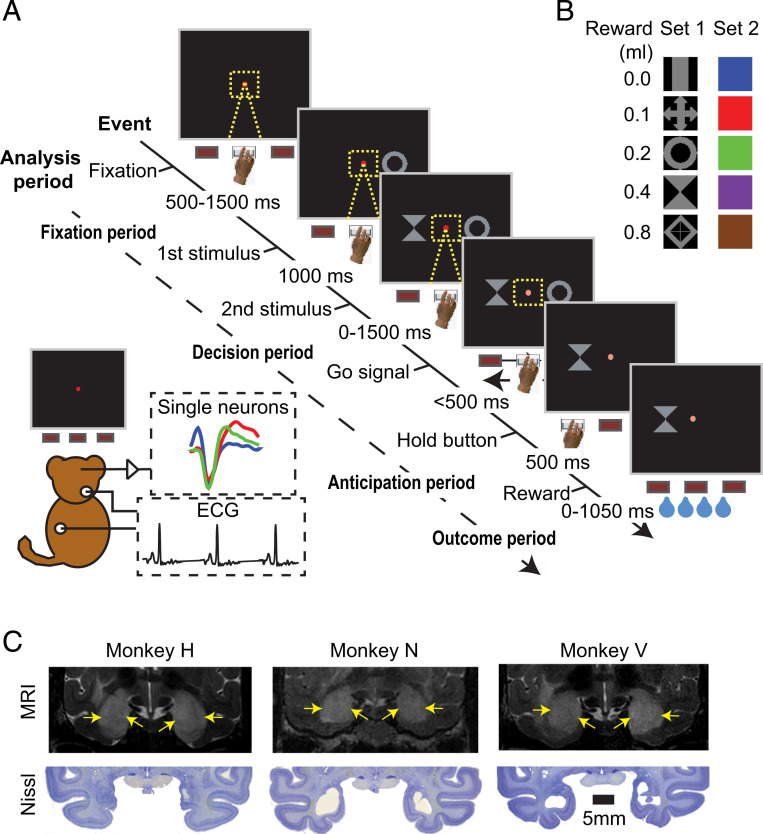
Decision-making and representations of arousal are intimately linked. Behavioral investigations have classically shown that either too little or too much bodily arousal is detrimental to decision-making, indicating that there is an inverted "U" relationship between bodily arousal and performance. How these processes interact at the level of single neurons as well as the neural circuits involved are unclear. Here we recorded neural activity from orbitofrontal cortex (OFC) and dorsal anterior cingulate cortex (dACC) of macaque monkeys while they made reward-guided decisions. Heart rate (HR) was also recorded and used as a proxy for bodily arousal. Recordings were made both before and after subjects received excitotoxic lesions of the bilateral amygdala. In intact monkeys, higher HR facilitated reaction times (RTs). Concurrently, a set of neurons in OFC and dACC selectively encoded trial-by-trial variations in HR independent of reward value. After amygdala lesions, HR increased, and the relationship between HR and RTs was altered. Concurrent with this change, there was an increase in the proportion of dACC neurons encoding HR. Applying a population-coding analysis, we show that after bilateral amygdala lesions, the balance of encoding in dACC is skewed away from signaling either reward value or choice direction toward HR coding around the time that choices are made. Taken together, the present results provide insight into how bodily arousal and decision-making are signaled in frontal cortex.
唤醒的决策和表现密切相关。行为研究经典地表明,过少或过多的身体唤醒都会对决策产生不利影响,这表明身体唤醒和表现之间存在着倒“U”型关系。这些过程在单个神经元以及涉及的神经回路水平上如何相互作用尚不清楚。在这里,我们记录了猕猴眶额皮层(OFC)和背侧前扣带皮层(dACC)在进行奖励引导决策时的神经活动。同时也记录了心率(HR),并将其用作身体唤醒的替代指标。在进行实验前和实验后,研究对象接受了双侧杏仁核的兴奋性毒素损伤。在未损伤的猴子中,较高的心率(HR)会促进反应时间(RT)。同时,OFC 和 dACC 中的一组神经元选择性地对 HR 的逐次变化进行编码,而与奖励价值无关。杏仁核损伤后,心率(HR)增加,HR 与 RTs 之间的关系发生改变。与这种变化同时发生的是,编码 HR 的 dACC 神经元的比例增加。通过应用群体编码分析,我们发现,双侧杏仁核损伤后,dACC 的编码平衡从信号传递奖励价值或选择方向偏向 HR 编码,时间正好是做出选择的时候。总之,目前的结果提供了关于身体唤醒和决策如何在额叶皮层中被信号化的见解。