Jülich Centre of Neutron Science (JCNS-1/IBI-8), Forschungszentrum Jülich GmbH, 52425, Jülich, Germany.
Institute of Neuroscience and Medicine (INM-1), Forschungszentrum Jülich GmbH, 52425, Jülich, Germany.
Sci Rep. 2021 Aug 27;11(1):17306. doi: 10.1038/s41598-021-92995-2.
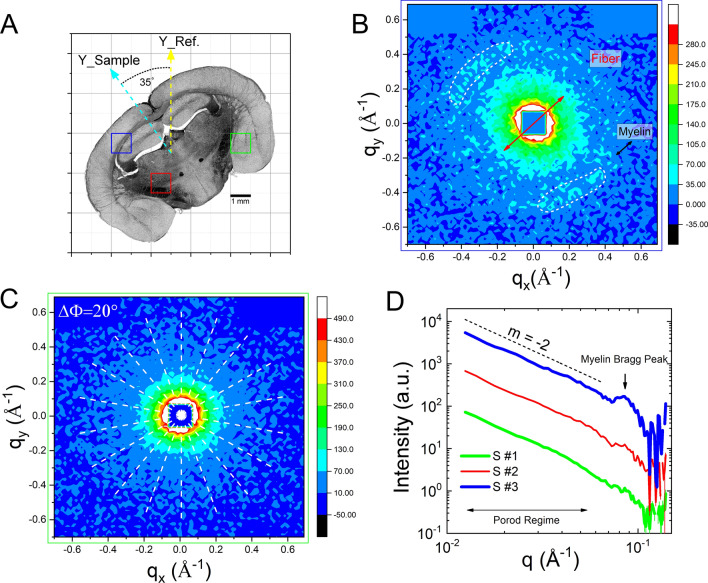
The structural connectivity of the brain has been addressed by various imaging techniques such as diffusion weighted magnetic resonance imaging (DWMRI) or specific microscopic approaches based on histological staining or label-free using polarized light (e.g., three-dimensional Polarized Light Imaging (3D-PLI), Optical Coherence Tomography (OCT)). These methods are sensitive to different properties of the fiber enwrapping myelin sheaths i.e. the distribution of myelin basic protein (histology), the apparent diffusion coefficient of water molecules restricted in their movements by the myelin sheath (DWMRI), and the birefringence of the oriented myelin lipid bilayers (3D-PLI, OCT). We show that the orientation and distribution of nerve fibers as well as myelin in thin brain sections can be determined using scanning small angle neutron scattering (sSANS). Neutrons are scattered from the fiber assembly causing anisotropic diffuse small-angle scattering and Bragg peaks related to the highly ordered periodic myelin multilayer structure. The scattering anisotropy, intensity, and angular position of the Bragg peaks can be mapped across the entire brain section. This enables mapping of the fiber and myelin distribution and their orientation in a thin brain section, which was validated by 3D-PLI. The experiments became possible by optimizing the neutron beam collimation to highest flux and enhancing the myelin contrast by deuteration. This method is very sensitive to small microstructures of biological tissue and can directly extract information on the average fiber orientation and even myelin membrane thickness. The present results pave the way toward bio-imaging for detecting structural aberrations causing neurological diseases in future.
大脑的结构连接性已经通过各种成像技术得到了研究,如扩散加权磁共振成像(DWMRI)或基于组织学染色或使用偏振光无标记的特定微观方法(例如,三维偏振光成像(3D-PLI)、光学相干断层扫描(OCT))。这些方法对包裹在髓鞘中的纤维的不同性质敏感,即髓鞘碱性蛋白的分布(组织学)、水分子在髓鞘限制下的表观扩散系数(DWMRI),以及取向的髓鞘类脂双层的双折射(3D-PLI、OCT)。我们表明,使用扫描小角中子散射(sSANS)可以确定薄脑切片中的神经纤维和髓鞘的方向和分布。中子从纤维组件散射,导致各向异性漫散射和与高度有序的周期性髓鞘多层结构相关的布拉格峰。布拉格峰的散射各向异性、强度和角度位置可以在整个脑切片上进行映射。这使得可以在薄脑切片中映射纤维和髓鞘的分布及其方向,这已通过 3D-PLI 得到验证。通过优化中子束准直以获得最高通量并通过氘化增强髓鞘对比度,使这些实验成为可能。该方法对生物组织的微小结构非常敏感,可以直接提取有关平均纤维方向甚至髓鞘膜厚度的信息。目前的结果为未来检测导致神经疾病的结构异常的生物成像铺平了道路。