Mind/Brain Institute, Johns Hopkins University, Baltimore, MD, USA; Kavli Neuroscience Discovery Institute, Johns Hopkins University, Baltimore, MD, USA; Laboratory for Computational Sensing and Robotics, Johns Hopkins University, Baltimore, MD, USA; School of Biomedical Engineering, Djawad Mowafaghian Centre for Brain Health, University of British Columbia, BC, Canada.
Mind/Brain Institute, Johns Hopkins University, Baltimore, MD, USA; Laboratory for Computational Sensing and Robotics, Johns Hopkins University, Baltimore, MD, USA; Mechanical Engineering Department, Johns Hopkins University, Baltimore, MD, USA.
J Neurosci Methods. 2022 Feb 15;368:109336. doi: 10.1016/j.jneumeth.2021.109336. Epub 2021 Aug 26.
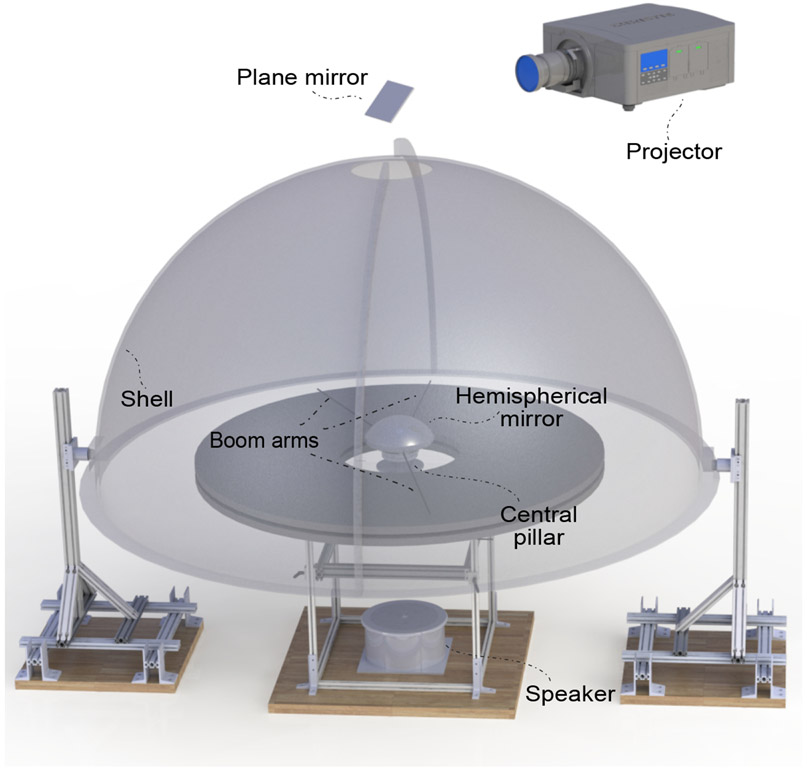
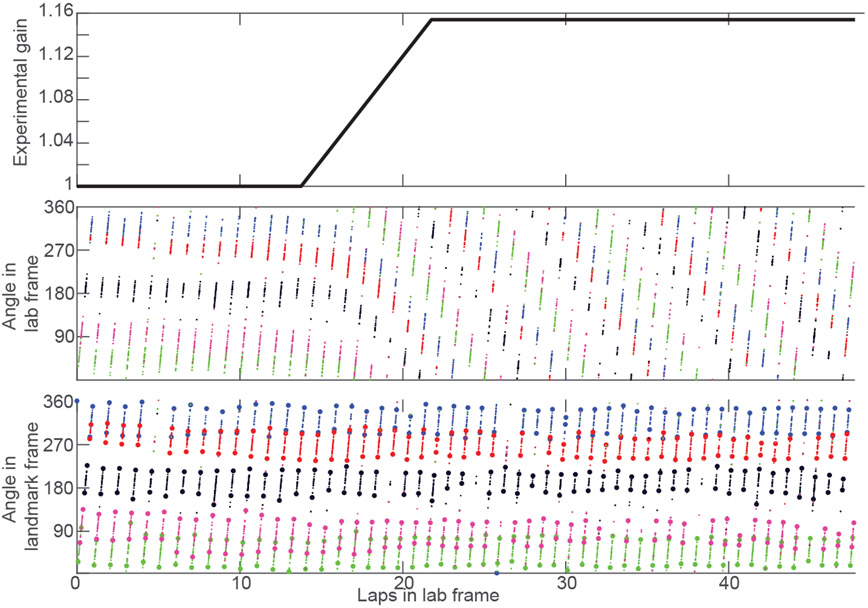
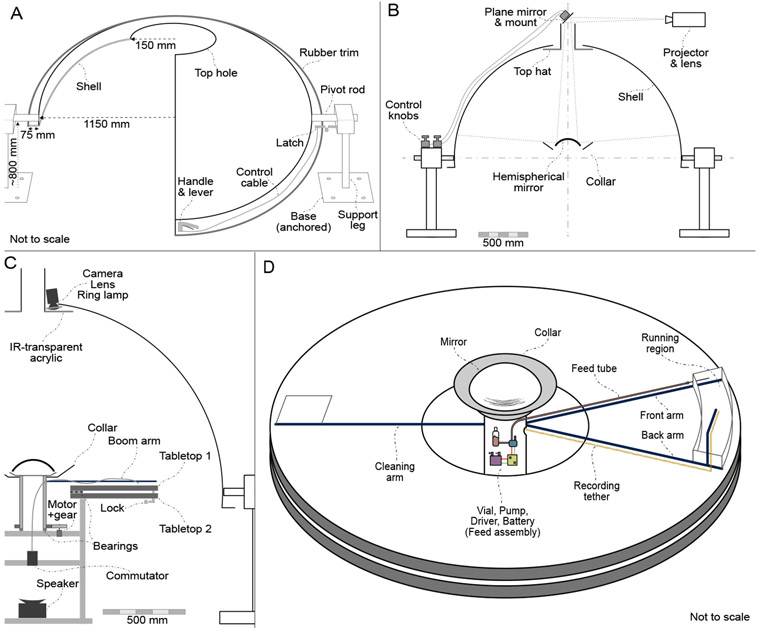
The cognitive map in the hippocampal formation of rodents and other mammals integrates multiple classes of sensory and motor information into a coherent representation of space. Here, we describe the Dome, a virtual reality apparatus for freely locomoting rats, designed to examine the relative contributions of various spatial inputs to an animal's spatial representation. The Dome was designed to preserve the range of spatial inputs typically available to an animal in free, untethered locomotion while providing the ability to perturb specific sensory cues. We present the design rationale and corresponding specifications of the Dome, along with a variety of engineering and biological analyses to validate the efficacy of the Dome as an experimental tool to examine the interaction between visual information and path integration in place cells in rodents.
啮齿动物和其他哺乳动物海马结构中的认知图将多种感觉和运动信息整合到对空间的连贯表示中。在这里,我们描述了 Dome,这是一种用于自由移动大鼠的虚拟现实设备,旨在检查各种空间输入对动物空间表示的相对贡献。Dome 的设计目的是在提供干扰特定感觉线索的能力的同时,保留动物在自由、无束缚的运动中通常获得的各种空间输入。我们介绍了 Dome 的设计原理和相应规格,以及各种工程和生物学分析,以验证 Dome 作为一种实验工具的功效,用于研究啮齿动物中位置细胞中视觉信息和路径整合之间的相互作用。